





CPA is climbing. Your first instinct: the creatives are tired. You brief a new batch, swap the hooks, refresh the visuals. Two weeks later—the numbers barely move.
Sound familiar?
This is one of the most expensive misdiagnoses in paid acquisition. And it happens constantly.
The problem isn’t always the creative. In many cases, the ad is still doing its job—CTR is holding, CPC hasn’t shifted, and the audience is clicking. But somewhere between the click and the purchase, the performance is silently leaking out.
This article is based on a recent FunnelFox webinar on creative fatigue, featuring Christian Zilio (CCO at ContentJet), Seva Ustinov (Founder at Plurio AI), and Leonid Ozemblovsky (Web Growth Product Lead at FunnelFox). Together they covered how performance decays across the full acquisition stack—from creative production to monitoring to post-click conversion. What follows focuses on the most overlooked layer of the three: what happens after the click.
Watch the full webinar:
Performance doesn’t break in one place
Before diving into post-click, it helps to understand where performance actually leaks.
User acquisition performance typically degrades across three distinct layers:
- The creative layer—message resonance, angle diversity, audience targeting. This is where ad fatigue originates: the same message shown to the same people too many times.
- The monitoring and optimization layer—the decision systems that determine when to stop, scale, or relaunch a creative. Without the right thresholds, teams overspend on tired ads or kill winners too early.
- The post-click layer—what happens inside the funnel after someone clicks. Narrative continuity, friction design, offer structure, paywall positioning.
Each layer can fail independently. But they’re also connected. A well-performing creative sending traffic to a broken funnel narrative wastes every dollar of the media spend behind it.
This article is about the third layer—the one most teams forget to interrogate when performance drops.
The diagnostic pattern: Stable CTR, falling CR
Here’s the pattern that signals post-click decay, rather than creative fatigue:
| Signal | What it tells you |
|---|---|
| CTR is stable | The creative message still resonates with the audience |
| CPC is stable | Auction dynamics haven’t materially changed |
| CR is falling consistently | The problem is inside the funnel, not before it |
| CPA is climbing | Budget is being wasted on traffic that’s converting less efficiently |
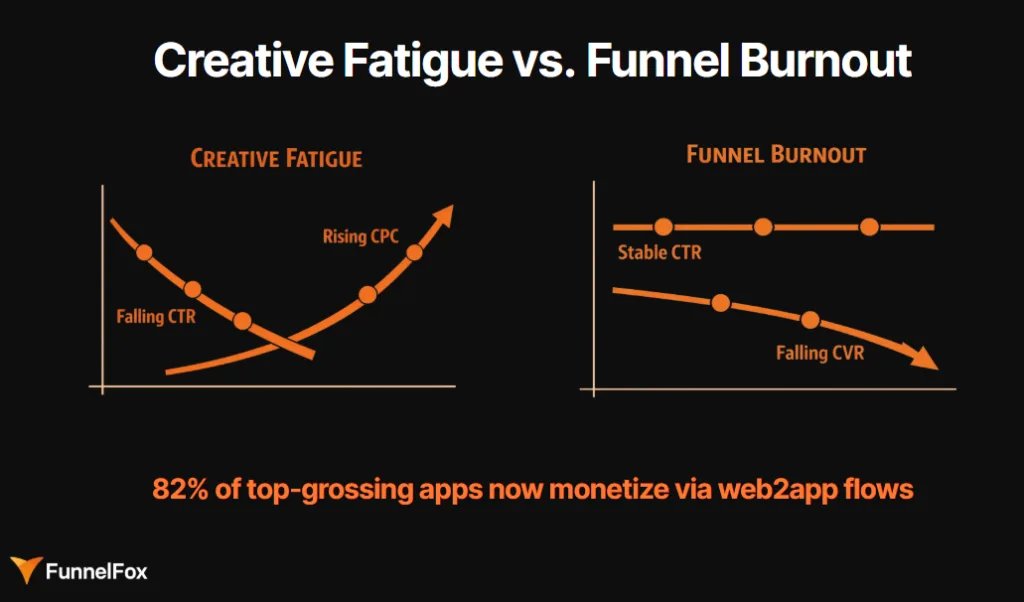
When CTR drops alongside CPA, you likely have a creative problem. When CTR holds but conversion to purchase steadily falls over weeks, you’re looking at funnel burnout.
The distinction matters enormously. Pouring more budget into traffic acquisition doesn’t fix structural friction inside the funnel. It just makes the leak faster.
As Leonid put it during the webinar:
If your bucket has holes, more water just makes a bigger mess. The diagnostic move is straightforward: track conversion rate trends over time and compare them against your creative performance trends. If CTR and CPC are flat but CR has been declining for 3–6 weeks, stop looking at the ads.

Why funnels burn out
1. Narrative collapse
The most common—and most damaging—cause of funnel burnout is a break in the storytelling chain between the ad and the funnel.
Every ad creates an expectation. The creative sets a tone, an audience, a problem, and a visual style. When a user clicks, they arrive with that expectation already primed. If the funnel’s landing screen doesn’t immediately confirm and extend that narrative, the user drops.
A simple example: a “military workout” weight-loss creative for men drives traffic to a generic weight-loss quiz. The value proposition might be similar. But the narrative has broken. The user arrived looking for one story and found another. That disconnect costs conversions at the top of the funnel—before they’ve even answered a single quiz question.
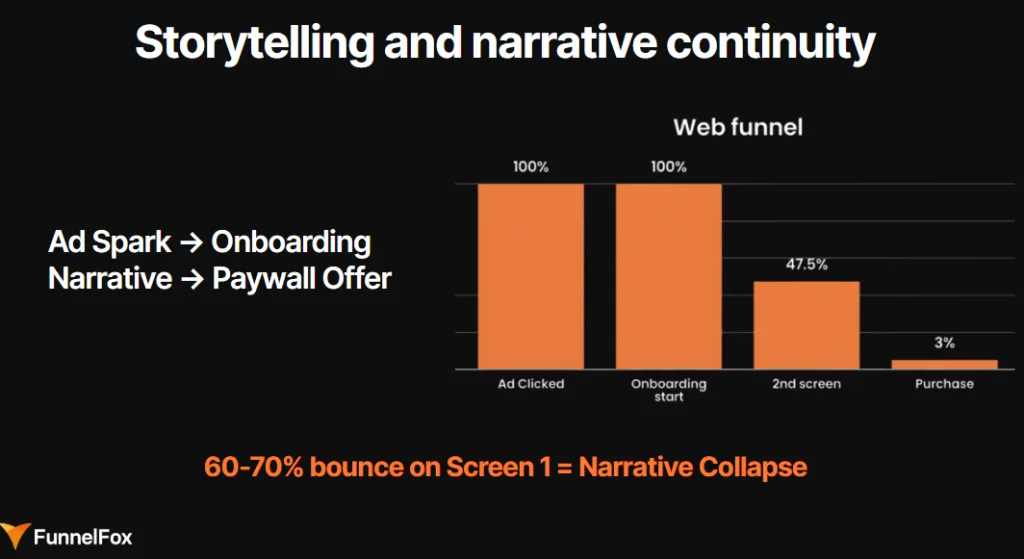
FunnelFox data shows that when narrative continuity breaks, 60–70% of users drop on the very first screen. The benchmark for that drop-off point is around 47.5%. Narrative collapse doesn’t just hurt conversion—it erases most of the traffic before the funnel even starts working:
Source: FunnelFox State of web2app report 2026
2. Funnel treated as a static asset
Teams launch a funnel, see an initial win, and stop. The funnel becomes a fixed landing page—maintained, not evolved.
This creates a slow-burn problem. The audience the funnel was built for gradually saturates. The messaging that felt fresh starts to feel familiar. And because the funnel hasn’t changed, there’s no new signal to test against. Performance drifts downward without a clear inflection point to act on.
Funnels aren’t landing pages. They’re performance assets. They require the same continuous iteration that’s applied to creatives.
3. Offer fatigue
Even when narrative and funnel mechanics are strong, offers can exhaust themselves.
If a free trial has been running for six months to the same audience, many of the users who were ever going to convert on that offer already have. The marginal user seeing it now is either less motivated or has already passed through the funnel and churned.
FunnelFox data shows that more than half of web-to-app revenue is now generated without free trials—with the highest LTV often coming from intro offers (a discounted first billing period) rather than full trials. Running the same free trial indefinitely isn’t just a missed optimization. It’s a form of audience exhaustion.
4. Useful friction
Not all friction is bad. In web-to-app funnels, the goal isn’t to minimize the time between click and purchase. The goal is to build intent.
Users don’t abandon long funnels. They abandon boring ones. Elements like scratch cards, promo codes, and interactive gamification toward the end of the funnel—when the user has already invested time—create psychological ownership and variable reward. The offer feels earned rather than imposed.
This is counterintuitive for teams trained to optimize for speed. But in web-to-app flows, where the purchase decision is high-consideration, useful friction lifts conversion.
Prehab is a good example of this in practice. Before the paywall, they added a “Black Friday Mystery” screen where users had to scratch to reveal their personalized offer:
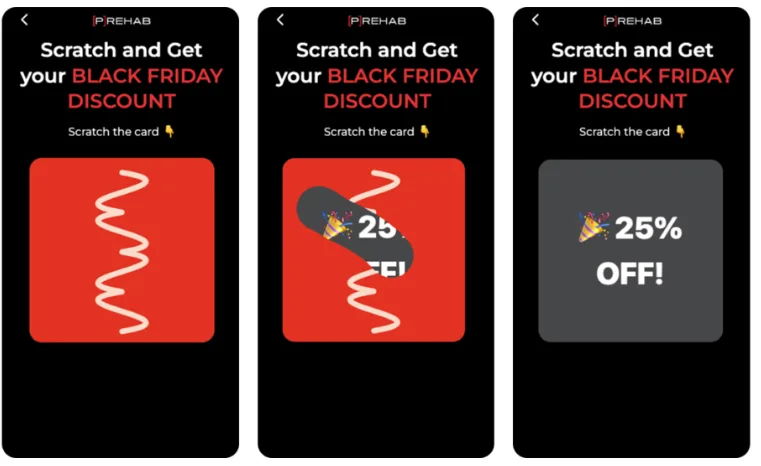
The discount no longer felt like a default giveaway—it became something the user actively earned. Read the full case study →
Creative burnout vs. funnel burnout: The signals side by side
| Signal | Creative burnout | Funnel burnout |
|---|---|---|
| CTR | Drops | Stable |
| CPC | Rises | Stable |
| CR | Stable or slight drop | Consistent decline |
| Primary Fix | New angles and hooks | Narrative and offer iteration |
These two failure modes look similar at the CPA level but require completely different responses. Misdiagnosing one as the other means fixing the wrong layer—and watching CPA continue to climb while the real problem goes unaddressed:
The infrastructure problem
Modern paid media algorithms automate a growing share of creative delivery and budget allocation. AI-driven bidding systems adjust spend toward better-performing creatives in near real time. But no algorithm automatically fixes what happens after the click.
This creates a structural imbalance: the creative and media layers iterate faster and faster, while the post-click layer lags behind. Teams are running dozens of creative angles with automated optimization—and routing all of that traffic into a single funnel that was last updated three months ago.
Funnel burnout is often less a strategic mistake than an infrastructure gap. Teams understand the need for iteration. They lack systems that make it operationally feasible to:
- Run parallel funnel variations aligned to different creative narratives
- Test offers independently of funnel flow
- Build segmented experiences without rebuilding from scratch each time
- Move fast enough to match creative iteration speed
FunnelFox treats web-to-app funnels as dynamic performance assets rather than static pages. The platform is designed for teams who need to iterate funnels at the same pace they iterate creatives: quickly, in parallel, and with full tracking of what each variation produces.
The operational principle is straightforward: iterate, align, scale. Identify what narrative is working in your creatives. Build a funnel that continues that narrative. Test the offer. When you find a combination that converts, scale it. Then start again with the next creative angle:
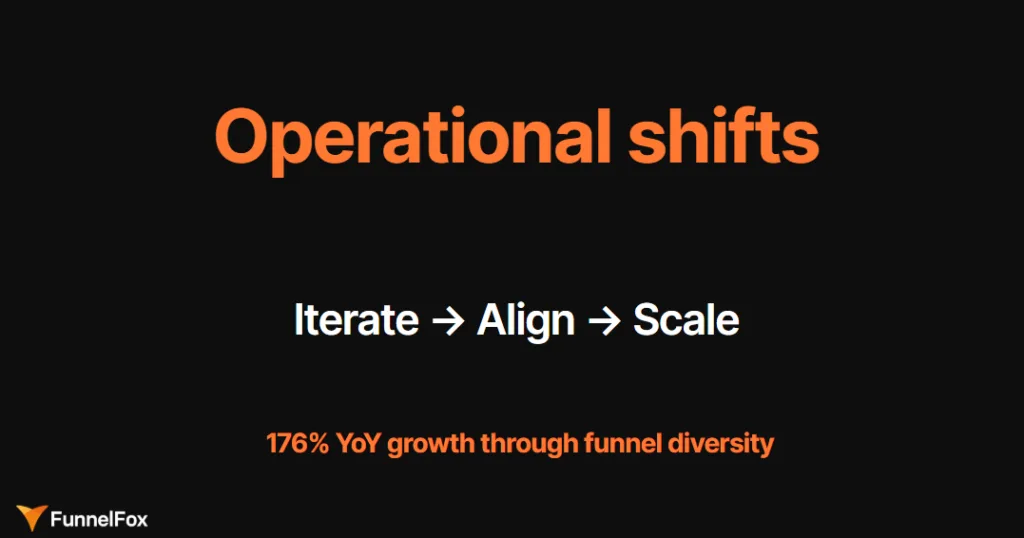
Successful apps following this approach run dozens—sometimes hundreds—of parallel funnel variations simultaneously, each matched to a specific creative angle and audience segment.
Fix the right layer
Creative fatigue is real. Ad fatigue is a genuine performance challenge, and it requires systematic solutions: angle diversity, modular production, and data-driven creative testing.
But misdiagnosing the problem is more expensive than the problem itself.
Before increasing creative production, scaling budget, or changing targeting, pause and ask one question: does the story break after the click?
If CTR is stable and conversion rate is falling, the answer is almost certainly yes. The fix isn’t more ads. It’s a funnel that actually continues the promise the ad made.
Web-to-app infrastructure—built for narrative continuity, offer flexibility, and fast iteration—is what makes that fix possible at scale. That’s what controls post-click burnout risk. And it’s where the next performance gain is waiting.
Want to see how FunnelFox helps teams diagnose and fix post-click performance decay?
Book a demo or watch the full webinar at https://www.youtube.com/watch?v=i849OLpZmWI.