





TL;DR
- AppLovin is a large performance network traditionally focused on mobile app installs through in-app inventory.
- Web2app teams rarely used it because funnel events, especially purchases, could not be sent back consistently for proper optimization.
- FunnelFox now integrates directly with AppLovin Axon engine and sends structured funnel events, including purchase data. It means campaigns in AppLovin can optimize for purchase events and bring in high-intent audience, just like in traditional channels.
- This integration gives apps access to underutilized in-app inventory, helps diversify acquisition, and lets you scale while competition is still low.
Most apps running web2app funnels scale through Meta, TikTok, and Google. But as competition increases, CPAs rise, and scaling requires steadily larger budgets. Even with strong unit economics, growth eventually runs into auction saturation.
At that point, teams start looking for additional sources of scale. And this is where part of the mobile inventory remains largely overlooked.
Performance networks like AppLovin are rarely considered a traffic source for web2app funnels. Not because the channel is ineffective, but because it has long been associated with app install campaigns, and web event infrastructure was limited.
FunnelFox’s direct integration with AppLovin removes that limitation. Funnel events, including purchases, can now be transmitted directly to AppLovin Axon engine, making AppLovin a viable acquisition channel for web2app funnels.
This article explains the value AppLovin can bring to web2app funnels and how FunnelFox makes it possible.
What is AppLovin?
AppLovin is one of the largest performance networks in the mobile ecosystem. Its inventory spans thousands of apps, providing access to high-volume in-app traffic.
What does AppLovin do? The platform connects advertisers and mobile apps through an auction model: advertisers buy installs or downstream events, and publishers sell ad placements inside their apps.
At the core of the platform is Axon, AppLovin’s proprietary AI optimization engine. Axon analyzes user behavior, processes conversion events, and reallocates budget toward higher-value segments. The algorithm optimizes around the signals it receives, and most commonly, it’s installs.
The channel web2app teams didn’t consider
AppLovin has typically sat outside the web funnel stack for three reasons: its positioning around installs, the perception of its in-app inventory, and the lack of consistent revenue signals from web funnels.
Positioning around installs
AppLovin was primarily used to scale mobile games. The typical flow was straightforward: an in-app ad → a click → the App Store → an install. The core optimization event was the install, and the algorithm was trained around that outcome.
Over time, this reinforced an association: AppLovin equals user acquisition for mobile installs.
In-app inventory bias
AppLovin operates mostly through in-app placements. Because of that, campaigns have usually been structured to drive users to the App Store rather than to a web checkout flow.
Limited revenue signals from web funnels
Web funnels didn’t consistently send revenue events back to the network. In most cases, the algorithm could see the click, sometimes even an install, but not the downstream conversion events tied to revenue.
Without clear purchase signals, the system could not distinguish between users who clicked and users who paid. As a result, optimization had little visibility into actual revenue outcomes.
So, the issue was never the channel itself — it was the quality and consistency of data coming from web funnels. AppLovin mobile marketing platform services are not inherently limited to install campaigns. It optimizes around the events it receives, and when revenue signals are clear and consistent, the platform can perform for web funnels just as effectively as it does in mobile app campaigns.
How AppLovin drives revenue in web2app
For AppLovin Axon optimization to work effectively, the platform needs two things: traffic and clear conversion signals. In a traditional model, that signal is the app install. In web2app, it becomes a purchase or a checkout event within the web funnel.
And this is where web funnels can provide even more visibility than the App Store. Instead of a single final event, AppLovin receives a sequence of steps: click → funnel actions (e.g., onboarding completion, email collection) → checkout → purchase.
That sequence helps the algorithm separate casual clicks from real buying behavior, and the more data the system receives between click and purchase, the more accurately it can identify which traffic drives revenue.
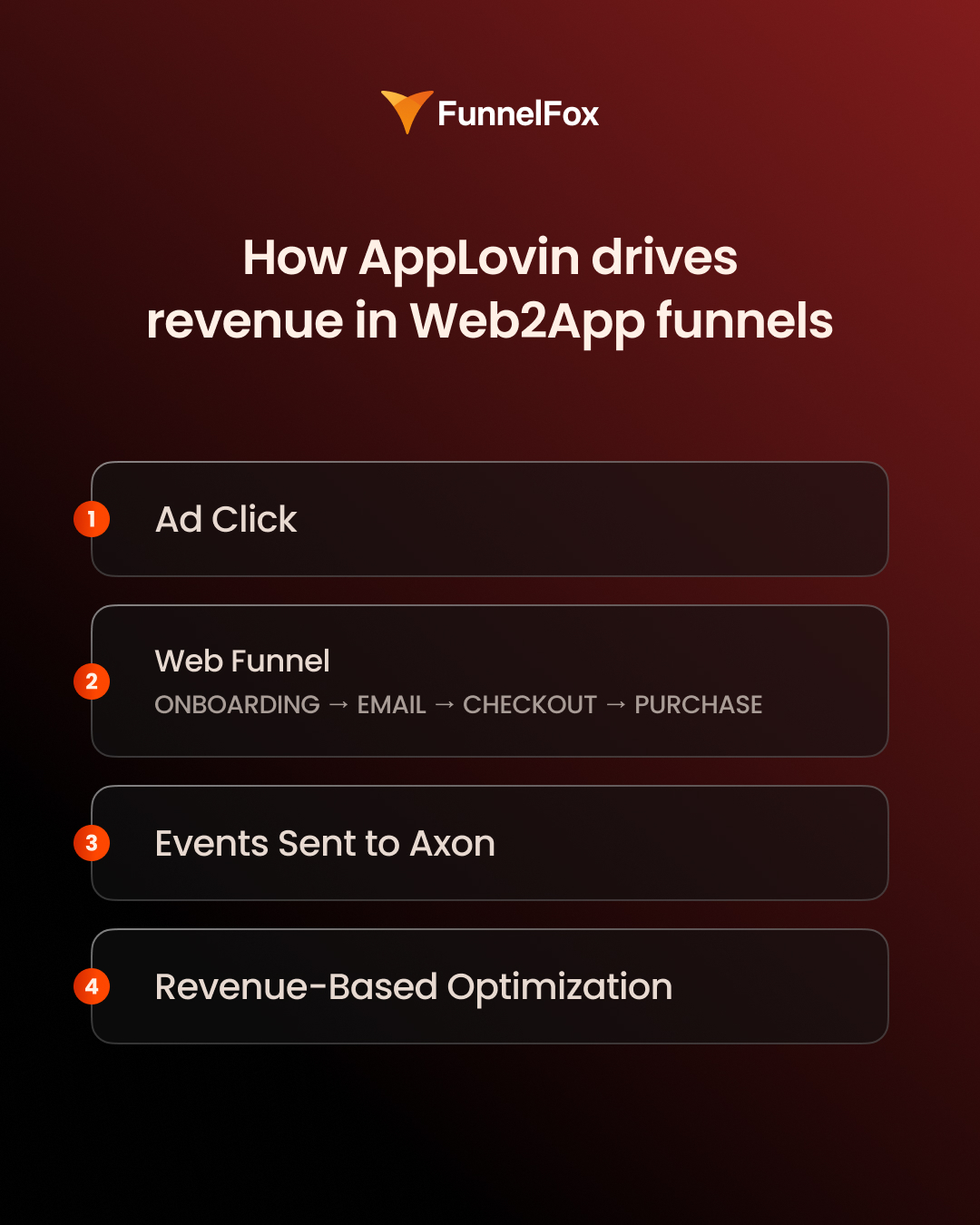
On the web, app monetization happens before the install, and performance isn’t measured purely by downloads, but by revenue generated within the funnel. That structure naturally aligns with how performance algorithms learn from value-based outcomes.
So AppLovin can work for web2app for the same reason it works for install campaigns: the algorithm learns from a clearly defined outcome. The difference is that the outcome shifts from installs to revenue.
However, for this setup to function properly, the funnel needs infrastructure that transmits those events directly into the AppLovin’s algorithm.
FunnelFox now integrates with AppLovin Axon
For a long time, the missing piece in using AppLovin for web2app funnels was consistent revenue data from web funnels. That layer is now in place.
FunnelFox integrates directly with AppLovin and transmits structured funnel events into the optimization system.
When a user interacts with the funnel — opens a page, submits an email, reaches checkout, or completes a purchase — those events are automatically sent to Axon. Supported events include:
- page_view
- generate_lead
- view_item
- begin_checkout
- add_to_cart
- purchase
FunnelFox also sends the FunnelFox profile ID, allowing Axon to associate events with the correct user within the funnel.
This gives Axon visibility into what happens after the click inside the funnel. Instead of relying on surface-level signals, the system can learn directly from completed transactions and respond to real performance signals.
With the integration in place, you can use AppLovin as an acquisition channel for your web2app funnels without additional technical workarounds.
How to connect FunnelFox to AppLovin
The integration works through the Axon Pixel — a JavaScript snippet that loads on your funnel pages and captures user actions.
Setup requires three steps:
- Copy your Axon Event Key in AppLovin.
- Open Integrations → AppLovin inside FunnelFox.
- Paste the key and save.
Once the funnel is published, events begin transmitting automatically.
You don’t need to add any scripts manually or configure a server-side integration — setup takes minutes. You can then launch AppLovin campaigns with real funnel events flowing into Applovin Axon and optimize toward revenue outcomes.
What AppLovin adds to web2app growth strategy
Reduced platform concentration
Web2app acquisition is largely concentrated within Meta, TikTok, and Google. Any changes in auction dynamics, pricing, or platform policy immediately affect revenue, which is why teams start looking for a Meta ads alternative.
Adding another performance channel reduces concentration risk and makes growth less dependent on a single ecosystem.
Access to underutilized mobile inventory
Since AppLovin is rarely considered for web funnels, competition is lower compared to traditional web2app acquisition channels. This creates room to test and potentially find efficient economics before the channel becomes too saturated.
Revenue-aligned optimization at scale
Axon is a mature optimization system built on large-scale mobile inventory. When it receives purchase-level signals, it optimizes toward revenue outcomes. This makes AppLovin a channel that can be scaled and measured within the same unit economics framework as the rest of your web2app stack.
The bottom line: AppLovin for web2app
AppLovin isn’t new. What’s still uncommon is using it inside web funnels.
The technical barrier that previously restricted this use case has been removed: with the FunnelFox integration in place, web funnel events are consistently transmitted into Axon, making revenue-based optimization viable.
What remains is a strategic decision: whether to test the channel.
For teams looking to diversify acquisition and reduce dependence on Meta and TikTok, running that test is a rational step. In competitive markets, incremental scale often comes from channels others haven’t fully explored.