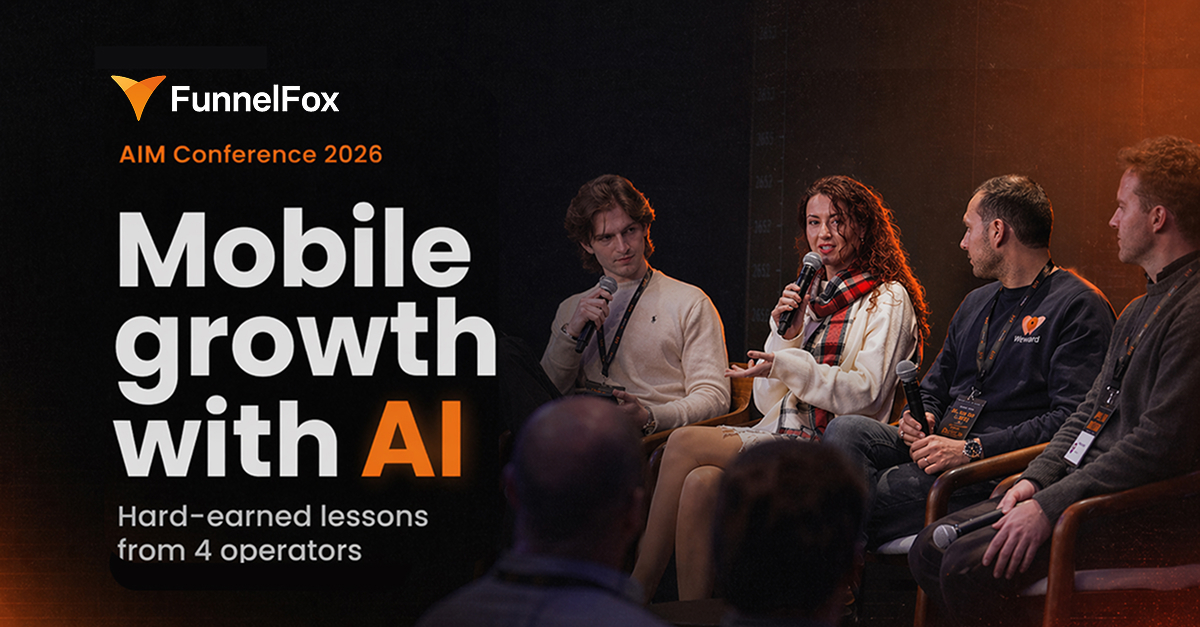






This post is based on a talk at Apps in Motion, a conference on mobile app growth hosted by FunnelFox and Adapty at Nasdaq HQ, New York. Watch the full session.
For most companies, influencer marketing starts and ends the same way: a handful of test campaigns, lukewarm results, and a quiet decision to move on. Cal AI took a different path and turned creator partnerships into the primary growth lever behind one of the fastest-growing apps in Health & Fitness.
At AIM Conference 2026, Jake Castillo, Co-Founder and CMO of Cal AI, walked through the exact strategy that made it happen: how the team chose influencers over other channels, what actually drives conversions in creator partnerships, and how to scale influencer marketing into a repeatable revenue machine.
For any mobile growth team exploring content-driven acquisition—whether through UGC, influencers, or paid ads—this session offered a rare, data-grounded look at what the Cal AI playbook actually involves.
The numbers behind Cal AI’s influencer-led growth
Within 18 months of launching its influencer program, Cal AI hit three milestones:
- 300+ influencer partnerships signed and actively producing content
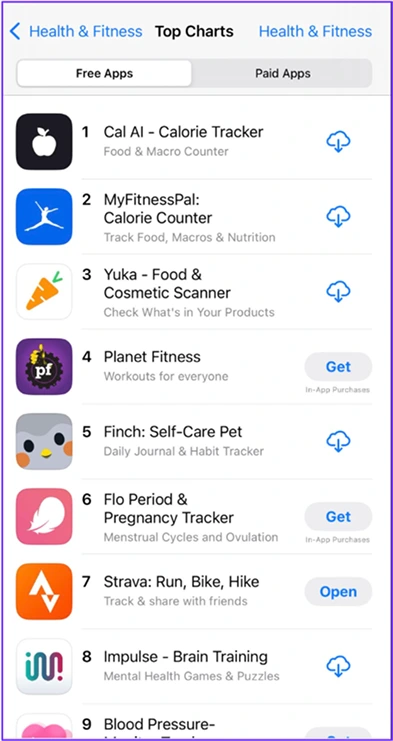
- #1 in Health & Fitness on the App Store
- $50M+ in annual recurring revenue
Three channels, one spectrum
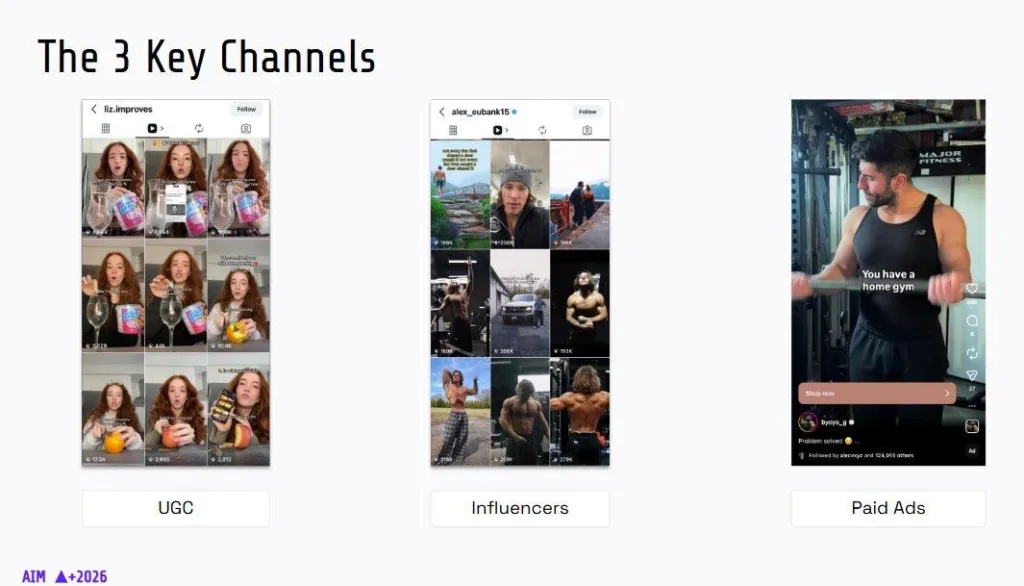
Before diving into influencers specifically, Jake framed the decision by laying out what he sees as the only three available acquisition channels for most apps today: UGC, influencers, and paid ads.
Each channel has a different risk-reward profile.
UGC means hiring someone to run a dedicated brand page. Every video is a hard sell. There’s no existing audience, so you’re relying entirely on the algorithm. That can go very well (one video goes mega-viral and generates massive revenue) or very poorly (100 videos, zero returns). It’s cheap—you can get 30 videos for around $1,000—but unpredictable.
Influencers come with an existing audience. That costs more. $1,000 might buy you a single video instead of 30. But you’re paying for two things: the creator’s reach and the trust they’ve built with their audience. If you find one influencer who converts, you can find 100 similar creators and run the same playbook. And you still get the viral upside if a video takes off.
Paid ads are the most predictable. You create the content, pay Meta (or another platform) to distribute it, and every dollar in returns roughly $1.20—$1.50. Scalable and low-risk, but no asymmetric upside.
Jake places these channels on a spectrum:
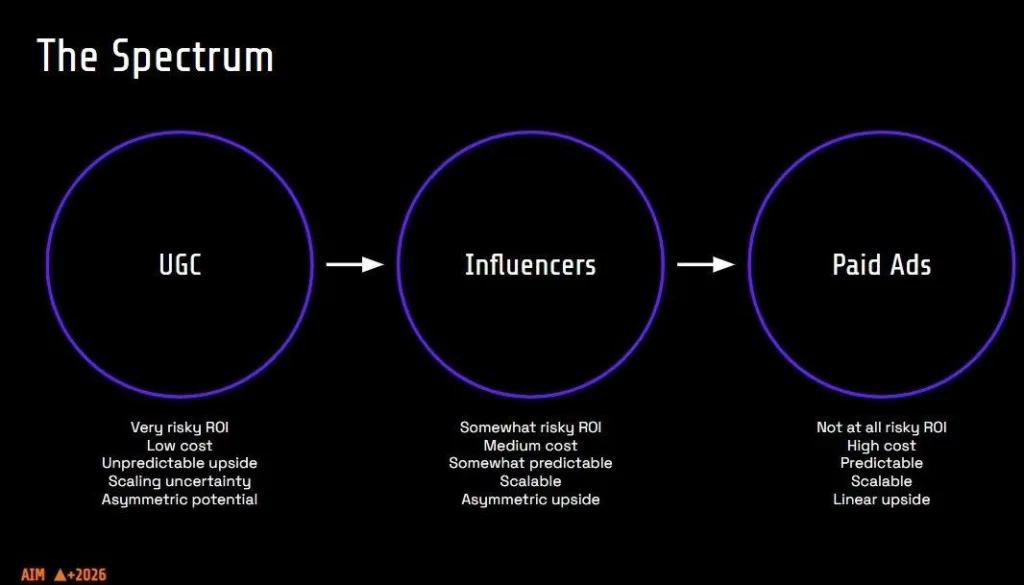
The question every team faces: where on this spectrum should you place your bets?
Why influencer marketing was the right bet for Cal AI
Cal AI operates in health and fitness—a niche with a unique supply-demand dynamic. As Jake put it, practically everyone on social media today is a health and fitness influencer. But the number of brands available to those creators is limited: apparel, supplements, and not much else.
That imbalance gave Cal AI access to CPMs between $0.50 and $3.00 — far below what most brands pay for influencer reach.
But the economics were only part of the story. The real advantage? The content these creators were already making was a natural fit for Cal AI.
Health and fitness influencers post “what I eat in a day” videos, “best low-calorie snacks” roundups, and transformation stories. These formats naturally involve showing food and tracking nutrition. Integrating Cal AI into that content required almost no behavioral change from the creator.
The result: sponsored posts that don’t feel like sponsored posts. Jake shared examples where the Cal AI integration was so seamless that the videos became some of the influencers’ highest-performing content—the opposite of what typically happens with brand deals.
Some of those videos reached 43 million, 56 million, and even 73 million views. All organic. No boosting.
What actually drives views-to-installs conversion
Jake was blunt about what matters when evaluating creators—and what doesn’t.
What doesn’t matter:
- Follower count. Ten million followers means nothing if views are consistently low. Follower count is a vanity metric.
- Results for unrelated products. A creator generating a million dollars for an apparel brand tells you nothing about how they’ll perform for a calorie-tracking app. Different product, different audience intent.
- Previous accomplishments. Forbes 30 Under 30, bestselling author status—these are impressive but have zero predictive value for conversion performance.
What does matter:
- Views. You’re paying for exposure. Views are the unit of measurement. A creator with 100 million followers and 10,000 views per video is a red flag.
- Comment sections. This is the conversion signal Jake trusts most. A comment section full of generic reactions (fire emojis, “you look great”) is fundamentally different from one where people are saying “thank you for this” or asking detailed questions about the product. The second type converts. The first doesn’t.
- Cult-like following. When you pay for influencers, you’re paying for reach and trust. If the audience doesn’t deeply trust the creator and there’s no real connection, you’re only getting half of what you’re paying for.
Jake emphasized that views alone don’t equal installs. Cal AI has seen videos with 100 million views that didn’t meaningfully convert. This is why the comment section matters: it’s the closest proxy for genuine purchase intent.
Early benchmark that validated the channel
In Cal AI’s early days, the team tracked roughly 10 installs per 1,000 views. That ratio shifted over time as the volume of content grew and attribution became harder to isolate. But it served as the baseline signal that validated the channel and gave the team confidence to scale from a handful of creators to hundreds.
How to turn influencer marketing into a scalable machine
Jake was equally direct about why most companies fail at influencer marketing: they run a few promos, see poor results, and write off the channel entirely.
That failure typically comes from a lack of systems, not a lack of opportunity. Here’s the framework Cal AI uses to scale:
1. Lock in what works
When you test an influencer and see real traction, sign them to a long-term deal immediately. Testing is about buying signal. Once you have it, your job is to protect it.
2. Streamline operations
Too many teams try to manage influencer relationships over email. That approach breaks at scale. Cal AI’s process: the second an influencer responds, jump on a call. Within that call, it becomes clear whether the partnership will work. If yes, sign the deal and move on. If no, end the call and move on. Speed is the priority.
At peak, Cal AI was onboarding around 20 influencers per week. The onboarding process itself was fully automated: contracts generated at the click of a button, Slack channels created automatically, content briefs and templates sent without manual effort.
3. Track everything
Once you get past roughly 10 influencers, things get chaotic fast. Cal AI built systems to track deliverables, views, comment section quality, and overall performance. Without this, scaling becomes impossible as you’re bottlenecked by your own disorganization.
The team also developed a proprietary “renewal score” to decide whether to continue working with each influencer. If a creator doesn’t hit the threshold, they’re cut. But Jake frames churn as a failure of the system, not the creator: if someone’s underperforming, it means the team set them up to fail.
4. Get comfortable with data science
In the early months, there’s a clear, visible correlation between a post going live and a spike in installs. As you scale, that signal gets buried in noise. Too many creators posting, too many overlapping campaigns, long-tail video performance. The spikes become invisible.
This is where the comment section becomes essential again. Even when install attribution is murky, the comment section remains a reliable source of truth. You can see whether people are talking about your app, asking questions, expressing intent.
Early on, capture what a high-performing video’s comment section looks like. Capture what types of integrations cause install spikes. That pattern recognition becomes the foundation for informed bets at scale.
Key takeaways for mobile growth teams
Cal AI’s story reinforces several principles that apply well beyond health and fitness:
- Choose channels based on your niche economics. Cal AI had access to low CPMs and content formats that naturally fit the product. That alignment made influencers the obvious bet. The same logic applies to any vertical: the right channel depends on where supply-demand dynamics and content fit intersect.
- Seamless integrations outperform hard sells. The best-performing Cal AI videos barely mentioned the app. Creators used it as a natural part of their content. That authenticity drove both views and conversions.
- Attribution will always be imperfect. Accept it. Build qualitative signals (comment section analysis) alongside quantitative tracking, and get comfortable taking informed bets based on incomplete data.
- Scaling requires systems, not just talent. The difference between a few successful promos and a $50M engine is operational infrastructure: automated onboarding, systematic tracking, speed-first processes.
This article is part of the AIM Conference 2026 series—a conference for mobile growth professionals organized by FunnelFox and Adapty. Stay tuned for more insights from this year’s speakers.