






When building web2app funnels, most apps face a choice: go in-house or use a platform like FunnelFox. At first glance, building in-house may seem logical and cost-effective. In reality, launch timelines stretch to 4-6 months, costs climb toward $200K, and teams end up constantly iterating and optimising on the funnel.
In this article, we break down what in-house really means in practice: the team you need, the time it takes, the true costs, and the performance trade-offs—backed by real numbers from apps that have gone down both paths.
What in-house web2app development actually means
Most teams underestimate what building a web2app funnel actually involves. The thinking goes: “How hard can it be? A landing page, a payment integration, maybe a short onboarding flow.”
In reality, going in-house means building and maintaining a complete growth platform from scratch.
What you’ll have to build
- Funnel builder with quiz logic
- Web2app routing and deep linking
- A/B testing splitter and analytics
- Tracking and attribution system
- Payment infrastructure
- Subscription management
- Cancellation flows
- Analytics dashboards
That’s why in-house funnels rarely launch in a few weeks. Realistically, development can take 4-6 months—time derived from your core product.
And most importantly, once your web-to-app funnel is live, the work doesn’t stop. Every experiment, fix, or new idea adds ongoing development and maintenance.
You’ll need a dedicated team
In-house funnels can’t be built on spare developer hours. They demand a team fully focused on creating and maintaining the system. At minimum:
- 2 developers (front- + back-end);
- Product manager to define flows, priorities, and experiments;
- Designer for UX, UI, and conversion optimization;
- QA engineer to prevent costly funnel-breaking bugs;
- UA or growth manager to actually run experiments and interpret results.
In practice, most apps end up with 6–8 people involved, either full-time or partially allocated.
The reality most apps discover too late
Many teams fall into the “start simple” trap. The logic seems obvious: “We’ll build a basic landing page, test it, then add features as needed.”
This approach rarely works as planned. Instead, here’s what typically happens:
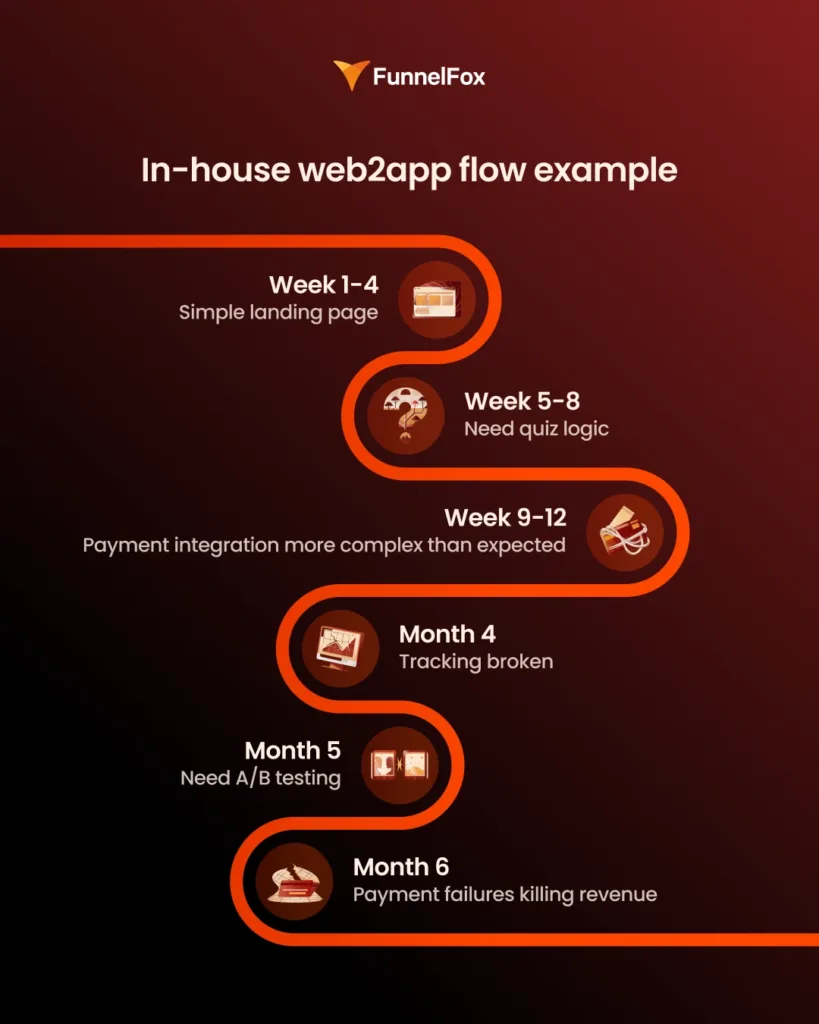
The result? Most of the time is spent on infrastructure and bug fixes, not on optimizing acquisition or running experiments.
The real costs
Let’s break down what in-house web2app actually costs over the first year. Spoiler: it’s more than you think.
Initial development
$50-$80K: This covers 2 developers working for 4–6 months, at around $7K/month each.
Iterations and maintenance
- $10-50K on ongoing development: new funnel variations, A/B tests, checkout optimizations, adding new payment providers, and continuously adding features based on what you learn from campaigns.
- $10-20K for maintenance: fixing bugs that emerge in production, applying security updates, covering infrastructure costs for hosting and tools, and adapting to third-party API changes.
- $100K for testing traffic to ensure your funnels are profitable.
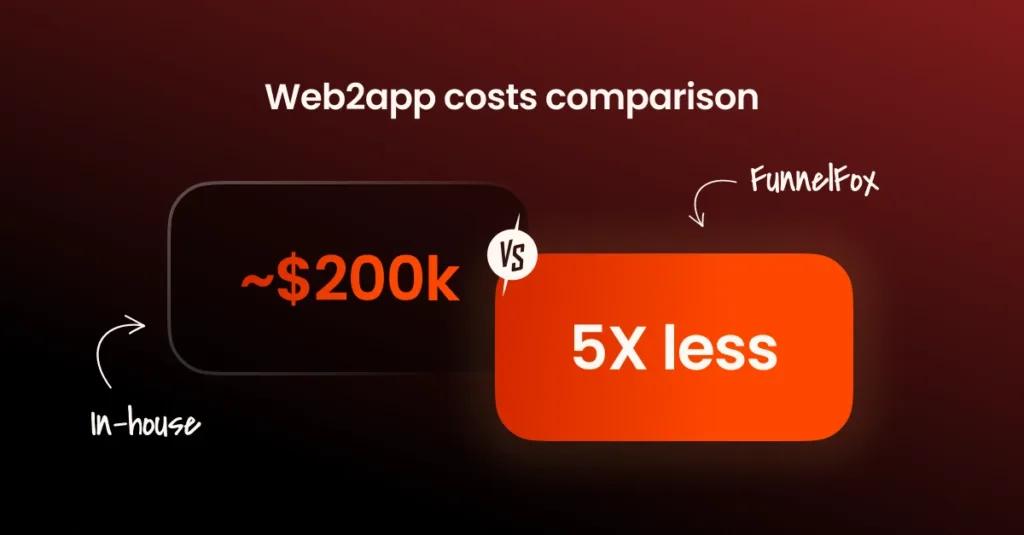
All in all, $200K is what you can expect to spend on in-house, just to make funnels fully operational.
FunnelFox costs approximately five times less, with funnels ready to launch in just days.
Hidden in-house costs
Beyond the direct costs, there are other expenses that are easy to overlook—costs that quietly slow down growth and delay results:
- Dev time derived from the product. Features and opportunities are delayed while teams maintain funnel infrastructure.
- Time-to-market delay. Every week spent building infrastructure is a week that could be spent on testing growth ideas or scaling successful channels.
- Lower early ROAS. Learning everything from scratch slows experiments, reducing early returns.
FunnelFox vs. in-house: Complete сomparison
Here’s a head-to-head look at the key decision factors—speed, expertise, payment infrastructure, features, team, and performance.
Speed and time-to-market
|
In-house |
FunnelFox |
|---|---|
|
|
As a no-code, all-in-one platform with pre-built features, FunnelFox is ready out of the box—no months spent building infrastructure. This speed advantage quickly adds up: you can launch more experiments, discover what works sooner, and scale your wins more efficiently.
💡 Success story: Glam AI built their first funnel with FunnelFox in just one day.
Expertise and best practices
|
In-house |
FunnelFox |
|---|---|
|
|
With an in-house option, you build a funnel from scratch, figuring out everything as you go: what works, what doesn’t, and where to even begin. The learning curve is steep, and each decision requires testing, adapting, and constant tweaking.
With FunnelFox, you get access to proven, best-in-class practices from thousands of successful funnels across dozens of verticals with high web2app adoption: health&fitness, education, lifestyle, AI apps, photos and videos, dating, and others. Your team works with proven templates that already convert instead of starting from zero.
Plus, FunnelFox’s Customer Success team can help you implement custom solutions for any creative ideas or hypotheses you want to test.
Payment infrastructure
|
In-house |
FunnelFox |
|---|---|
|
Need to build payment infrastructure from scratch. |
|
In-house teams often start with a basic payment setup, only to realize they need more advanced infrastructure down the line.
FunnelFox provides the payment infrastructure out of the box. Transactions are automatically routed to the provider most likely to approve them, failed payments are recovered without manual intervention, and switching providers takes minutes instead of weeks.
The critical advantage? If a provider blocks your account (which can happen due to high chargebacks or sudden volume spikes) you don’t lose access to subscribers. Tokens are stored and routed to backup providers, keeping revenue flowing while the issue is resolved.
💡Success story: Shmoody recovered 20% of failed payments using FunnelFox tools.
Web2app funnel features
|
In-house |
FunnelFox |
|---|---|
|
No pre-built features. |
|
With FunnelFox, you get a complete web2app platform: a visual builder that lets non-tech teams create and modify funnels, AI-powered funnel creation, deep linking, built-in A/B testing, and comprehensive analytics with integrations to the tools you already use like Appsflyer, Mixpanel, Singular, Amplitude, and others.
Team requirements
|
In-house |
FunnelFox |
|---|---|
|
6-8 people including full-time developers, product and UA managers, a designer, and a QA engineer. |
Growth teams ship independently with 1-3 people. |
With FunnelFox, even small teams can move fast and launch experiments instantly—helping apps grow without being slowed down by internal bottlenecks.
No dev resources are needed. Simple funnel changes, A/B test variants, or payment provider integrations don’t require sprint planning or approval delays. Growth and product work in parallel instead of competing for the same resources.
FunnelFox also provides a support team for technical questions.
💡Success story: English on Smartphone scaled their web funnels using only a three-person team (teacher, marketer, and developer). They doubled revenue while cutting ad spend in half—proof that you don’t need a massive team when you have the right tools.
Performance and ROAS
|
In-house |
FunnelFox |
|---|---|
|
|
FunnelFox users consistently see better performance across all key metrics: higher conversion rates from proven templates tested across thousands of funnels, increased LTV from built-in upsell and upgrade flows, and higher ROAS from more effective funnels.
💡Success story: Shmoody switched to FunnelFox and achieved +80% ROAS increase in 3 months.
When in-house actually makes sense
For most mobile apps, FunnelFox is faster, cheaper, and more effective. But there are a few scenarios where building in-house can be a reasonable choice:
- You have spare DevOps capacity. When your team has bandwidth for a multi-month infrastructure build without slowing the core product.
- Urgency is low. When a 4–6 month delay won’t affect growth or competitive position.
- Full ownership is required. When you’re prepared to manage infrastructure, maintenance, security, and scaling long term.
- Experimentation speed isn’t critical. When slower iteration cycles are acceptable.
- Cost efficiency isn’t a priority. When investing around $200K is acceptable.
- You have in-house funnel expertise. When your team can execute efficiently without a steep learning curve.
For everyone else, the trade-offs—time, cost, and opportunity loss—outweigh the perceived control of going in-house.
Conclusion: Making your decision
Building web2app funnels in-house means months of development, significant costs, and teams spending more time maintaining infrastructure than running growth experiments. For most apps, it’s a resource-intensive detour that delays learning and scaling.
Apps using FunnelFox launch faster, run more experiments, learn from proven best practices, and benefit from conversion-optimized funnels built by experts.
The outcome: lower total cost, faster time-to-market, higher conversion rates, stronger ROAS, and higher customer LTV.