





When building web2app funnels, most apps face a choice: go in-house or use a platform like FunnelFox. In-house used to mean one thing—a dedicated dev team coding everything from scratch. Today, with vibe coding tools like Lovable, Cursor, Bolt, or v0, even non-technical teams can spin up a funnel in days. So the choice has expanded: traditional in-house development, AI-assisted vibe coding, or a purpose-built platform.
At first glance, both in-house paths look appealing. Traditional builds promise full control. Vibe coding promises speed at a fraction of the cost. In reality, traditional in-house projects stretch to 4-6 months and climb toward $200K, while vibe-coded funnels look fast on day one but quickly hit walls around payments, tracking, A/B testing, and ongoing optimization.
In this article, we break down what going in-house really means in practice—across both traditional development and vibe coding: the team you need, the time it takes, the true costs, and the performance trade-offs, backed by real numbers from apps that have gone down each path.
What in-house web2app development actually means
Most teams underestimate what building a web2app funnel actually involves. The thinking goes: “How hard can it be? A landing page, a payment integration, maybe a short onboarding flow.”
In reality, going in-house—whether through traditional development or vibe coding—means building and maintaining a complete growth platform from scratch.
What you’ll have to build
Regardless of which approach you take, the funnel surface area is the same:
- Funnels with quiz logic
- Web2app routing and deep linking
- A/B testing splitter and analytics
- Tracking and attribution system
- Payment infrastructure
- Subscription management
- Cancellation flows
- Analytics dashboards
Most importantly, once your web-to-app funnel is live, the work doesn’t stop. Every experiment, fix, or new idea adds ongoing development and maintenance.
Traditional development path
This is the classic in-house route: a dedicated team writing custom code from the ground up.
Realistically, development takes 4-6 months—time pulled away from your core product.
Traditional in-house funnels can’t be built on spare developer hours. They demand a team fully focused on creating and maintaining the system. At minimum:
- 2 developers (front- + back-end);
- Product manager to define flows, priorities, and experiments;
- Designer for UX, UI, and conversion optimization;
- QA engineer to prevent costly funnel-breaking bugs;
- UA or growth manager to actually run experiments and interpret results.
In practice, most apps end up with 6–8 people involved, either full-time or partially allocated.
Vibe coding path
Vibe coding has changed the equation for many teams. Tools like Lovable, Cursor, Bolt, v0, and Replit let growth teams generate working code from natural-language prompts, drastically lowering the technical barrier. For apps that previously couldn’t justify a full dev team, vibe coding makes in-house feel suddenly accessible.
The initial build is faster: a basic funnel can be prompted into existence in days, not months. Costs drop because you don’t need a full engineering squad—a technically curious growth manager or solo founder can ship a v1.
But “fast v1” isn’t “production-ready.” Vibe-coded funnels still need:
- Manual context-setting at every step. Generic AI tools don’t know your brand, your vertical’s conversion patterns, or web2app best practices. You spend hours feeding them context and reviewing what they produce.
- Code review and supervision. AI-generated code can be inconsistent, insecure, or break in production. Without engineering oversight, small issues compound into expensive ones.
- Manual integration of payments, tracking, and analytics. Vibe coding builds the surface; the infrastructure underneath—Stripe webhooks, deep linking, attribution, A/B testing logic, subscription management—still has to be wired up correctly.
- Ongoing maintenance. Every iteration, bug fix, and provider update requires re-prompting, re-testing, and redeploying. The “vibe” wears off the second you’re 30 funnel variations deep.
In short, vibe coding lowers the cost of starting in-house—but it doesn’t eliminate the cost of running a web2app funnel system at scale.
The reality most apps discover too late
Whether you go traditional or vibe-coded, most teams fall into the same “start simple” trap. The logic seems obvious: “We’ll build a basic landing page, test it, then add features as needed.”
This approach rarely works as planned—and the friction points show up regardless of which in-house path you chose. Vibe coding may compress the early weeks, but the pattern of escalating complexity is the same.
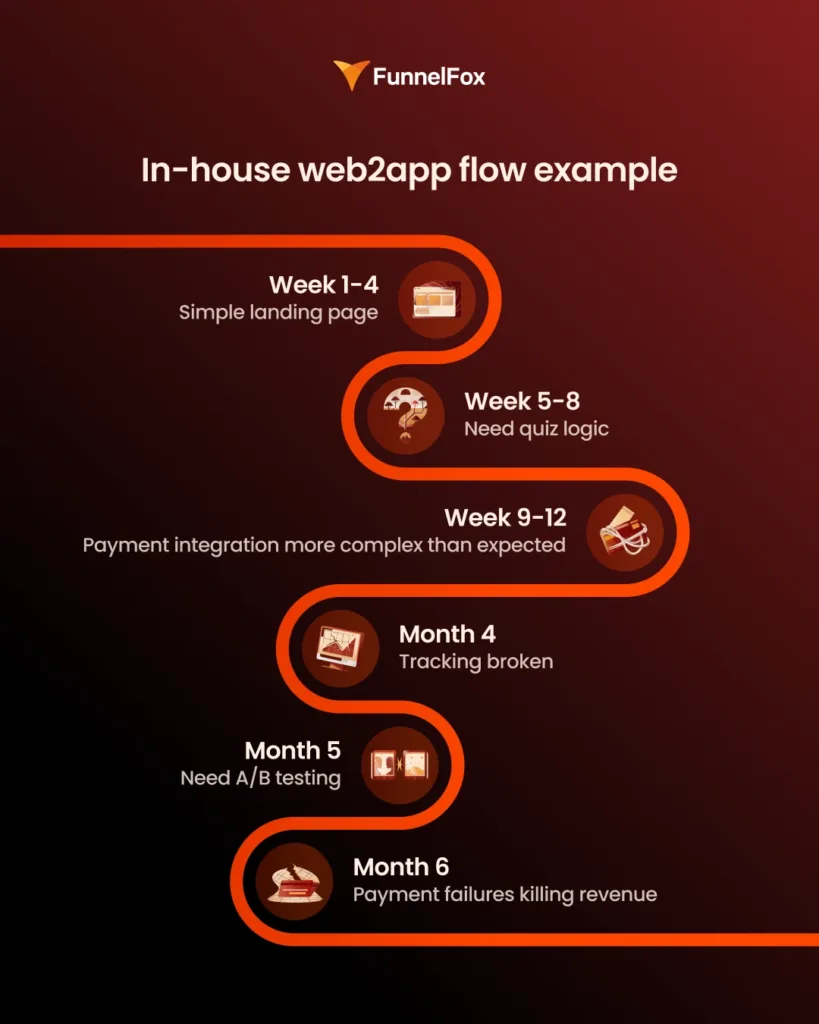
The result? Most of the time is spent on infrastructure and bug fixes, not on optimizing acquisition or running experiments.
The real costs
Let’s break down what in-house web2app actually costs over the first year, across both paths. Spoiler: even the cheaper option costs more than you think.
Initial development
Traditional in-house
$50-$80K. This covers 2 developers working for 4–6 months, at around $7K/month each.
Vibe coding
Tool subscriptions are cheap—roughly $40-200 for 1-2 months of access to platforms like Lovable, Cursor, Bolt, or v0. The real cost is the engineering oversight: $10-20K to bring in a part-time developer to review code, harden security, and wire up integrations.
So the realistic floor sits around $10-20K to get a vibe-coded funnel into production.
Skipping the dev review is technically possible—but it usually means shipping a funnel with broken tracking, leaky payment flows, or untested edge cases that cost far more in lost revenue than the saved developer time.
Iterations and maintenance (both paths)
- $10-50K on ongoing development for traditional builds, or $3-15K for vibe-coded funnels: new funnel variations, A/B tests, checkout optimizations, adding new payment providers, and continuously adding features based on what you learn from campaigns.
- $10-20K for maintenance: fixing bugs that emerge in production, applying security updates, covering infrastructure costs for hosting and tools, and adapting to third-party API changes. Vibe-coded funnels are not exempt—AI-generated code often needs more maintenance, not less, as the codebase grows.
- $100K for testing traffic to ensure your funnels are profitable. This cost doesn’t change based on how you built the funnel.
All in all:
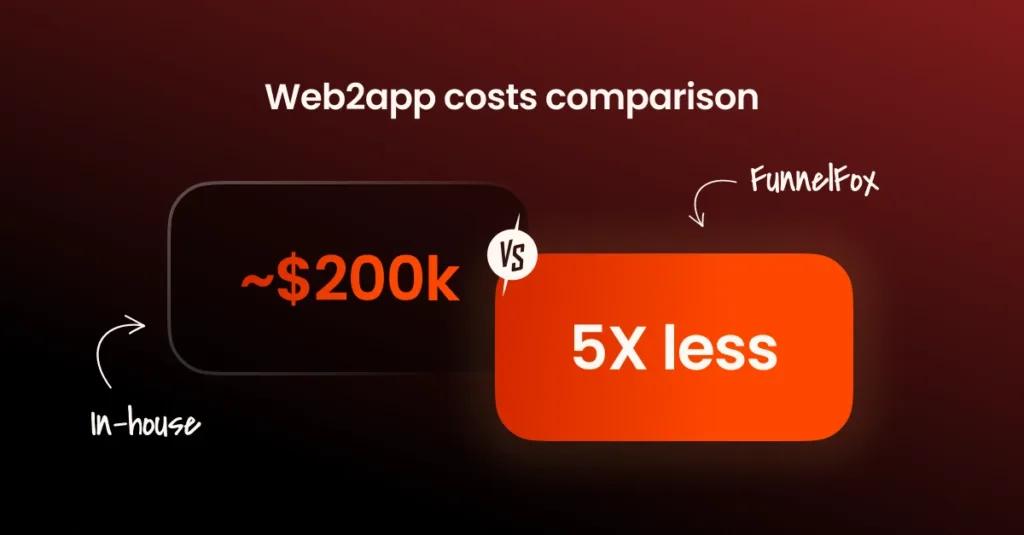
- Traditional in-house: ~$200K to make funnels fully operational.
- Vibe-coded in-house: ~$123-155K, with significant variability depending on how much human engineering oversight you add.
FunnelFox costs approximately five times less than traditional in-house.
Compared to vibe coding, the cost gap is smaller—but hidden costs make a real difference (more on that below).
Hidden costs (traditional in-house and vibe coding)
Beyond the direct costs, both in-house paths come with expenses that are easy to overlook—costs that quietly slow down growth and delay results:
- Dev time pulled away from the product. Whether your team is hand-coding a funnel or reviewing AI-generated code, those hours come at the expense of core product work. Features and opportunities get delayed while teams maintain funnel infrastructure.
- Time-to-market delay. Traditional builds take months. Vibe coding shortens the first build, but every iteration still requires prompting, code review, and redeployment. Either way, the time spent on infrastructure is time not spent testing growth ideas or scaling winning channels.
- Lower early ROAS. Both paths require learning from scratch—what funnel structures work, which payment flows convert, how to localize for different markets. That learning curve slows experiments and reduces early returns.
- Engineering oversight, even with AI tools. Vibe coding may feel like it removes the dev dependency, but production-grade funnels still need someone reviewing code, securing payment flows, and wiring up integrations. Skipping that step is where most vibe-coded funnels break.
FunnelFox vs. in-house: Complete сomparison
Here’s a head-to-head look at the key decision factors: AI agentic capabilities, speed, expertise, payment infrastructure, features, team, and performance.
AI agentic funnel generation
|
In-house (vibe coding) |
FunnelFox |
|---|---|
|
|
Vibe coding tools can quickly generate functional code and build interfaces. But they work from general web patterns, not web2app funnel best practices. And you still need to prompt them correctly, review the code, and supervise the build. Moreover, they require a lot of manual context-setting: brand guidelines, product details, tone preferences, and more.
FunnelFox’s agentic AI is built specifically for web2app funnels. Context Page reads your App Store listing once and retains that context across every funnel you create, including product positioning, brand identity, and tone of voice.
FunnelFox’s AI generates new funnels or modifies existing ones based on simple prompts. With in-funnel AI chat, you can replicate a screen from a screenshot, clone a paywall design from Figma, or localize your entire onboarding for a new market.
This level of flexibility, combined with constant product alignment, isn’t available with generic AI tools or vibe coding platforms.
On top of that, FunnelFox Intelligence is trained on conversion patterns from thousands of successful web2app funnels. The funnel structure reflects what actually works in your specific category, built on real data that other AI tools simply don’t have access to.
Speed and time-to-market
| In-house (traditional) | In-house (vibe coding) | FunnelFox |
|---|---|---|
| 4-6 months to launch; Each new funnel variation, A/B test, payment provider integration: several weeks. | Days to a basic v1, but weeks to wire up payments, tracking, and A/B testing properly; Each iteration requires re-prompting, code review, and redeployment. | 1 day to launch; A/B tests go live instantly; Payment integrations are pre-configured and require no time. |
Traditional in-house builds take months because the entire infrastructure has to be coded from scratch.
Vibe coding shortens the first build, but the supporting work—payment integrations, attribution, A/B testing logic, deep linking—still has to be done by hand, and each subsequent change adds review and redeployment cycles.
💡 Success story: Glam AI built their first funnel with FunnelFox in just one day.
Expertise and best practices
|
In-house (traditional and vibe coding) |
FunnelFox |
|---|---|
|
|
With an in-house option, you build a funnel from scratch, figuring out everything as you go: what works, what doesn’t, and where to even begin. The learning curve is steep, and each decision requires testing, adapting, and constant tweaking.
FunnelFox’s agentic AI shortcuts that process. It’s trained on conversion patterns from thousands of successful funnels across dozens of high-adoption verticals: health & fitness, education, lifestyle, AI apps, photos and videos, dating, and others. So when the AI generates a funnel for your app, it applies quiz logic, paywall structure, social proof placement, and pricing presentation that already convert in your category.
Plus, FunnelFox’s Customer Success team can help you implement solutions for any creative ideas or hypotheses you want to test.
Payment infrastructure
|
In-house (traditional and vibe coding) |
FunnelFox |
|---|---|
|
Need to build payment infrastructure from scratch. |
|
In-house teams often start with a basic payment setup, only to realize they need more advanced infrastructure down the line.
FunnelFox provides the payment infrastructure out of the box. Transactions are automatically routed to the provider most likely to approve them, failed payments are recovered without manual intervention, and switching providers takes minutes instead of weeks.
The critical advantage? If a provider blocks your account (which can happen due to high chargebacks or sudden volume spikes) you don’t lose access to subscribers. Tokens are stored and routed to backup providers, keeping revenue flowing while the issue is resolved.
💡Success story: Shmoody recovered 20% of failed payments using FunnelFox tools.
Web2app funnel features
|
In-house (traditional and vibe coding) |
FunnelFox |
|---|---|
|
No pre-built features. |
|
With FunnelFox, you get a complete web2app platform: a visual builder that lets non-tech teams create and modify funnels, AI agentic funnel creation, deep linking, built-in A/B testing, and comprehensive analytics with integrations to the tools you already use like Appsflyer, Mixpanel, Singular, Amplitude, and others.
Team requirements
| In-house (traditional) | In-house (vibe coding) | FunnelFox |
|---|---|---|
| 6-8 people including full-time developers, product and UA managers, a designer, and a QA engineer. | 2-4 people, typically a growth manager prompting AI tools plus a part-time developer for code review, integrations, and production hardening. | Growth teams ship independently with 1-3 people. |
Traditional in-house funnels demand a full cross-functional team. Vibe coding cuts that down significantly — small teams or even solo founders can ship a v1 — but production quality still requires technical oversight, especially around payments, security, and data integrity. Skipping that oversight is where vibe-coded funnels typically break.
With FunnelFox, even small teams can move fast and launch experiments instantly — helping apps grow without being slowed down by internal bottlenecks. No dev resources are needed. Simple funnel changes, A/B test variants, or payment provider integrations don’t require sprint planning or approval delays. Growth and product work in parallel instead of competing for the same resources.
FunnelFox also provides a support team for technical questions.
💡Success story: English on Smartphone scaled their web funnels using only a three-person team (teacher, marketer, and developer). They doubled revenue while cutting ad spend in half—proof that you don’t need a massive team when you have the right tools.
Performance and ROAS
|
In-house |
FunnelFox |
|---|---|
|
|
FunnelFox users consistently see better performance across all key metrics: higher conversion rates from proven templates tested across thousands of funnels, increased LTV from built-in upsell and upgrade flows, and higher ROAS from more effective funnels.
💡Success story: Shmoody switched to FunnelFox and achieved +80% ROAS increase in 3 months.
When in-house actually makes sense
For most mobile apps, FunnelFox is faster, cheaper, and more effective. But there are scenarios where building in-house — traditionally or through vibe coding — can be a reasonable choice:
Traditional in-house may make sense when:
- You have spare DevOps capacity. When your team has bandwidth for a multi-month infrastructure build without slowing the core product.
- Full ownership is required. When you’re prepared to manage infrastructure, maintenance, security, and scaling long term.
- You have in-house funnel expertise. When your team can execute efficiently without a steep learning curve.
- Cost efficiency isn’t a priority. When investing around $200K is acceptable.
Vibe coding may make sense when:
- You’re a solo founder or pre-revenue team validating a concept and willing to accept rough edges in payments, tracking, and analytics.
- You have at least one technical person to review AI-generated code, harden security, and wire up integrations properly.
- You’re testing a single funnel hypothesis and don’t yet need A/B testing, advanced analytics, or revenue recovery.
- You’re comfortable rebuilding or migrating later as the funnel scales beyond what AI-generated code can reliably support.
For both paths:
- Urgency is low. When a delay of weeks or months won’t affect growth or competitive position.
- Experimentation speed isn’t critical. When slower iteration cycles are acceptable.
For everyone else, the trade-offs — time, cost, technical risk, and opportunity loss — outweigh the perceived control of going in-house.
Conclusion: Making your decision
Building web2app funnels in-house, whether through traditional development or vibe coding, means trade-offs that compound over time.
Traditional builds take months and cost around $200K, with teams spending more time maintaining infrastructure than running growth experiments.
Vibe coding lowers the entry cost and shortens the first build, but production quality, payment infrastructure, and ongoing optimization still require engineering oversight—and the maintenance burden grows with every iteration.
Apps using FunnelFox launch faster, run more experiments, learn from proven best practices, and benefit from conversion-optimized funnels built by experts. The agentic AI generates and edits funnels with full product context, so growth teams move at the speed of vibe coding without inheriting the technical debt.
The outcome: lower total cost, faster time-to-market, higher conversion rates, stronger ROAS, and higher customer LTV.