





TL;DR
- AI builders have reduced app development time to hours. Everyone ships fast now, but not everyone can get reliable data fast enough to make decisions.
- For subscription apps, the main bottleneck now is the speed of getting a reliable revenue signal.
- The App Store and Google Play still slow this cycle down through review delays, limited pricing flexibility, constrained analytics, and slower experimentation.
- The speed of learning is what defines subscription revenue in 2026.
- Web-to-app funnels shorten the path from hypothesis to revenue signal, so learning and app monetization can keep up with product speed.
The barrier to building mobile apps has almost disappeared. With tools like Lovable or Cursor, you can go from idea to a working product in days or even hours.
Teams are shipping faster than ever, but still waiting weeks or months to learn if people are willing to pay and if the pricing works.
The problem sits in infrastructure you don’t control. The App Store and Google Play haven’t changed — review cycles, in-app purchase constraints, limited analytics, and rigid pricing rules. You can build a product in a day, but getting reliable data to make decisions still takes weeks or months.
So the real constraint shifts from how fast you can build to how fast you can get a revenue signal.
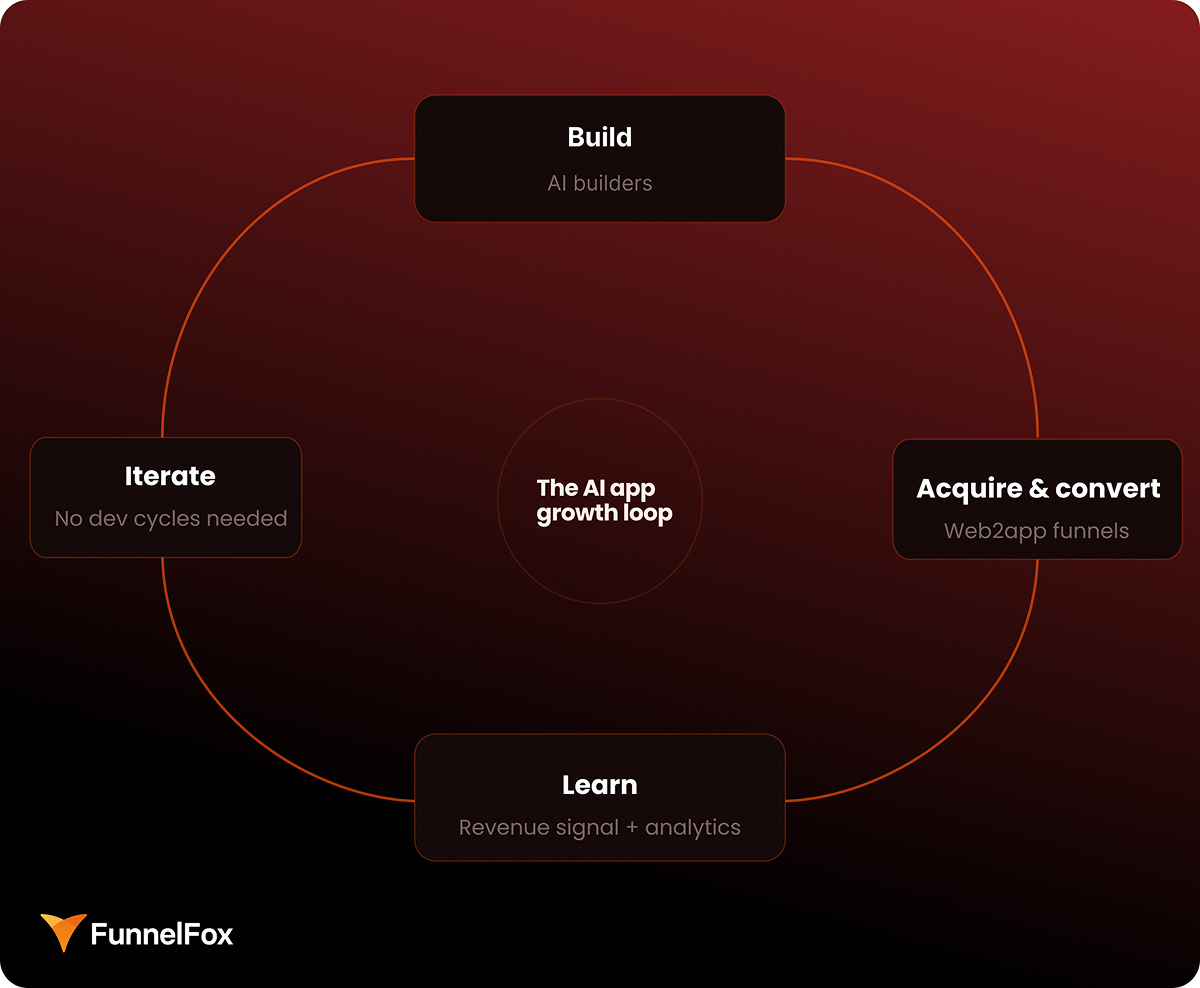
That’s where web2app funnels come in: they let you test ideas as fast as you build them, and see what sticks before you invest more into the product.
In this article, we’ll look at why learning still slows things down, even as AI speeds up product creation, how web-to-app changes that, and how to monetize AI apps in 2026.
Why is app monetization still a bottleneck after AI product creation?
AI builders haven’t just increased development speed — they’ve multiplied the number of product ideas a team can realistically launch. What used to take weeks of development now takes hours. Launching a new product or variation has become cheap and straightforward.
More experiments sound like a win, but they create a new problem: prioritization. When you can launch anything, you need to know what to launch first. And the only real filter for that is market signal — is there demand, are users willing to pay, and which model works?
App stores slow down learning loop
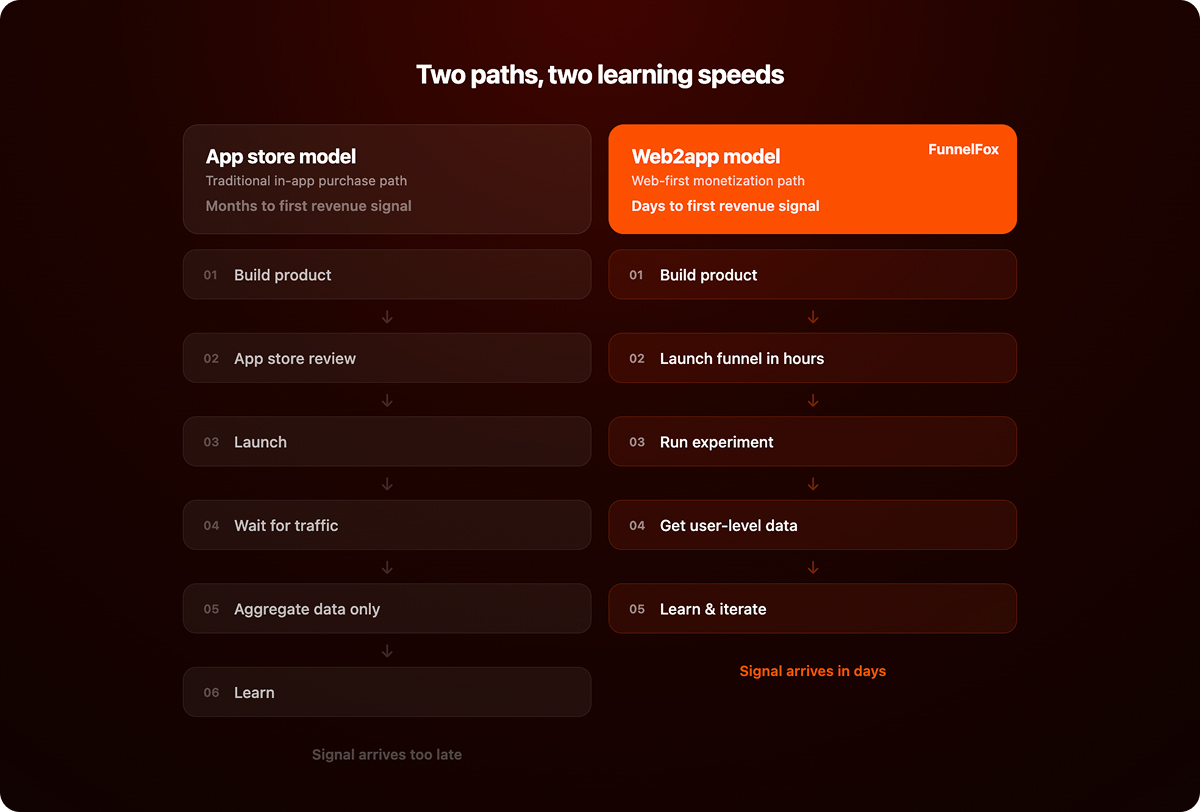
This is where the gap shows up. In a traditional app store setup, the time to learning gets stretched out.
Idea validation still takes too much time. Every meaningful change goes through a review cycle, so even with fast development, each iteration adds days or weeks of delay.
On top of that, analytics remain aggregated, so you can’t clearly see what’s working.
As a result, you can build a product in a day, but you still wait months to get a clear revenue signal. And by then, it may turn out that time was spent on something that doesn’t work.
Web2app funnels close this gap.
How to monetize AI apps faster with web2app funnels
Web-to-app funnels give AI app teams three things the app store model doesn’t: the ability to move fast, full control over the conversion path, and clean data to act on.
Faster testing of messaging and positioning
In a web funnel, you can change anything without a review cycle: message, value prop, offer structure, price, paywall, whatever. Launch a variant, get a signal, iterate.
And funnels don’t have to wait for a finished product. You can run a web2app flow around an app or a feature that doesn’t exist yet to validate an idea fast and easy.
More control over onboarding and offers
In the in-app model, onboarding and offers are rigid and heavily constrained by platform rules.
In a web funnel, those constraints disappear. Number of onboarding steps, question logic, segment-level personalization, pricing experiments, trial mechanics, plan structure — all of it can be configured and changed without development or platform approval.
This makes it possible to do more than just “test variants.” You can systematically optimize the full conversion path for different segments and traffic sources.
Better connection between experiments and revenue signals
A web funnel captures the entire path from first touch to payment in one place. No need to manually stitch together attribution, onboarding behavior, and payment data from separate systems.
That gives you a fundamentally different signal: not just CR at an individual step, but a direct connection between a specific onboarding variant or offer and downstream metrics. The faster that signal arrives, the faster you can make decisions that improve the actual economics of the product.
ExploreApps tested demand for a specific feature by running a dedicated funnel variant before writing a single line of code. The signal was clear enough to greenlight development. In parallel, their web2app funnels delivered 1.5x lower cost per subscription compared to direct app store campaigns. Read the full case study.
Together, these factors compress the monetization cycle. In the classic in-app model, the gap between a hypothesis and a validated signal takes months.
In web-to-app, that cycle shrinks to days. A team that shipped a product in a day can validate whether the app monetization works just as fast and keep iterating without losing momentum.
What does the modern monetization stack look like in the AI era?
Shipping fast is only half the equation. The other half is infrastructure that lets you test hypotheses at the same speed and turn that testing into real revenue signals.
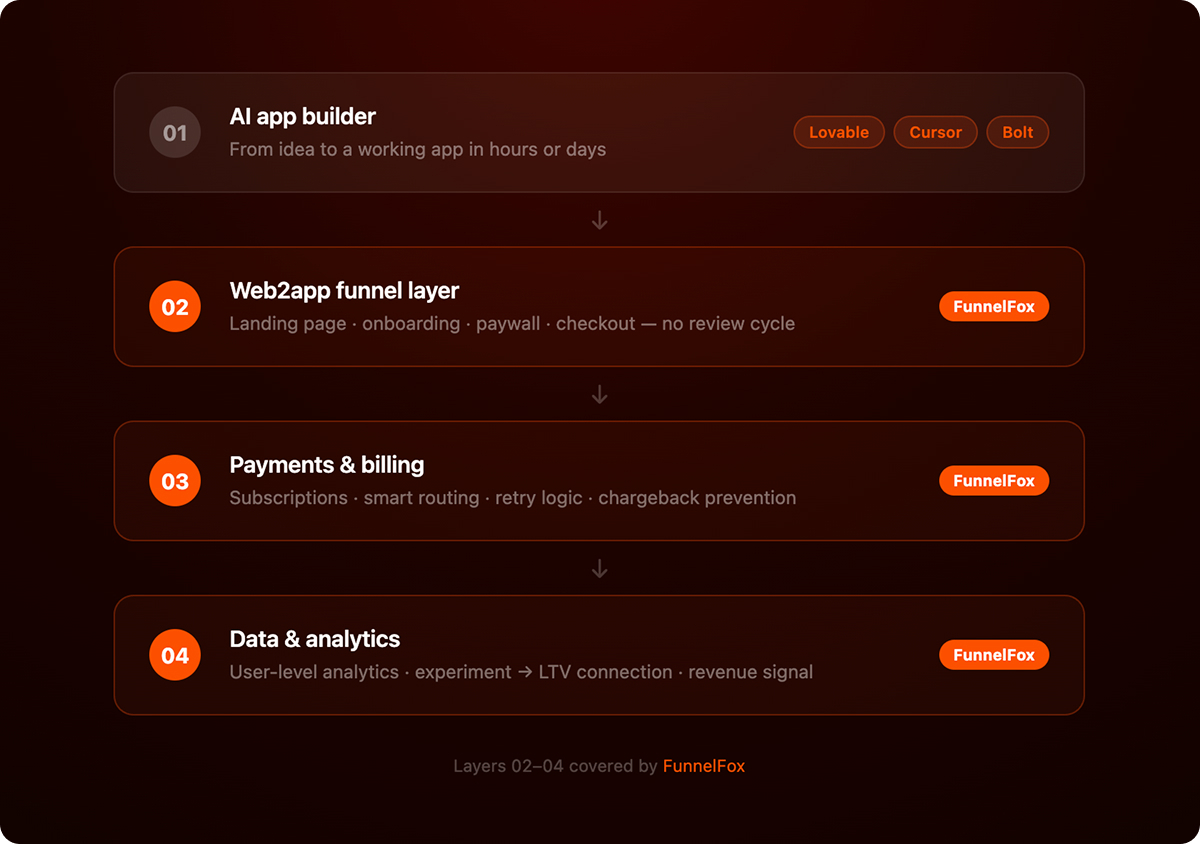
In practice, it’s a stack of layers, each covering a distinct part of the cycle.
AI app builder
The AI app builder ecosystem has expanded fast. At this point, it splits into two broad categories: coding assistants like Cursor, which work alongside developers and accelerate engineering output, and vibe coding tools like Bolt and Lovable, which allow non-technical founders to ship working products without writing code at all.
The choice between them comes down to who is building. If there’s an engineering team, Cursor fits naturally into the existing workflow. If the founder is the product person and there’s no dev capacity, Bolt or Lovable are the faster path to a working build. Either way, AI product development now moves fast enough that the build isn’t the hard part anymore.
Web2app funnel layer
Web2app funnel is where acquisition meets monetization: ad click, landing page, onboarding, paywall, checkout flow — all outside app store constraints, all fully testable without a release cycle.
However, building a web-to-app funnel from scratch may take weeks. That’s the same bottleneck AI builders were designed to eliminate, and FunnelFox does it for web2app: you can build a working funnel in under an hour, no code required.
Payments/checkout layer
This layer covers your payments and subscription logic, and it goes beyond simply integrating a single payment provider. It includes recurring billing, multiple payment providers, localized pricing, payment routing, refunds, and dispute and chargeback management.
Learning layer (analytics)
This layer brings the full data — from first touch to payment — into one place. It gives you user-level data instead of aggregates, so you can directly connect specific experiments to downstream metrics like LTV and retention.
In theory, you can piece these layers together from different tools. In practice, that usually slows things down. That’s why teams are moving toward more integrated setups, where these layers work as a single system.
How FunnelFox fits into the stack
FunnelFox brings three of these layers together — web2app funnels, payments infrastructure, and learning — in one system.
Web2app funnels
FunnelFox includes a visual no-code builder for landing pages, quiz onboarding, paywalls, and checkout. You can go from zero to a live funnel in hours — fully customized for a specific segment, traffic source, or ad creative.
Built-in A/B testing lets you run experiments and track conversion at every step, shortening the time from hypothesis to signal and giving you direct control over the conversion path.
Payments, billing, and revenue recovery
FunnelFox also covers the full payments and billing layer: subscription management, smart payment routing across providers, network and provider-level tokenization for billing continuity, intelligent retry logic for failed transactions, and chargeback prevention and monitoring tools.
On top of that, you can set up custom cancellation flows. Instead of a cancel button, you get a configurable retention flow — pause, downgrade, free period. Users who were about to leave get a reason to stay, and you get the feedback to work on your retention strategy.
Data and analytics
FunnelFox provides reliable data across the entire funnel. The key difference from app store analytics is user-level visibility and a direct connection between experiments and outcomes. You can see how a specific onboarding variant or offer affects not just conversion, but also impacts revenue.
With FunnelFox, you get a connected system where funnels go live in under an hour, signal arrives fast, and the impact on revenue is immediately visible.

How should teams adapt their app monetization strategy in 2026?
Speed of execution is no longer a competitive advantage — it’s a baseline. AI app monetization strategies in 2026 are defined by one thing: how quickly teams get data and act on it.
A few concrete things that make that possible.
Validate pricing and value prop early
Not after launch, not after the first few thousand users. Pricing and value prop aren’t final-stage adjustments — they’re part of the initial validation. If the audience isn’t paying, scaling only makes the mistake more expensive.
Treat web2app as a learning environment, not just an acquisition channel
Web-to-app is more than acquisition. It’s the layer where you test messaging, onboarding, offer structure, and pricing and get valuable insights about your audience and product.
Teams that treat it purely as a traffic channel are leaving most of the value on the table — the real advantage is in the speed and quality of the learning loop it enables.
Shorten the loop from idea to revenue signal
The shorter the cycle between a hypothesis and a validated signal, the faster the team accumulates knowledge, and the less resources go toward what doesn’t work. The goal is to minimize the delay between a decision and its financial outcome.
Give your growth team control over experiments
If every funnel change requires engineering, your learning speed is capped. The teams that win move experimentation to a layer where growth can operate independently changing onboarding, offers, pricing, and funnel structure without waiting for a release. That directly increases the number of hypotheses tested and reduces time to insight.
A product manager at a content subscription app used to spend two weeks building a single funnel, with a developer and a designer. With FunnelFox, she now does it solo in a day or two. One experimental funnel converted at 5% and cut acquisition costs by 30%. More importantly, it reshaped the entire product direction. Read the full case study.
Conclusion: speed without learning loop doesn’t scale
The barrier to building a product is gone — what used to require a team, a budget, and months of work now takes a few days.
But that cuts both ways. If you can ship an app in a day, so can tens of thousands of other people. Competition has scaled proportionally with access to the tools.
In that environment, the advantage shifts. Not to development speed — that’s been commoditized — but to how fast a team can figure out whether their product can make money, and how.
When that cycle is long, you scale uncertainty. When it’s short, you scale what works. And if you don’t control that cycle, you don’t control your growth.
Web2app funnels give that control back, shortening the loop from hypothesis to revenue signal. In 2026, web2app isn’t just another acquisition channel, but a part of the baseline stack for anyone figuring out how to monetize AI apps.