







In-app purchases transformed mobile app monetization when they launched. They made it simple for users to buy subscriptions, unlock features, or grab premium content without leaving the app. But as apps mature and growth teams push for faster iteration, the limitations of IAPs become harder to ignore.
Many apps now layer web2app flows on top of their IAP infrastructure—not to replace it, but to unlock the flexibility that platform-native billing can’t provide.
This post breaks down what in-app purchases are, where they excel, where they constrain growth, and how web2app helps mobile apps move faster.
What does in-app purchase mean?
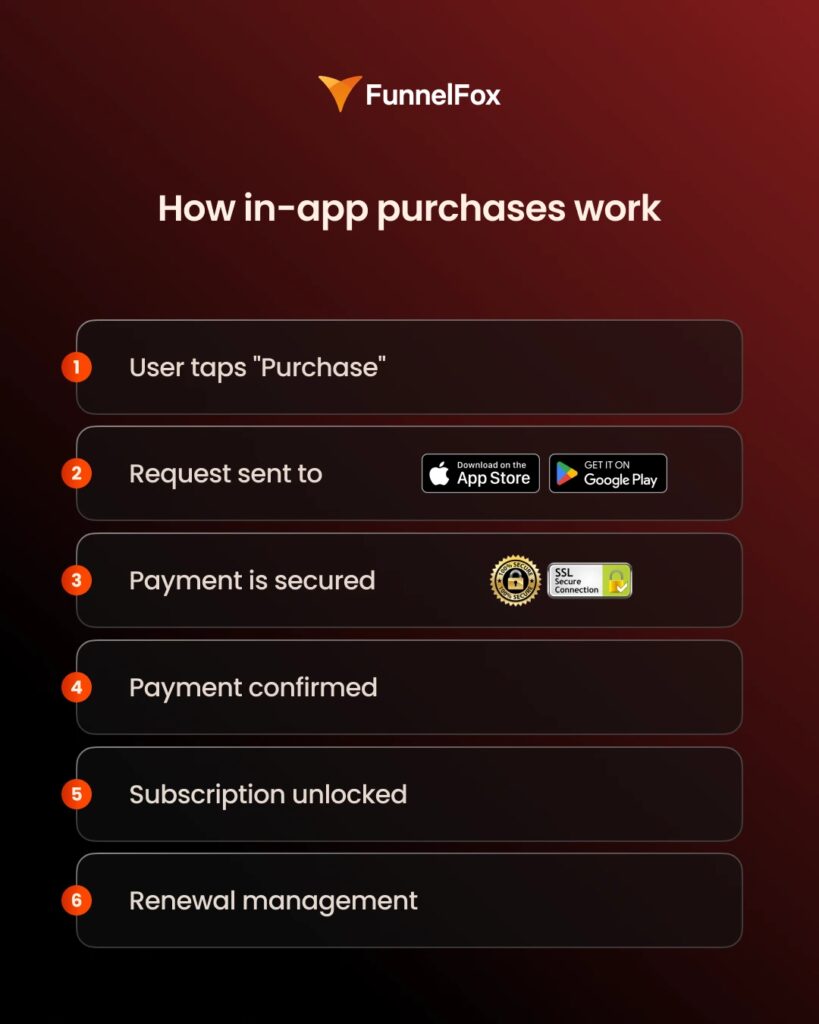
In-app purchases (IAPs) are transactions processed directly within a mobile app through Apple’s App Store or Google Play Store. The platform handles billing, receipt validation, and—in the case of subscriptions—automatic renewals.
This native integration is what makes IAPs feel seamless. Users don’t need to enter payment details every time. The store manages everything behind the scenes.
Types of in-app purchases
IAPs fall into several categories, each designed for different monetization models:
|
Type |
What it is |
Examples |
|---|---|---|
|
Consumables |
Items used once and repurchased |
Extra lives in a game, in-app currency |
|
Non-consumables |
One-time purchases that don’t expire |
Removing ads, unlocking a premium feature |
|
Auto-renewable subscriptions |
Recurring charges until canceled |
Monthly fitness plan, weekly meditation app |
|
Non-renewing subscriptions |
Time-limited access without auto-renewal |
30-day course access, seasonal content pass |
Why in-app purchases became the default
IAPs weren’t always the norm. When the App Store launched in 2008, apps could only be free or paid upfront—there was no way to monetize within the app itself. Over time, Apple and Google made IAPs the standard—and for good reasons.
Benefits for apps
IAPs reduce the complexity of launching monetization.
- Centralized distribution and billing. App discovery, download, and payments all happen in one place.
- Faster monetization setup. No need to integrate a separate payment provider or build a checkout from scratch.
- Shorter path to purchase. Once a user installs the app, they can pay without leaving it.
Benefits for users
From a user perspective, platform-native payments are simple and secure.
- High security perception. Users know it’s Apple and Google handling the payment, which reduces purchase hesitation.
- Saved payment methods. Payment details are already saved in users’ accounts.
- Familiar checkout experience. No need to trust a new checkout or enter card details again.
Global infrastructure
Both platforms support 175+ countries and handle local currency pricing automatically. Your app can charge users in euros, yen, or rupees without custom logic. The store manages currency conversion in the background.
For apps with global ambitions, this infrastructure is a major advantage.
Platform requirements
IAPs are mandatory for certain transaction types: subscriptions to app features, in-app content like articles or videos, virtual currencies, game items, and premium features.
However, recent regulatory changes are shifting the landscape. From May 2025, Apple updated its App Store Review Guidelines to allow apps in the U.S. to include a link redirecting users to external websites for purchases.
From October 29, 2025, Google Play permits external payment methods in the U.S.—though this policy is temporary and expires November 1, 2027.
These changes open the door for more flexible monetization strategies, but IAPs remain the default for most apps.
What in-app purchases are good at
Simple subscription flows
If your app has standard pricing tiers and straightforward offers, IAPs handle them efficiently. The platform’s billing system is built for recurring payments—no custom infrastructure needed.
This works especially well for apps early in their monetization journey. You can launch subscriptions quickly and start generating revenue from day one.
Built-in subscription management
One of IAPs’ strongest features is automatic subscription handling. The platform takes care of the heavy lifting:
- Automatic renewals. Renewals happen without developer intervention.
- Failed payment handling. Both stores have sophisticated “Billing Grace Periods” and “Account Hold” states—the platform notifies users and retries charges over several days.
- User control. Users can manage subscriptions directly in their OS settings, reducing support tickets.
This built-in management means you don’t need to write custom logic for common subscription scenarios.
Reducing user drop-offs
The trust and convenience of platform-native checkouts minimize friction. Users who’ve purchased apps before know the flow. They’re more likely to convert when the experience feels familiar and secure.
This leads to higher retention for paying subscribers and steadier revenue streams. For apps just starting out, it also provides more predictable performance.
In-app purchase SKUs limitations
Here’s where things get tricky. Apple and Google are “pre-defined” ecosystems where apps can’t change prices on a whim. Every variation—whether it’s a new price point or a promotional tier—must be configured as a specific SKU (Stock Keeping Unit) or Offer ID before it can be used.
This requirement creates multiple bottlenecks:
Pricing
- Slower iteration. Every small change involves administrative overhead that slows down your testing cycle.
- Setup is redundant. Global pricing experiments require manual configuration in two different consoles.
- You are limited to platform rules. You must follow the currency and rounding rules set by Apple and Google.
Offers
Want to test a limited-time bundle? A winback offer for churned users? Each variation demands a new SKU and a custom backend logic.
This rigidity limits how many experiments you can run per quarter. Growth teams that thrive on iteration find themselves boxed in.
Personalization
To avoid a “one-size-fits-all” experience, you have to manually sync your internal user data with the platform’s settings for every possible scenario and different user segments.
This way, if your backend logic isn’t perfectly aligned with the store’s configuration, your personalized offers simply won’t trigger.
Other limitations
Beyond SKUs, IAPs impose other constraints that affect growth and user experience.
Rigid subscription logic
The platform dictates how subscriptions work, leaving little room for customization:
- No native subscription pauses. Users must cancel and resubscribe manually.
- Fixed durations only. Weekly, monthly, quarterly, or yearly—no custom durations.
- Upgrade/downgrade timing restrictions. Changes won’t happen until the end of the current billing cycle.
- Platform-default grace periods: You can’t customize them to match your retention strategy.
Fixed checkout flows
The checkout experience is set by the platform. You can’t customize the layout, add upsells mid-flow, or A/B test different checkout designs.
Store fees
Apple and Google charge 15-30% per transaction. For subscription apps with tight margins, this fee compounds over time and directly impacts LTV. While necessary for platform access, it’s a significant cost.
💡Learn more about App Store fees and how they affect your app’s economics.
How in-app purchases affect LTV and growth
Slower experimentation
The inability to iterate quickly creates a compounding disadvantage:
- Fewer tests per year means slower feedback loops;
- Apps learn less about what works;
- Insights that could drive growth are delayed by weeks or months;
Fewer growth levers
Rigid purchase flows make results predictable—but also limited. Apps can’t easily optimize checkout or experiment with advanced features like one-click upsells or dynamic discounts.
For mature apps, these constraints can quietly put a ceiling on growth potential.
Why many apps add web2app as a second monetization layer
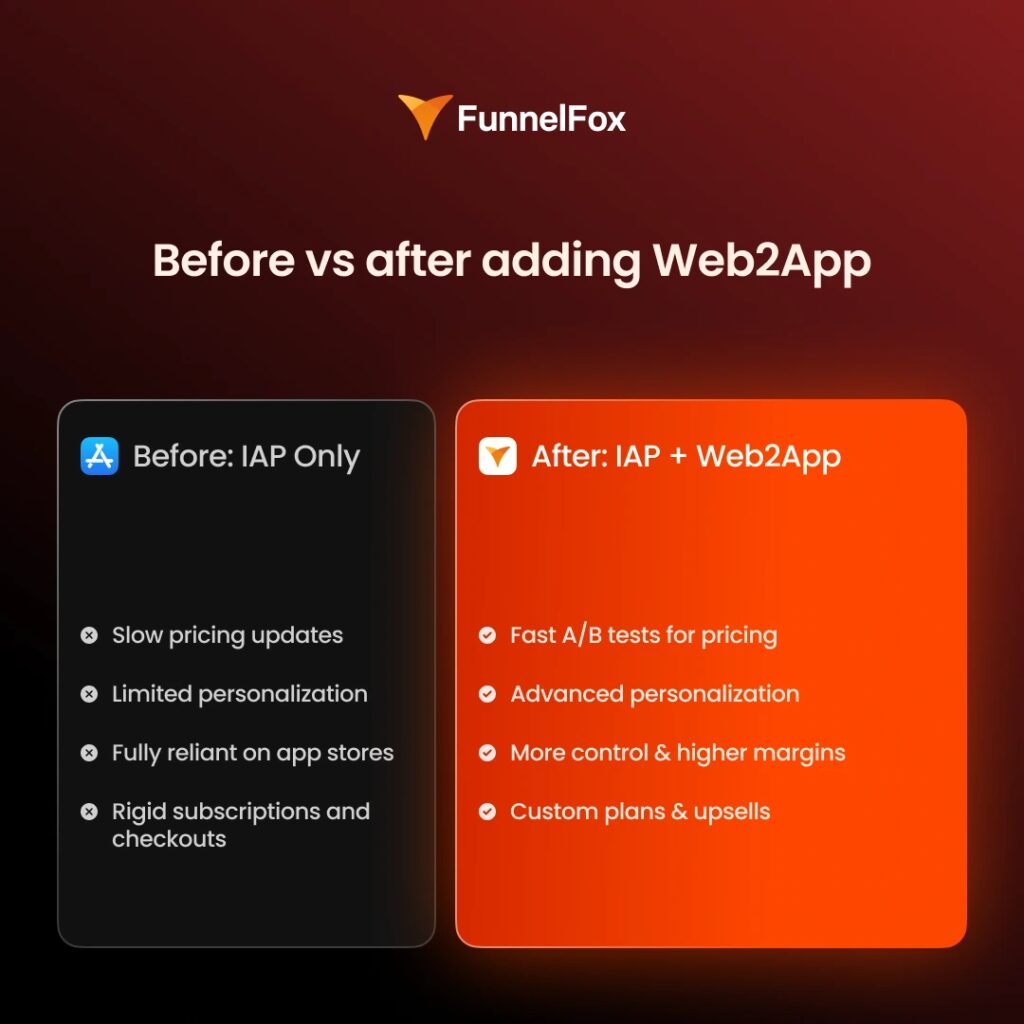
Web2app doesn’t replace IAPs—it complements them. Apps keep IAPs for what they do well and layer web2app on top to unlock flexibility.
Faster experimentation
Web2app lets you test pricing and offers without manual store updates, so you can:
- Run more tests;
- Gather insights faster;
- Iterate based on real user behavior.
💡Learn more about how to run pricing experiments in web-to-app that drive growth.
Greater flexibility
Web2app puts you in full control of subscription options and checkout flows, letting you create experiences that align with your growth strategy:
- Build custom durations;
- Test different paywall layouts;
- Personalize offers at the user level;
- Add one-click upsells.
With this flexibility, apps can design the experience that works best for their audience, maximizing conversion to purchase and LTV.
Personalization
With web2app funnels, you can tailor offers based on user behavior, lifecycle stage, or segment:
- Show high-value users premium plans;
- Offer winback discounts to churned users;
- Adjust pricing based on acquisition source.
This level of personalization isn’t possible with IAPs alone.
Reduces platform dependency
By handling payments outside Apple and Google, you rely less on their rules and fees. The benefits go beyond flexibility:
- You’re not constrained by policy changes;
- Lower transaction fees mean higher margins;
- Better unit economics overall.
FunnelFox: Infrastructure for flexible monetization
For apps that want to move beyond the limitations of IAPs, FunnelFox provides the infrastructure to build a second monetization layer. It’s designed to let teams experiment, iterate, and personalize offers without being slowed down by store rules or SKU configurations.
With FunnelFox, you can set up web2app funnels that handle everything from the first user interaction. Its no-code builder makes it possible to launch new flows in hours, while built-in analytics allow you to track how different pricing, paywall layouts, and offers perform.
FunnelFox gives growth teams the tools to test and optimize monetization continuously, while keeping IAPs as the reliable foundation for subscriptions and purchases.
Ready to unlock flexible monetization with FunnelFox? Book a demo.
Conclusion
In-app purchases are powerful but constrained. They excel at simple, secure transactions but struggle with flexibility, speed, and personalization.
The fastest-growing teams don’t choose between IAPs and web2app—they use both. Keep IAPs for what they do well: seamless, native transactions. Add web2app for the flexibility to iterate, personalize, and scale.