




Building a subscription app is the easy part now. Getting that app to $100K MRR is a different job, and the hard one.
FunnelFox sat down with three founders who have taken their apps well past that mark:
- Jake Castillo, co-founder of Cal AI, which he started in April 2024 and scaled from zero to $50M ARR in 18 months before selling it to MyFitnessPal. He now builds Virally, an influencer CRM, and several new apps.
- Ernesto Lopez, co-founder of Covenant Studios. His first app made $25K in its first month. He then paid $40K to buy into Prayer Lock as a co-founder and took it to $150K MRR within a couple of months, at an 80% profit margin.
- Steve P. Young, founder of App Masters, has been building apps since 2010. Today he runs an agency, a YouTube channel, and his own portfolio of apps.
Below are the main takeaways, in the order an app needs them:
- Before launch: which niche and market to pick, how to set up the paywall, and what not to build yet.
- Growth: how to run organic TikTok at volume, when influencers pay off, and when to start Meta and Apple Ads.
- Once it works: how to deal with copycats.
The most profitable app niches in 2026
Picking a niche feels like the fun part, the one you do before the real work starts. In practice, it decides your revenue per install, your creator costs, and your paywall options before you’ve written a line of code.
Why health and fitness apps have the highest revenue per install
Pick health and fitness if you want the highest revenue per install. Someone who downloads an app to lose weight or quit a habit arrives already motivated to pay. These users don’t flinch at a hard paywall, and exit-intent offers work on them too. “Quit anything” apps belong in the same bucket.
“I’ve seen the highest revenue per install in that category. For the portfolio side of our business, I’m focused on health and fitness, because I know I can do a hard paywall there. People in that niche are very motivated to buy.”

When to launch a health and fitness app: before January 1
Interest in the category keeps growing, and the weeks before New Year’s are its Super Bowl. From mid-November you have six or seven weeks to build the app and get it live in the App Store, so it’s ready on January 1, when resolutions are at full strength. There’s no better launch window all year.
Once you’re live, sell the app with transformation videos: 100 days before, 100 days after, one routine in between. The “day one of 75 Hard” series works the same way: everyone seems to be on day one forever, and people still follow every video. One health and fitness app made $30K in a single day from one viral video, most likely an AI transformation.
App niches to avoid: where competitors outbid you for creators
Take an AI style coach. There are a million fashion creators out there, which sounds great until you look at who else pays them: fashion brands whose customer is worth thousands of dollars. A $10-a-month app can’t outbid that. Peptides have the same problem, since you’re up against GLP-1 companies with an LTV you can’t match. So before you commit to a niche, look at who else is bidding for the same users and creators. If they can afford an enormous cost per customer, pass.
How to grow an app outside the US
Pick your market at the same time as your niche. The US comes first for most apps, and there’s a large market right behind it that almost nobody targets.
Should you launch in the US or your home market first?
A learn-to-drive app reached $30K a month in Chile alone, and a health and fitness app reached $30K a month in Spain alone, on Spanish-language videos. If you can pick any market, though, start with the US and go to the Spanish-speaking market second.
Why the Spanish-speaking app market is underserved
The Spanish-speaking market is badly under-indexed, has real disposable income, and its audience is tech-forward. Since 99% of apps don’t target Spanish, any format that went viral in English is still open there. One of Prayer Lock’s Spanish-language creators was the first to run the app’s format in Spanish and picked up 100K subscribers on her channel in her first month.
“Grab any format that went viral in English. I guarantee you, 99% of apps aren’t targeting Spanish.”

How to localize a proven US app or format for your country
If you live outside the US, take an app or a format that already works there and rebuild it for your country. You know the differences that matter, and nine times out of ten, nobody is running the format in your language yet. An App Masters client built a Cal AI for Thailand around how Thai food is different and grew it to $30K. A founder in Brazil ran a ChatGPT wrapper, found one influencer format that worked, scaled it, and reached $100K in Brazil alone.
“Grab anything that works in the US, and nine times out of 10, nobody’s running the same format in other countries.”
Paywall best practices for subscription apps
Every install you’ll ever pay for, earn, or get from a creator ends up on the same screen, so the paywall comes before the traffic.
Hard paywall or free tier? Launch with a hard paywall
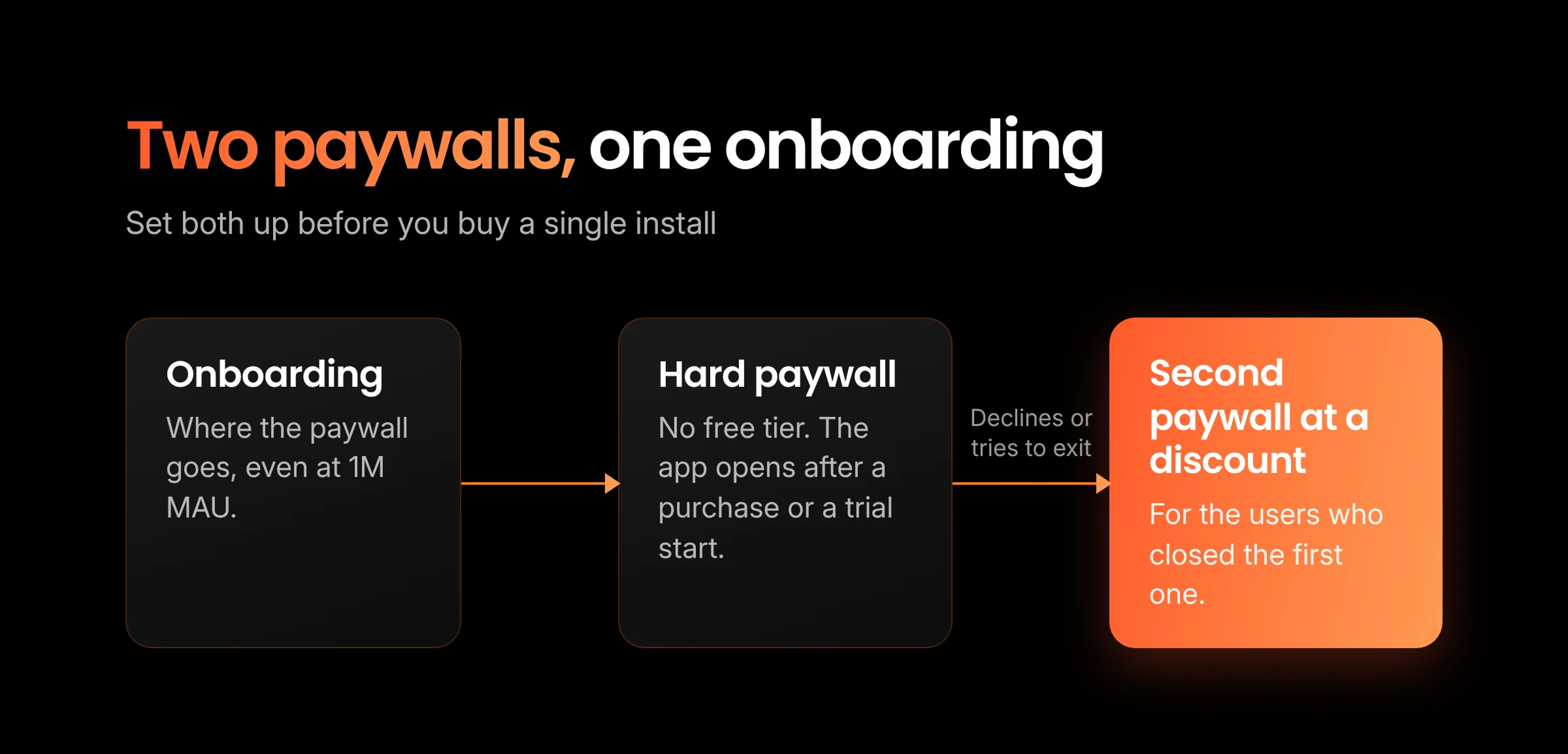
Launch with a hard paywall: no free tier, the app opens only after a purchase or a trial start. It works especially well in categories like health and fitness, where users arrive motivated and don’t freak out when they see one.
Transaction-abandoned paywall: a discount for users who close the first one
Some users will close the first paywall, and that’s where one of the cheapest wins sits: a transaction-abandoned paywall. When a user declines or tries to exit, show them a second paywall at a discounted price. It takes very little effort and gives one of the highest returns of any change you can make.
“When users decline the first paywall or try to exit, give them another one at a discount. You’ll see a significant lift in conversion rate. If you don’t have one, it’s free money you’re leaving on the table.”
Should the paywall be in onboarding? Yes, even at 1M MAU
Put the paywall in onboarding, even if the app already has a large audience. Expect retention to go up along with sales: for non-game apps, monetization drives retention. One App Masters client had a million monthly active users and no paywall in onboarding. The app sold packs rather than subscriptions, and it was doing fine. Once the paywall moved into onboarding, sales went up, and so did retention, the metric the client cared about most.
“Focus on distribution and monetization. Especially if you’re a non-game app, monetization will drive retention. And if users don’t retain, you’ve already made your money.”
What early-stage apps should skip: retention, Live Activities, and email
One listener had paused distribution work to focus on retention. It should be the other way around, and the same goes for most of what early apps worry about.
What to focus on first: distribution and onboarding
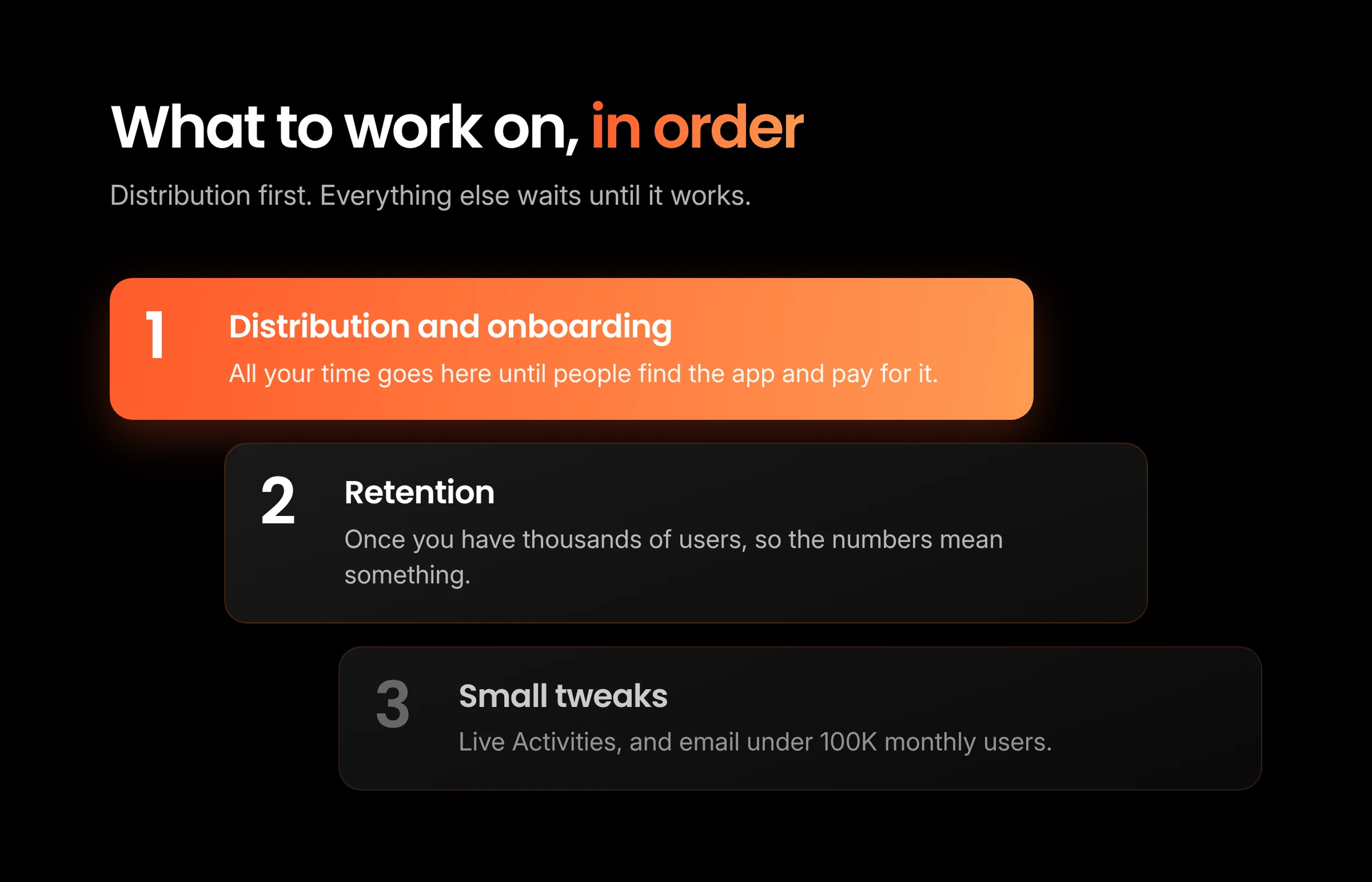
Keep your list two items long: distribution and onboarding. Retention comes after that, and small tweaks with small impact come last. Give yourself a long list of things to optimize, and the paradox of choice kicks in: you try to work on everything and end up getting nothing done. Building feels like the easy win because you see the result right away, but the dopamine should come from downloads and revenue. Once distribution works, most other things take care of themselves.
When to start working on app retention
With 10 users, retention numbers tell you nothing. You need 1,000, maybe 10,000 users to see the real picture, and until you have hundreds of thousands, retention isn’t your main problem. Monetization often lifts it anyway, as the onboarding paywall case above showed.
“You can get your retention to 100%, but 100 times zero is still zero.”
When retention does start blocking something, set up analytics first. Prayer Lock made it to the Y Combinator interview and was rejected over retention: about 8% at day 30, and no analytics in the product. The team set up Amplitude, tracked every user action, and started choosing features based on data rather than on what seemed cool. An in-app community with a live support chat, where users could text the founders directly, showed problems in real time. Day-30 retention eventually reached 60%.
Can you put an offer in a Live Activity?
Keep offers out of Live Activities. As Prayer Lock understood it from talking to Apple, they’re meant for app functionality only: the team added an offer to one, following Duolingo’s example, and had to take it down. One sleep sounds app runs offers through Live Activities successfully, so it can be done, but stay away from it. Whether Live Activities help retention at all depends on the kind of app.
“I’m not big on Live Activities. It feels like majoring in the minors.”
When email marketing starts to pay off for apps
Below 100K monthly users, skip email and spend that time on marketing. With a couple million active users, it starts to pay off. Two subject lines worth testing:
- “our most popular workouts”
- “You’re not alone.”
The second one reliably gets opens, because other people struggle to quit a habit or lose weight too.
“One client had a workout app and wanted people who started a trial to work out, because they usually stay and don’t cancel. We changed the subject line from ‘the benefits of HIIT workouts’ to ‘our most popular workouts,’ and that doubled the workout rate.”
TikTok marketing for apps: how to run organic content at volume
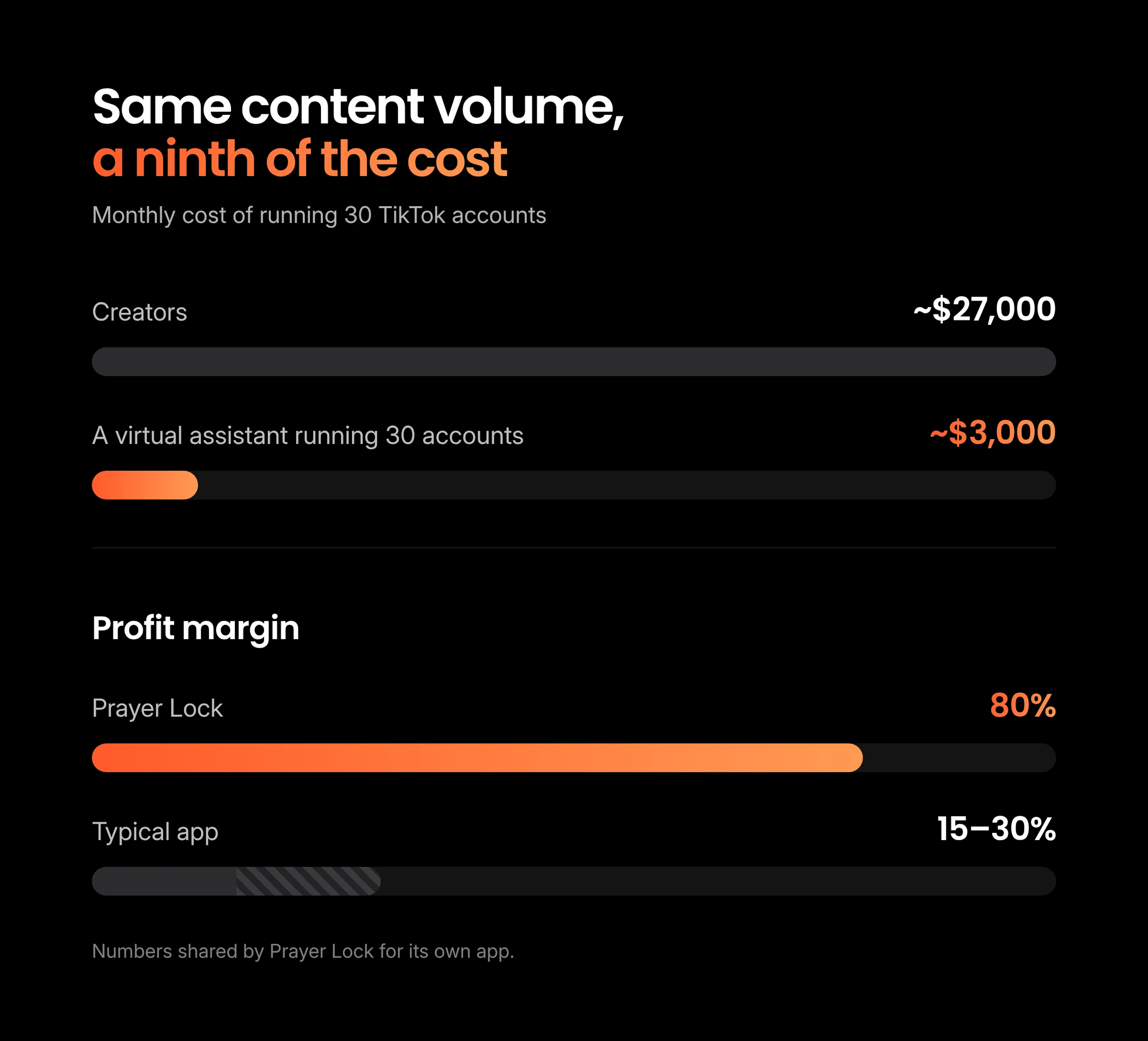
Prayer Lock ran at an 80% profit margin, while 15–30% is standard for apps. The difference came from amplifying content instead of pouring more money into creators and influencers.
Creators vs a virtual assistant: what it costs to run 30 TikTok accounts
If you’re still scaling a creator budget, stop. Mass-produce content with Claude and pay a virtual assistant (VA) to run 30 TikTok accounts. That costs about $3K a month, while the same volume from creators would run around $27K. At one point, Prayer Lock was getting 20M views for under $3K, and that’s what pushed the margin up.
“With Claude, you can mass-produce content as a one-person army.”
How to find a viral TikTok format for your app and repeat it
Use volume to find what to repeat, then repeat it. Prayer Lock tried reactions and other formats, and most of them got low views until one video came out a clear outlier. Instead of moving on to the next idea, the team wrote three scripts and ran them on every video for three months, about 6,000 videos a month, with a different person on camera each time. That took the app from $25K to $150K a month. Once a script works, the only thing left to test is detail: a Bible in frame or not, a professional setting or a casual one.
“If it worked once, it’s gonna work again, even if it’s the same script. That’s what took our app from $25K to $150K.”
When to stop testing a TikTok format
Trust your gut once you have experience, and back it with volume. If other apps already run a format and it isn’t working for them, skip it. When you’re inventing a new one, five videos aren’t a test: if they flop, the problem is more likely your execution than the format. Test properly: 60 posts a day, half your accounts on the new format, each one varying something, whether it’s the setting, the script, or the hook. If the whole batch fails, move on. The same script-based approach later put a second app, launched after Prayer Lock, on track for $25K in its first month.
Another way to set the threshold is the rule of 100: if 100 shots produce no hit, your hit rate is under 1%, and it’s time to move on. Every round of 100 costs money, though, so if you’re bootstrapped, shoot the content yourself. Before you have revenue, your time is the cheapest resource you’ve got.
“If we take 100 shots and not one goes in, our hit rate is under 1%. Move on.”
How to set up 30 TikTok accounts on four phones without warm-up
Ernesto Lopez set up 30 accounts in one day for a new app still in stealth. To repeat it:
- buy iPhone 8s at about $100 each; with your own phone, three extra ones get you to 30 accounts
- create free Outlook email aliases, one per TikTok account, and add a bio
- skip the warm-up: no scrolling sessions, no commenting on other people’s posts
- wait one day, then post
The person running it doesn’t have to be a professional. Ernesto hired his wife’s brother, and a 14-year-old cousin who’s on TikTok all day will do it for about $100 a month. With a budget, a VA posting twice a day across 30 accounts puts out 1,800 videos a month for $3K, while you produce the content.
On the first day, each of the 30 accounts posted once: 30 different videos on similar scripts. The plan is two posts a day, but the first day was cut to one to be safe. No video got under 1K views, the total came to 31K at a 3.7% engagement rate, and none of the accounts showed signs of a shadowban. That’s one day of data, from a single warm-up post.
“Wipe from your memory everything you’ve heard about shadowbans. They don’t exist. We didn’t warm up, didn’t scroll for 15 minutes, didn’t comment on anyone’s posts. We created the accounts, made great content, posted a first video as a warm-up, and they’re all getting views.”
If running accounts in-house is too much, use Human Post, a new service that takes a batch of content and distributes it across as many accounts as you need. With a large enough batch, CPMs come down to 20–30 cents.
Influencer marketing for apps: when it pays off
Everyone wants to repeat the Cal AI influencer playbook, but it won’t work for most apps. Once organic gives you your RPM, the math tells you quickly whether yours is an exception.
How to tell if an influencer deal is profitable: CPM vs RPM
Pick creators carefully, and influencers become the safest channel you have. UGC is a bet on virality. Meta needs spend to learn, and a long learning phase can burn $10K with no downloads or leave you with a $200 CAC against a $10 LTV. With influencers, you need one number: your RPM, the revenue you make per thousand views, which one or two videos will show you. Then sign creators whose CPM, what you pay per thousand views, comes in under it.
“As long as you sign an influencer whose CPM is lower than your RPM, profitability is guaranteed. It really is that simple.”
Before you pay, check two things:
- The comment section: bot comments are a red flag, and real conversations are what you want to see.
- The creator’s usual format, which should leave natural room for your app.
And don’t hand over full creative freedom, especially on a flat fee. Stay involved in the creative process.
Why influencer marketing doesn’t work for most apps
For most apps, there are no creators who fit. Or they fit, but the niche is too expensive because a richer brand is bidding for the same people.
“If it were that easy and that replicable, there’d be a million more out there. There aren’t. It really was right time, right place, perfect storm, stars aligning.”
Which niches influencer marketing works best in
Look for niches with plenty of creators and very little for them to sell. A creator in a quit-a-habit niche has almost no products to promote, so an app that fits comes as a relief, and usually a cheap one.
“A creator in a quit-a-habit niche doesn’t have many products to promote. So when you come to them with your app, they’re like, ‘Oh, hell yeah. Finally, a way to monetize the following I’ve built.’”
Don’t limit the search to creators in your niche. Ernesto Lopez’s first app had no experience and no playbook behind it, only 100 DMs a day. Many creators quoted $5K a post, until one with 200K followers agreed to $1 CPM and nothing upfront. His post opened with a two-word call to quit, built on slang that was trending at the time, and the app went from about $800 after 15 days to $25K over the next two days. The creator made comedy videos, and his audience of heavy scrollers happened to have the problem the app solves. Look for the places where people with your users’ problem spend their time, even if the content there is about something else.
Influencer marketing for B2B apps: founders and operators on X and LinkedIn
For a B2B app, expect a different muscle. It’s less exciting than B2C, and users need a lot more warm-up before they buy. Influencers still work, but they look different: founders and operators on X and LinkedIn rather than Instagram creators. Their rates feel steep, and the RPM they generate is what makes them worth it. The more niche your product, the harder this gets.
“Accept that your CPMs are gonna be offendingly high. It’ll make you want to throw up. But the RPM that killers like Ernesto and Steve generate makes it worth it.”
When to start running Meta ads and Apple Ads for your app
Meta gets expensive fast, so start scrappy and figure out what works before it gets a dollar.
What revenue per install you need before scaling Meta ads
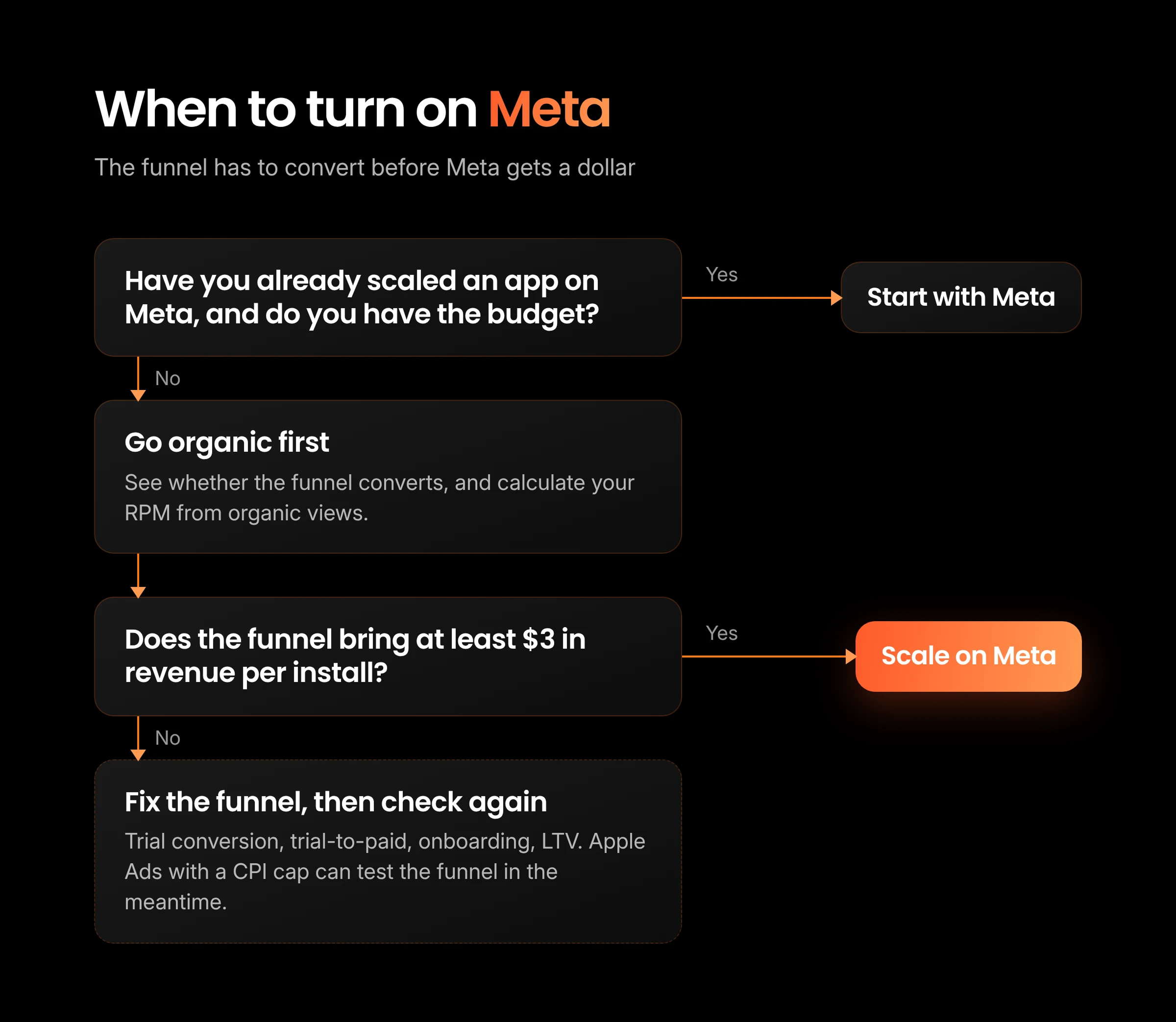
Don’t scale on Meta until the funnel brings in at least $3 of revenue per install. Below that, you won’t find installs cheap enough to pay off, and the users behind cheap installs rarely pay. Check the four numbers under it first: trial conversion, trial-to-paid, onboarding, and LTV. That’s the whole funnel, and it has to convert before Meta sees any of your budget.
“I almost think you need at least $3 in revenue per install before you even start thinking about scaling on Meta. Some people think higher, but getting a cost per install under $3 is gonna be extremely hard, and those users are probably never gonna pay.”
Should you start with organic or Meta ads?
Get the data for that $3 from organic. Post, see whether the funnel converts and how much people want the app, and calculate your RPM from organic views. Then decide on Meta. If you’ve already scaled an app on Meta and have the budget, you can start there. Otherwise, remember that small Meta budgets mislead: CAC swings between peaks and valleys, cash flow gets hard to manage, and it’s hard to tell whether you’re profitable in any durable way. CAC only settles at serious scale, while with organic you can read it from the start.
“I always recommend going organic before Meta ads, unless you’re absolutely cracked and you’ve done it before.”
Apple Ads setup for a new app: Max Conversions with a CPI cap
Use Apple Ads to test the funnel before Meta, and expect only a handful of keywords to pay. Start with this setup:
- a Max Conversions campaign
- a few niche keywords you’ve already researched, on broad match
- a CPI cap at your target cost per acquisition
- a narrow list, repeated until the keywords that convert show up
If influencers are the channel you know best, test there instead. Start with the route you’re strongest in.
“We had one client spending about $70,000 a month on Apple Ads, and on exact match there were maybe three or four keywords besides the brand that worked.”
How to deal with copycat apps
Once an app works, the copies arrive. Cal AI had countless clones. Prayer Lock had 100 copycats and a bigger problem: apps with $50M and $100M in funding copied the content format that had brought it 150M views in three months.
How clone apps send App Store search traffic to the category leader
Let clones advertise the category for you. Every Cal AI clone pushed more people to search for an AI calorie tracker in the App Store, and Cal AI topped that list. With the best onboarding, conversion, and marketing in the category, it collected that traffic for free. Cal AI also had a first-mover advantage, since it popularized photo calorie tracking, and most apps don’t get that.
“They’re bringing the traffic to me, and I know our app is the best. They’re giving us brand awareness for free. Bring it on.”
How to keep creators when copycats offer them double
Keep your creators with culture: daily contact, rewards, and public shout-outs in a group chat whenever someone goes viral. The funded copycats tried to hire Prayer Lock’s creators at double the pay. One creator forwarded a competitor’s pitch, which included Prayer Lock’s exact script, and said he was staying. Not a single creator left.
“He told us, ‘This is David versus Goliath. I’m standing with you guys all the way. You guys have been amazing.’ Not a single creator on our team left.”
How copycats find your creators, and how to hide them
Copycats often find your creators through videos that tag your app on Instagram, and then offer them 30% more. Hide the tags on your best creators’ videos and leave them on the underperformers. The poachers end up paying a premium for creators who don’t convert.
“We’d hide the tags on our best creators’ videos and leave them only on the ones who didn’t perform. It’s a cool way to stick it to the copycats.”
Why distribution is the moat copycats can’t copy
Anyone can copy an onboarding flow, a paywall, and a feature set. Years of experience in one growth channel can’t be copied from a tweet. Get good at something besides building: content that goes viral, organic, Meta, web2app campaigns. You don’t need to master all of them. One channel you know well is enough to beat copycats where it counts.
“Anybody can copy an onboarding, a paywall, and all the features. Can you get good at distribution?”
Are mobile apps dead? Predictions for 2027
Next year you’ll probably hear a lot of “mobile apps are dead.” It won’t be true.
Will mobile apps still make money in 2027?
Look at the App Store and you’ll find apps launched a few months ago already making $100K a month. One is doing $2M a month. More people will make more money in apps, so tune out the doomers.
“More and more people are gonna make more and more money in mobile apps. They’re always going to be around, so ignore the doomers. And why not you?”
Does ASO still matter in 2027?
Keep doing ASO the way it always worked: find keywords with demand, then build the app for them, since building is the easy part now. And start investing in your brand. SaaS looks more exposed than apps, because a founder can rebuild a tool like Calendly with Claude. In apps, the bigger a category gets, the more people go straight to the brand that owns it.
“I’ve always been against branding, but branding becomes important, because as a category grows, people go to Cal AI for calorie tracking and to Calm or Headspace for meditation. So I’m starting to focus a little more on branding now.”
What decides which apps win through 2030
Claude can already handle the production side, video editing included, and consumer markets haven’t changed. Build in health and fitness or any other profitable niche, figure out distribution, and you’ll be fine through 2030.
“Consumers are always gonna be there. As long as you crack distribution, you’ll be fine in 2027, 2028, 2029, 2030.”
To wrap up: a 7-week plan to grow your subscription app
- Pick a motivated niche (health and fitness, quit-anything) where no deep-pocketed brand bids for the same creators.
- Start with the US. If you’re outside it, take a format that works in English and be the first to run it in your language.
- Ship with a hard paywall and a discounted second paywall for people who close it. Put the paywall in onboarding.
- Leave retention, Live Activities, and email alone until distribution works.
- Buy three $100 phones, create 30 TikTok accounts on Outlook aliases, skip the warm-up, and start posting on day two.
- Post up to 60 times a day across formats. When a video breaks out, turn it into a script and repeat it across accounts.
- Kill a format after 100 shots with no hit.
- Calculate your RPM from organic views and sign only creators whose CPM is below it.
- Hold off on Meta until the funnel brings in $3 per install. Test the funnel on organic, or on Apple Ads with Max Conversions and a CPI cap.