





Products fail for familiar reasons: poor execution, bad timing, weak distribution. But a significant share fails for a simpler one: they solve problems that never mattered.
Validation exists to expose that early. It helps teams test whether a problem is real, whether the value is obvious, and whether users are willing to take action before development time is committed.
Web2app funnels offer a fast, low-friction way to do this. They let teams validate product ideas and test specific features through user behavior rather than assumptions.
This article explains how web2app funnels can help with product validation, which metrics provide meaningful signals, how to read early data, when it makes sense to move to development, and how validation insights translate into product roadmap and decisions.
Quick reminder: Why product idea validation comes before building
Teams often move forward without clear answers to a few basic questions: is the problem real, is it a priority, and will users pay? These questions are usually postponed until launch under the assumption that there is nothing to test yet.
In reality, that just increases the size of the bet without confirming it is worth taking.
MVP is already late
MVP is often described as fast and lightweight. But it’s still a product.
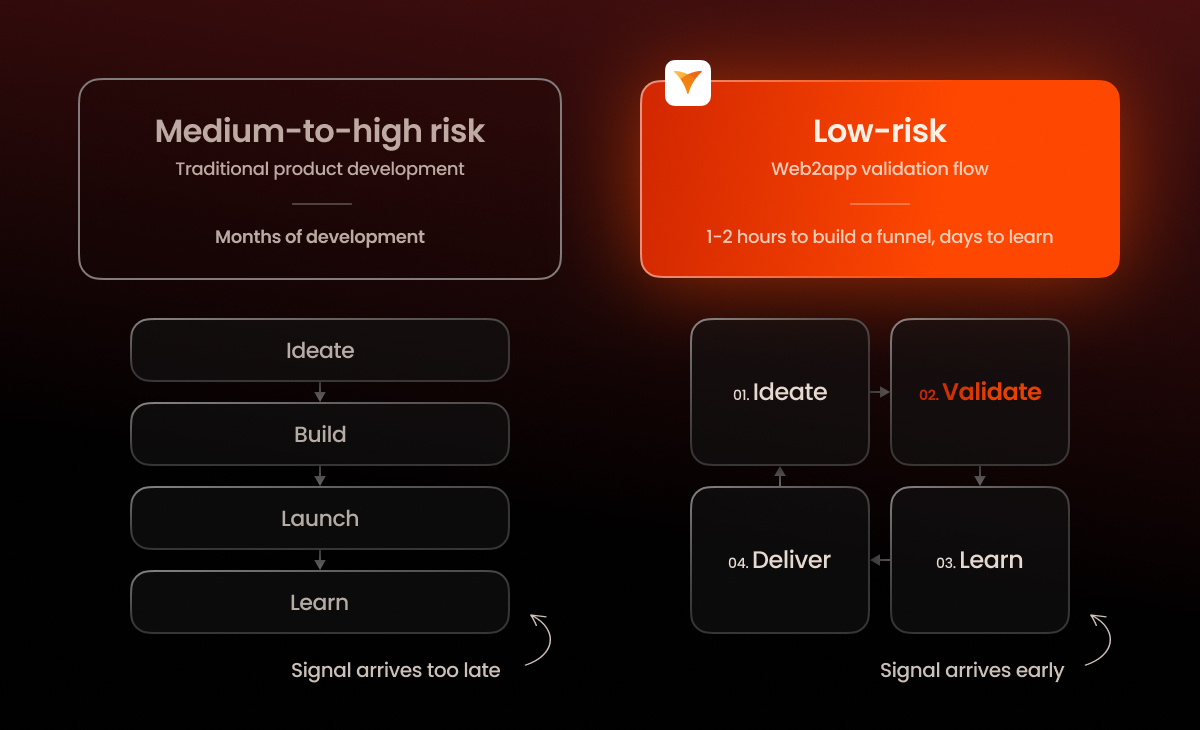
By the time an MVP ships, a long list of decisions is already made: which problem to solve, for whom, in what format, with which UX, onboarding, and monetization flow. If the hypothesis doesn’t hold, the signal arrives after months of work.
This is where inertia sets in. The more effort has been invested, the harder it becomes to step back. Teams start explaining away weak signals, adjusting metrics, blaming the audience, refining features, and protecting past decisions instead of questioning the core assumption.
MVP marks the start of execution, but validation needs to happen earlier.
The real cost of premature development
Money is the most visible loss, but rarely the most damaging one. More often, the real cost shows up as:
- months of engineering time spent on an unproven idea,
- team focus tied up in a product or feature that should not exist,
- decision inertia that allows weak ideas to survive longer than they should.
Every day spent on early-stage product development without validation is a missed opportunity to test multiple directions quickly and focus on the one that shows real demand.
What validation can tell you before you build
Before committing to development, you need proof that an idea is worth building at the level of user behavior. It means you need to understand whether a user is willing to act.
Early validation surfaces the most uncomfortable answers early:
- do users engage with the promise,
- do they understand the value,
- do they make it through the flow,
- and most importantly, do they show payment intent or leave a strong signal of interest?
Validating before you build lets you discard weak ideas early, identify viable ones sooner, and test product or feature concepts without committing to full-scale development.
Where web2app funnels sit in product validation
Web2app funnels enable a single feature or an entire product idea validation without entering a multi-month development cycle.
Traditionally, web2app funnels are used to acquire users and sell subscriptions outside of app stores. They allow teams to avoid app store commissions, gain full control over monetization strategy and user flows, and get clean, transparent attribution data.
In product validation, these funnels serve a different purpose. Here, a web2app flow functions as an experimental environment that allows teams to test the fundamentals: whether the idea is understood, whether the value is clear, and whether users are willing to move through a flow and approach payment.
The best part is that web2app funnels let you test user response without delivering a real product. Because validation does not require a product — it requires a signal.
A click is a signal.
Progressing through onboarding is a signal.
Reaching the paywall is a signal.
Attempting to pay is the strongest signal available.
Sometimes that signal is missing. And that is still a successful outcome. When a hypothesis fails, a funnel makes it possible to close it within days, without sunk-cost pressure, and move on to the next idea.
What you can validate with web2app funnels
A full product idea or a single feature
You can validate not only feature ideas, but full product concepts. And you do not need to build even an MVP to test demand — a funnel already produces enough behavioral data to support a decision.
Willingness to pay
Engagement alone isn’t enough. The only meaningful moment is when a user sees the price and does not close the tab. Even without a real transaction, reaching the paywall or clicking “Continue” already produces a clear sign. This is the boundary between interest and intent.
Price sensitivity
Once payment intent appears, resistance becomes measurable. $9.99, $12.99, and $19.99 represent very different decisions in a user’s head. A validation flow makes it possible to see where value stops outweighing doubt and whether the offer justifies its price.
User segment
The same idea can fail with a broad audience and resonate strongly with a narrow one. Quiz-based onboarding and different entry points make it clear who stays and who drops off, often challenging the original ICP.
Funnels in action: Three examples of how web2app data shaped product decisions
1. Rino validated the audience hypothesis and identified a new core segment
At an early stage, Rino faced a common product challenge: there were users, but it was unclear who they were and why they were using the product. The team had audience hypotheses, but they were largely assumption-based.
The team used web2app funnels for user acquisition and added a single clarifying question to one of their quiz-based onboarding flows. This produced an unexpected but critical signal.
- 35% of users belonged to a segment the team wasn’t targeting at all.
- This segment showed higher conversion rates and stronger engagement.
- After adjusting creatives and messaging, the segment grew to 80% of the total audience.
This wasn’t a marketing tweak but a shift in how the product was understood.
The team started with a simple “what if” thought, and web2app made it possible to test and confirm it quickly. As a result, Rino stopped building for an imagined user and adjusted the product roadmap based on real user behavior.
2. ExploreApps validated a feature idea before development
ExploreApps was trying to find out if there was demand for a specific feature. The typical path would have been to define a feature set, build it, launch, and wait for results.
Instead, the team moved the feature idea into a web2app flow. They built a separate funnel where the feature itself was the core value proposition and observed how users responded.
The signal was clear. Users responded well to this scenario, which gave the team confidence to move forward with development.
As a result, the team stopped spending engineering resources on low-signal ideas and focused on directions that had already shown demand at the validation stage.
3. Shaping product direction based on user response to an idea
In this case, web2app flows were used as a fast detector of viable ideas.
The process was straightforward:
- The team launched multiple creative hypotheses.
- When one creative showed strong performance, they quickly built a web2app flow around it.
- Whey then analyzed user behavior and payment signals.
One experimental creative showed a high CTR. The team built a dedicated funnel around it within a few days. That flow:
- reached up to 5% purchase conversion rate,
- reduced CAC by 30%,
- and, most importantly, showed that this specific narrative and value scenario was worth developing further.
These results gave the team a basis to revisit positioning and shape the next stage of product development.
What matters is that the signal was collected without a fully built product and within a short timeframe. Users moving through different funnels were effectively interacting with different versions of the product. This is live validation of product direction.
Had the team followed the classic path, this idea would likely have stayed in the backlog for a long time or reached the market too late.
How to set up a product validation process
1. Use a funnel builder (for example, FunnelFox)
Fast product validation process is only possible when you can build and launch funnels quickly. Web2app builders like FunnelFox are designed for this purpose. You can set up a funnel without code, designers, and app store submissions. The path from idea to live flow takes hours.
Trying to assemble the same setup manually effectively turns the experiment into an MVP, with all the associated costs.
2. Follow a classic flow structure
Validation funnels typically follow a simple sequence:
- an ad creative with a clear message,
- a landing page that continues that message,
- quiz-based onboarding to segment users,
- a paywall with an offer or a clear CTA.
Each step exists for one reason: to test whether users understand the value and are willing to move closer to payment.
3. Set up analytics with key metrics to track
In product validation, weak metrics are not a failure. They are an answer (that saves you money).
This set is sufficient to identify where the hypothesis breaks:
- CTR. Click-through rate reflects the strength of the promise: do users click on the idea as it’s framed, or do they ignore it? When CTR is low, it usually means the offer does not resonate or the value is too abstract.
- Completion rate (onboarding). This metric shows whether the idea holds up across multiple steps. Large drop-offs in the middle of the flow indicate that the value is either unclear or overestimated.
- Call-to-action click rate. It marks the transition from passive interest to action. A low rate here means users are not ready to take the next step, even if the flow initially appeared convincing.
- Drop-off points. The drop itself matters less than where it happens — on the problem statement, on the solution explanation, on the price? Each drop-off points to a specific question about the hypothesis.
- Email collected or payment intent. An email is a weak but still meaningful signal of interest. Payment intent is much stronger. Plan selection, attempts to proceed to checkout, or clicking “Pay” provide a more honest signal than almost any other metric.
- Time to engagement. Time to the first meaningful action shows how quickly the idea is understood. If users hesitate, reread, or stall, the value is either too complex or poorly framed.
- Paywall CR (even if fake). Even a simulated paywall is useful — it measures if the user is willing to accept the price for the promised value. If not, the issue is either pricing or value, and the funnel makes that visible.
4. Choose UA channels
Go Meta for fast directional signals and Google Search or UAC when testing intent-driven problems. Remember that in product validation process, precise targeting matters more than scale or budget.
5. Run a quick QA before launch
Before going live, run a short QA: verify that events fire correctly, flows have no dead ends, and users understand what to do at each step.
If users get confused, the result is noise rather than signal. And in validation, noise is worse than poor metrics.
When (and how) to move from product idea validation to building
Now that you know how to validate a product idea with web2app funnels, it’s time to learn when to move into development and when to move on to the next hypothesis.
The first thing to accept is that product validation doesn’t provide precise forecasts. It provides direction and signals.
The mistake is to isolate a single metric and declare success. CTR without follow-through means nothing. A paywall without users reaching it also means nothing. Meaning emerges only when metrics form a consistent sequence: the user understands the offer, moves through the flow, and eventually takes a deliberate step.
Another critical point is context. Validation data should be read in relation to the hypothesis and prove — or disprove — a specific idea.
When it makes sense to build: baseline conversion signals
A green light for development comes from a repeatable signal, not a single successful test. In practice, this usually looks like:
- a stable CTR that holds across creative changes,
- a meaningful share of users reaching the end of the flow,
- clear payment intent through paywall clicks, plan selection, or payment attempts,
- a hypothesis that holds across more than just one lucky scenario.
The focus here is consistency. If an idea survives multiple iterations and continues to generate user response, that is a strong signal that it’s worth turning into a product or feature.
When the answer is no: weak signals and early drop-off
Negative signals are usually clear if teams do not try to explain them away. If users consistently drop off on the first screens, and only a small fraction ever reaches pricing with no signs of payment intent, this almost always indicates that the problem is either insignificant, poorly framed, or artificially constructed.
The key mistake to avoid here is trying to force progress through cosmetic changes. Better design does not compensate for the absence of demand. If the signal is weak at the level of the promise, tweaks will not make it stronger.
Validation has delivered its answer, it’s simply not a pleasant one.
How to apply product validation insights to the roadmap and pricing
The greatest value of a validation flow is understanding what to build and how. Insights feed directly into product decisions:
- which features deserve priority and which should be removed from the roadmap,
- which user segment the product is actually being built for,
- which pricing and payment formats create the least resistance,
- where pricing should realistically start.
After validation, products often look different from the original plan: positioning may shift, core use cases change, sometimes even the pricing model evolves. That is expected. Ignoring data after collecting it would be far more irrational.
In an ideal scenario, the validation funnel becomes a blueprint: what users care about, where they hesitate, what they are willing to pay for, and where friction must be avoided.
This is likely the most valuable signal a product team can get before writing a single line of production code.
Wrap-up on product validation with web2app funnels
Product validation itself does not guarantee success. What it does guarantee is early clarity. But it only works if you do your part: read the signals correctly and act on them:
- If an idea survives several iterations and produces a stable signal, it makes sense to turn it into a product or a feature.
- If it does not, it should be closed without protecting invested resources, and the team should move on.
Web2app funnels make validation possible at speed, and that speed matters. In mobile, fast experimentation is the foundation of growth and finding the right direction sooner rather than later.
Ready to experiment for growth? Build your first no-code validation funnel in under an hour with FunnelFox.