





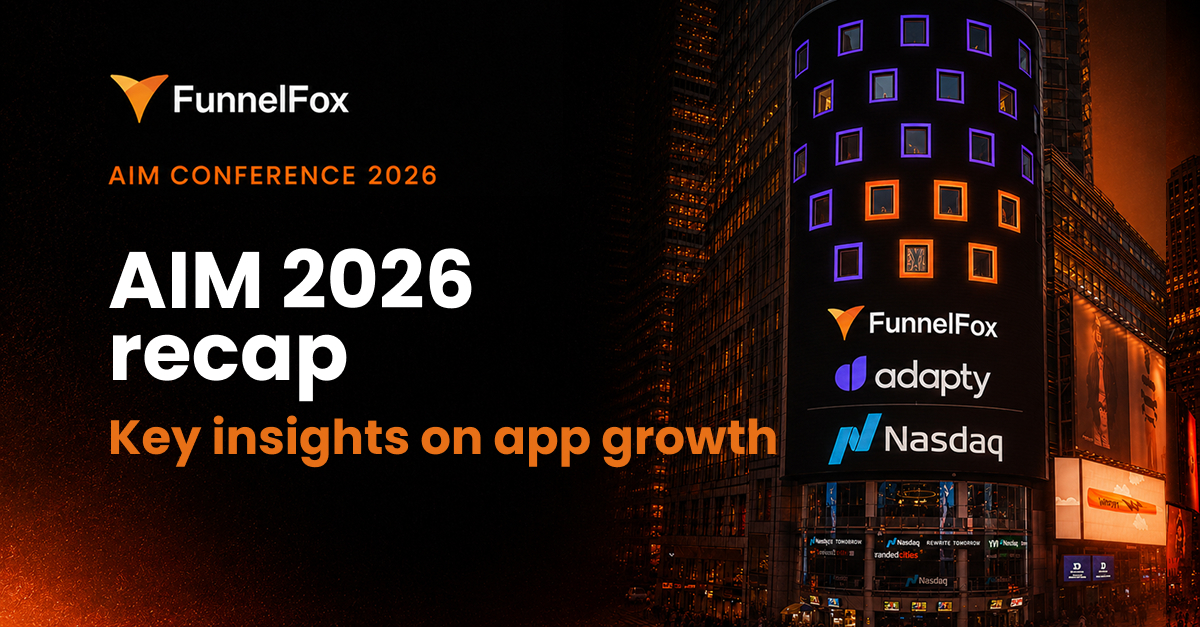
FunnelFox and Adapty brought together 150+ app leaders — founders, CMOs, and CPOs from Flo, Simple, WeWard, Cal AI, TikTok, Paddle, and others — for a full day of conversations about where mobile subscription growth is heading. Below is a breakdown of the key insights from the event.
The full session recordings are available here.
Why everyone is moving to web2app and what it actually takes to make it work
82% of top-grossing apps now use web2app funnels. Web users generate almost 2x the LTV of users who convert purely in-app.
The shift makes sense. Web funnels give teams control over pricing, onboarding, customer relationships, and conversion flows. They also make it easier to test messaging and tailor the experience before users ever reach the app.
But launching a web funnel isn’t the same as making it work. The most common failure pattern is driving traffic into overcomplicated flows with too much friction and prices not calibrated for a web audience.
Web isn’t another landing page — it’s a conversation
What separates apps that scale web2app profitably from those that struggle is how they think about the funnel. The ones doing it well don’t treat the web as just another place to put a paywall.
The brands that are doing it best don’t just land you on a page with pricing information that emulates the paywall. They give you a full experience — thinking multi-touch, what’s the brand story I can tell so people get to know us. That’s where you’ll see higher conversion.

In the App Store, you have seconds. On the web, you have a full conversation — space to explain value, address objections, educate. I’m working with a postnatal fitness app targeted at women who’ve just given birth. The key job of their web funnel isn’t to show features — it’s to provide reassurance: we know your body is different right now, we’re not going to throw you into insane workouts, we’ll do this properly. When the funnel didn’t communicate this clearly, conversion suffered. And it’s not just about getting users to pay — it’s about setting the right expectations so that when they open the app for the first time, the experience matches what the funnel promised.
The web-to-app handoff
That continuity between web and app is also where deferred deep linking becomes a real advantage:
A lot of MMPs recognize your website as an owned property connected to your app. Apple then allows deferred deep linking even without ATT permissions, so you can connect the web experience directly to what the user sees inside the app.
If a user goes through a web funnel for a fitness app and selects improved mobility as their goal, you can deep link them straight into a mobility program the moment they open the app without asking them to repeat any choices, without a generic empty home screen. The entire journey from ad to first session inside the product is one continuous flow.
AI is making web2app accessible to everyone
Building a web funnel used to take weeks — designer, copywriter, developer, growth strategist, and after all that, you’d sometimes launch something that simply didn’t convert. Now, the teams I work with are throwing up funnels for clients within hours.
FunnelFox agentic AI generates funnels with the structures and patterns that work in your category — not a generic template, but a starting point built on what converts in your specific market. From there, you can edit entire screens with simple prompts, generate variants, localize flows instantly, or rebuild something from a reference using your own branding and copy.
But speed to market isn’t the same as strategy:
You still need a strategic lens on top of it — someone looking over and saying: does this make sense for my brand and for my users? Don’t just take something that someone else did. Do you have historical data you can feed in? The AI is going to be smarter the more it knows about what does or does not work for your brand.
Top-grossing web2app apps aren’t running a handful of funnels — they’re running hundreds, each calibrated to a different user segment, traffic source, or creative angle.
There’s a clear correlation between the number of unique funnels a team runs and their revenue. Web2app unlocks personalization that’s impossible through the App Store. Different personas, segments, entry points — each gets its own funnel.

Web specialists have been doing this kind of personalization for years. App teams are only now catching up — partly because iOS privacy changes made in-app personalization harder, and partly because AI has made building and maintaining hundreds of variants feasible.
Why getting users in is only half the job
Scaling web2app funnels and driving installs is only part of the picture. What happens after the click — how teams attract the right users, activate them, and keep them — is where most of the work actually lives.
Creative that converts, not just clicks
Creative fatigue in acquisition is accelerating. The old model — find a few winning ads, scale them for months — is breaking down. Some brands are now testing more than 1,000 creatives per month; the highest-volume teams reach 15,000. But producing more assets isn’t enough on its own.
You need to diversify your creative by understanding who your audience is. If you’re creating for TikTok, that same asset won’t work on Meta or YouTube.

The same logic applies across funnel stages. Awareness creative and conversion creative serve different jobs. Treating them interchangeably typically produces neither. And creative performance needs to be tied to MMP and subscription data, not evaluated through clicks or installs alone.
If you’re getting high impressions or high installs, but people aren’t following through and converting, then those creatives are not working for the brand.
Only a small percentage of creatives drive meaningful business results: 20% of creatives convert, only 5% generate meaningful revenue, and 3% generate most of the profits. The goal of testing isn’t to make every asset a winner but to build systems that repeatedly produce them.
Retention has to be engineered
Getting the right users in is necessary, but the work doesn’t stop there. You can’t drop users into a product and expect them to build a habit on their own. What building that habit system looks like in practice:
- Onboarding milestones. Acknowledge when a user does something for the first time. Reinforce that they’re on the right track, especially for habit-forming products like language learning or health and wellness.
- Behavioral triggers. Identify when and in what context users are most likely to engage, and reach them at that moment. For The Economist, that’s the commute: you’ve probably got a bit of time right now, here’s a topic we think you’ll love.
- Repeat usage loops. Don’t just focus on getting users to do something once or twice. Actively monitor who’s dropping out of the engagement funnel and follow up over time.
The right retention loops can generate 3x higher retention within one year. But what’s more important is that usually translates into 10x higher LTV — because the loops can be daily, weekly, monthly, even yearly, and within that time you are constantly bringing the user back.

Push, email, and social keep users informed about what’s happening in the app, remind them when they haven’t opened it in a while, and surface value in the context of their day. Duolingo’s home screen widget is a useful example: it updates throughout the day based on whether you’ve used the app, functioning as a persistent contextual reminder. It’s a retention lever that most apps still don’t use.
The economics reinforce the case. Retaining an existing user costs less than acquiring a new one, and in some cases, winning back a churned user is cheaper than new acquisition. With acquisition costs rising and competition increasing, this is only going to become more important.
Why AI app monetization is harder than it looks
AI apps have a real advantage at the top of the funnel — they get installs faster than traditional apps and often show stronger LTV upfront. The problem shows up later: retention for AI apps is typically not great. And pricing decisions that seem straightforward turn out to have more moving parts than expected.
The hard paywall trap
The first thing I see publishers doing that makes retention worse is hard paywalling everything. The reason is understandable — AI apps carry infrastructure costs that traditional apps never had to think about. Every user prompt has a GPU cost on the publisher’s side. Engagement, which used to be essentially free, now has a price tag. In many cases, your most active users are your least profitable. So, publishers lock everything behind a paywall and kill conversion in the process, because users never get to try the UX or see if it solves their problem.
The smarter approach is to think about which actions actually cost money and which don’t. A short text prompt is cheap. Exporting an edited video is not. Give users access to learning-based actions for free — one simple prompt, one music generation they can sample — and put outcome-based actions behind the paywall. Let people experience the value before asking them to pay for it.
Credit limits that don’t match user behavior
The second issue is credit limits that are too restrictive. If a subscription gives users 200 credits a day, but editing a video costs 70-80 credits per edit — and a user realistically needs more than 3-4 edits to land on a meaningful outcome — the math doesn’t work for normal usage. Credits have to be designed around how people behave, not around what’s cheapest to offer.
On the cost side, there are a few levers worth knowing about:
When it’s something new, people don’t know it, and that’s where the cost starts to go up, as they’re trying to figure it out, asking long questions. A prompt bank — a library of structured prompts that helps users get to a result faster — can lower costs while still delivering value.
Two others: recycling outputs so you’re not regenerating the same prompts repeatedly, and routing different actions to cheaper models where quality difference doesn’t matter. There’s also a creative angle to demonstrating value without triggering costs — using an avatar in onboarding to show a before-and-after instead of running the AI on the user’s own content. The user sees what the product can do without the publisher paying for a full generation.
Finding the right trial length
Pricing decisions don’t end with the paywall. Most teams default to a 3-day trial — the logic is usually about acquisition data, shorter trials give faster feedback loops. But for most habit-forming products, 3 days isn’t enough time to activate. In a fitness app, you’ll get one workout out of a user in that window. One workout is not enough for someone to think: this is working, I need to keep going.
7 days wasn’t enough either — if there’s a weekend, you just forget about it. With 30 days, you have a month. Eventually you find the time, you commute, you read some content, you love it, and that’s when you create the habit. It was also a big retention driver for us.
The trial vs. hard paywall question also depends on whether users can assess value without trying the product. A fitness app can show transformation imagery, projected outcomes, a clear before-and-after. Editorial content can’t — you have to read the articles to know if they’re worth paying for. For The Economist, even as a major brand, a hard paywall didn’t convert.
Urgency framing is a separate lever. When testing “50% off” against a message tied to a specific end date, the deadline consistently wins:
If there’s a sale but no urgency, users have no idea when it ends. They think: I’ll come back later, let me browse other apps. Versus: this ends tomorrow. There’s a clock. I need to subscribe right now.
There’s also a trust dimension. Many apps run fake urgency — strikethroughs on prices that are always there, 60% off that appears the moment someone declines the first paywall. A real deadline with specific dates signals the offer is genuine, and that alone can move conversion.
The free trial vs. hard paywall decision also has a third option worth testing: a $0.99 introductory offer. Free trials maximize top-of-funnel volume but can produce shallow cohorts. Hard paywalls produce smaller but more committed cohorts. The $0.99 intro often hits the sweet spot between the two.
People take it like a free trial, but they’re more serious about it. They use the product, which habituates them, and then they stick around. Free trial always has the highest number of starters, but that 99 cents trial-to-conversion rate is usually higher.
The bottom line: Three things worth taking away
- Creative testing, web2app, and AI are no longer experiments — they’re table stakes. The gap between teams that treat them as one-off tests and those that have built them into permanent systems is already showing up in revenue.
- Pricing is a product decision. Trial length, AI feature gating, regional localization — how you price shapes how users discover value, build habits, and decide to stay. It deserves the same rigor as any core product decision.
- The biggest underinvestment most teams are making right now is in what happens after the install. Getting users in is only half the job. The real multiplier is in activation, habit formation, and retention, and most apps still don’t have a proper system for it.
In the end, acquisition gets you in the game. Everything else — the funnel, the trial, the onboarding, the habit — is what actually wins it.