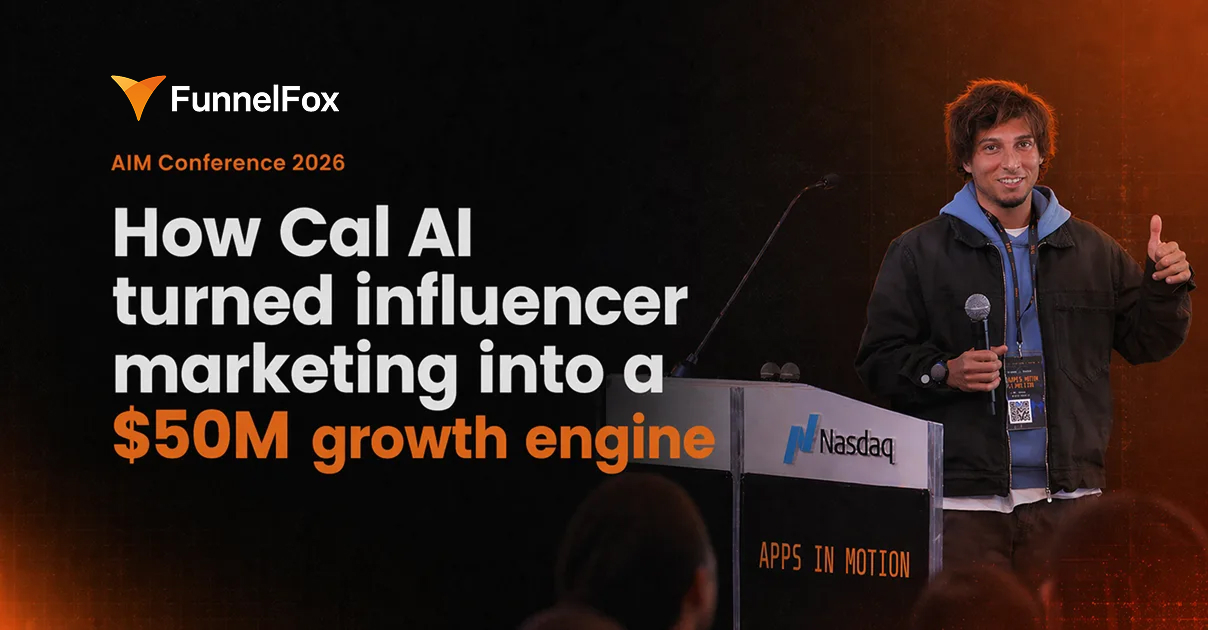





This post is based on a talk at Apps in Motion, a conference on mobile app growth hosted by FunnelFox and Adapty at Nasdaq HQ, New York. Watch the full session.
Across Plurio AI’s dataset, 80% of paid creatives never generate a single sign-up. Another 15% generate sign-ups but no meaningful revenue. Only 2–3% generate real profit. And that ratio is getting worse, not better, because AI has made it cheap to produce more of everything.
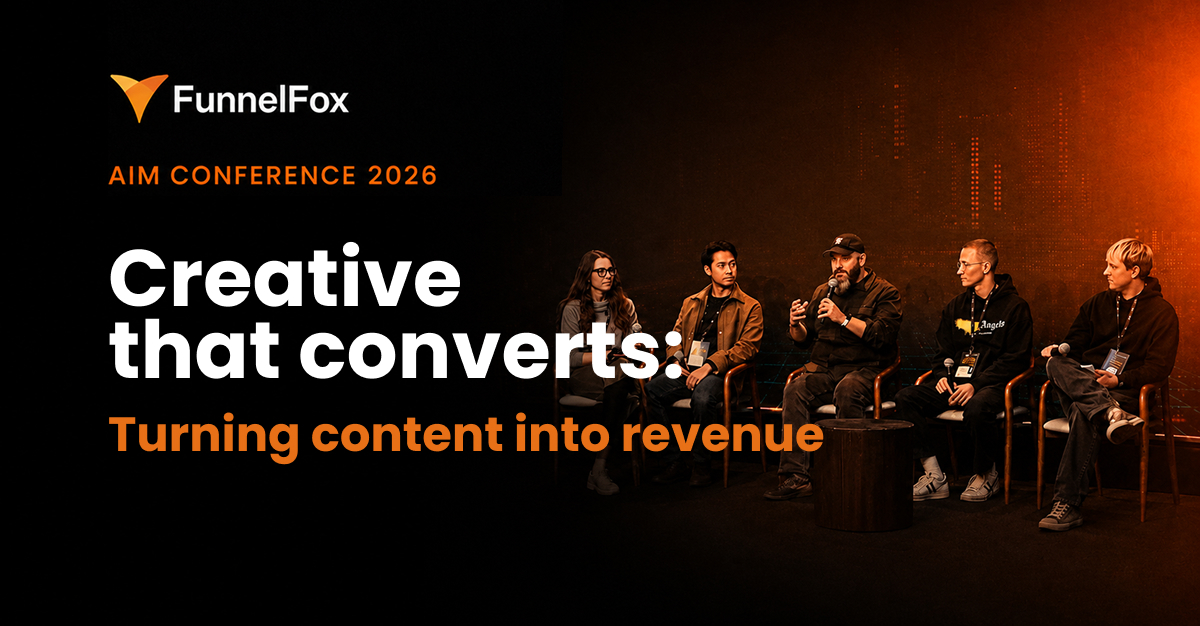
That was the backdrop for the closing panel at AIM Conference 2026, organized by FunnelFox and Adapty in New York.
Moderated by Nicole Weiss (Brass Finch, ex-Audible and Macy’s), the panel brought together four practitioners:
- Daniel Lee sees what works at scale across thousands of apps as Director of Tech & Apps at TikTok
- Seva Ustinov, Founder of Plurio AI, runs the autonomous agents now managing $100M+ in annual ad spend for performance marketers
- Ivan Semin is CMO of Simple—a $160M ARR weight loss app—and owns its performance marketing end to end
- Barry Hott, co-owner of creative agency Adcrate and founder of Havaclus, has spent over a billion dollars on paid ads since 2008 and is known for making “ugly ads” that convert.
The discussion that followed covered the polish-vs.-scrappy debate, the real numbers behind creative success rates, how AI is changing the production loop, and where human judgment still wins. Here’s what stuck.
The polish-vs.-scrappy debate is over
Lo-fi wins. Across categories, polished creative is being out-converted by content that looks and feels like the platform it runs on. Seva had the cleanest data point in the room: he had run the comparison live, 30 minutes before the panel started, by pointing his agent at his clients’ accounts.
That said, “lo-fi” is not the same as “ugly.” Daniel was careful to separate the two:
And Barry, who has been making the case for “ugly ads” for years, clarified what he actually means by it.
Authenticity, and how to manufacture it
At Simple, the breakthrough came from a sourcing decision rather than a stylistic one. The team stopped writing ad copy and started lifting it directly from real users.
Ivan’s most striking example came later in the panel: one user delivered a single phrase “This app changed my life” that ran in their hooks for three years. The body of the ad changed underneath. The hook didn’t need to.
The 80/20 rule is actually more like 98/2
Nicole opened the section by quoting a sobering stat: roughly 80% of paid creative doesn’t convert. Seva’s response, drawn from across Plurio’s dataset, was that the real picture is worse:
| Creative outcome | % of creatives |
|---|---|
| Never generate a single sign-up | ~80% |
| Generate sign-ups but no meaningful revenue | ~15% |
| Generate revenue but not significant profit | ~2.5% |
| High-revenue, high-profit creatives | ~2–3% |
At Simple, Ivan has solved this at the strategy layer, by sizing the production mix around the success rate they actually observe.
The Simple production mix
Ivan described how his team at Simple splits creative production across three buckets:
- About 70% reworks of existing top performers: the easiest path, since you’re copying what already worked.
- A slice of market adaptations: taking ideas from competitors and adjusting them to fit the product. Success rate drops here, because the ideas are further from what’s already worked for Simple.
- A smaller bucket of net-new R&D ideas: completely new concepts, with the lowest success rate of the three.
The reason for not relying on just the first two buckets:
Stop the scroll, then know who you’re stopping
Daniel made the strongest case for working backwards from the audience. With targeting handled by the algorithm, the burden of identifying the right viewer falls on the creative itself.
He also flagged that conversion rarely happens on the first exposure:
Barry’s principle for the opening seconds of a creative:
Where AI is actually changing creative work
Daniel proposed a useful breakdown of how teams are using AI in production today, sorted by maturity:
| Bucket | What it does | Required skill |
|---|---|---|
| Optimization | Resolution, background cleanup, brightening | Low—anyone on the team |
| Lightweight generation | Soundtrack swaps, image replacement, resizes | Moderate |
| Net-new generation | Generating a video from a website or image | Higher, but improving fast |
At Simple, Ivan has been blunt about what worked and what didn’t. The team initially expected current models to analyze performance, generate concepts, and write scripts end-to-end. That didn’t pan out, at least not yet.
Plurio sits on the other side of that line, building the agent layer itself. For Seva, the real value of AI agents is in replacing manual work, not speeding it up:
Detecting creative fatigue: a four-level playbook
Creative fatigue is real, but it’s not always terminal. Seva walked through how to detect it properly: separating optimization of a specific ad from optimization of the creative lifecycle.
Level 1: compare CPM, CTR, and cost-per-microconversion against 3-day and 7-day moving averages. The easiest signal, and a fine place to start.
Level 2: when conversions are delayed (trials, leads), a creative can show fatigue signals while still being profitable. Calculate expected value, not just headline metrics.
Level 3: point an agent at 6+ months of data across hundreds or thousands of creatives. Find which combinations of signals actually forecast a true burnout vs. a minor dip.
Level 4: ML models do the prediction work, distinguishing real burnout from noise, and quantifying the cost of acting too early.
Seva also flagged a counterintuitive note: your best creatives can be relaunched up to 30 times and keep working—sometimes with new targeting, sometimes with the same.
The Meta side: let the system do its job
Barry made the case for a less interventionist approach to media buying. With Meta’s machine learning now doing most of the targeting and pacing, the role of the buyer shifts to setup, not micromanagement.
Barry also raised a structural point about platform incentives:
Generative AI vs. real people: the next five years
The session’s most contested question came from the audience—Jeannie, from Omnicom Media Group, leading analytics for the L’Oréal portfolio. Her question: will big brands like L’Oréal or Coca-Cola actually replace real models with AI-generated content in the next five years?
The panel split.
Ivan offered a generational data point that surprised the room. One of Simple’s static images featured people with unusually large fruit. Younger audiences immediately flagged it as AI and disengaged. Audiences 60+ responded sincerely: “Oh, wow, such a huge banana.”
Barry’s view is that the tech is already here, and humans will keep wanting human content even so:
And on the consumer pushback to AI content, the cyclical view from Nicole:
Tools the panel actually uses
Asked which tools they reach for, the panel was specific:
- Video generation: Seedance 2.0 (ByteDance) was the model with the most votes. Daniel called it “way better” than Sora. Ivan’s team has shifted to Seedance for that reason. Sora 2 and Veo 3 are also in the rotation.
- Editing: CapCut for everyday work; Google Flow (which packages Nano Banana and Veo) for more ambitious pieces.
- Platform-native: TikTok’s Symphony is starting to use Seedance technology under the hood.
- Analysis (not generation): Gemini for video analysis. For analytics work, Seva uses both Claude Opus 4.6 and GPT-5.4, and rotates between them “twice a month, maybe twice a week.”
The one principle each panelist takes with them
Asked for the single creative principle that has mattered most to their results, the panel landed on the following answers:
Daniel: the three-part test. Do you know who you’re speaking to? Are you solving their pain or need? Are you actually entertaining and authentic? Pass all three and you have a recipe that works.
Nicole: humanize. Especially for apps. It’s not about the product, it’s about the human component. What’s the emotion that relates to the problem you’re solving?
Barry: relevance, with discipline. Hyper-relevance kills reach. Find the broader threads that relate to multifaceted people, and obsess over the first frame, the first word.
Ivan: work with your most emotional user. Pick one. Listen to how they describe the change in their life. That phrase is your hook, and it may carry you for years.
Seva: AI actually changed the work this time. After three years of “AI is the future” panels, this is the first one where it’s true at the execution layer. Send your agents to do the work. Go try it.
The bottom line
Platforms have absorbed most of the targeting and pacing decisions, so creative is doing more of the work. Lo-fi beats polish across nearly every category, as long as “lo-fi” means native to the platform and not careless. Authenticity is what’s converting, and the most reliable source of it comes from your users’ actual words rather than your brand voice.
The 80/20 rule for creative performance is closer to 98/2, which means the production mix has to be designed around the math: mostly reworks, some market adaptation, a smaller R&D bet. AI has compressed the production cycle from days to hours, which means whatever advantage you build is also faster to copy. Fatigue detection, creative selection, and account management are all moving from manual to agent-run.
In 2026, the work of the marketer is shifting upstream: less time in dashboards, more time talking to users, building the system that selects winners, and deciding what to actually say. Execution moves to agents, while judgment stays with people.
This article is part of our coverage of AIM Conference 2026 organized by FunnelFox and Adapty.
Learn more on web2app funnels, paid UA strategy, and subscription growth on FunnelFox blog.