





Dating apps are one of the strongest monetizers among consumer subscription products. They also have one of the most tired user bases: people complain about endless swiping, paywalls at every turn, and matches that never turn into a conversation.
To understand what still works in this category, FunnelFox hosted a roundtable with three people who have seen it from different sides:
- Ravi Mehta, former Chief Product Officer at Tinder, now a product strategy advisor and investor
- Shawn Gong, who led monetization at Tinder and international expansion and monetization growth at Grindr
- May Ku, founder of Reev, a voice-first dating app that launched in Sydney in February 2026
Below are the main takeaways: why the category stalled, how to grow a product whose best outcome is a user who leaves, when and how to charge, what makes a dating paywall convert, and where the market is heading.
Why are users tired of dating apps?
The category’s strength became its trap. Dating monetizes so well that the major companies are locked into protecting their current ARPU. Any experiment that might cannibalize revenue looks like a risk, and for public companies, a risk to the stock price. So the core experience barely changes.
“If you look at Facebook today versus Facebook in 2017–2018, it’s a fundamentally different experience. If you look at Tinder today versus what it was in 2018–2019, it’s very similar.”

Users, meanwhile, have changed. Millennials adopted tech on tech’s terms: the product pushed them down its own funnels. Millennials and Gen Z now use tech on their own terms and look for products that fit what they want to do. In dating, that means meeting someone they can actually connect with, past six photos, a swipe, and a blank chat.
The signs of dating app fatigue were there years ago. In 2019–2020, Tinder was already hearing that people were exhausted by swiping and hookup culture. Around 30–40% of Tinder users listed a long-term relationship in their profile.
The photo decides everything
On most dating apps, the first photo drives the decision. At Tinder, the same person got completely different results just by changing the first photo. Tinder built Smart Photos around this: the feature moves the photo most likely to get likes to the front, and it lifted matches by up to 20%.
“Most dating apps are like a bookstore that only shows the covers. A voice-first app lets you read the first chapter. The hard part is that we are visual creatures, so we’ll see.”

The voice-first answer
Reev is one of a growing number of voice-first concepts built around this problem. As a long-time dating app user, May Ku found herself focusing on appearance because that is how the products were designed, while what actually made her interested in someone was the interaction.
“When there is a photo, it’s really hard to look beyond it. So I just had to remove it.”

Reev moves people toward an in-person date step by step:
- A live five-minute voice chat, with no photos and no profile information
- If both people want to connect, a longer voice chat
- A video chat
- A decision on whether to meet in person
- Exchanging contact details
How does a dating app grow when success means users leave?
Hinge says it openly: the app is designed to be deleted. That raises the obvious question of how a subscription business can retain users when its goal is to get them to leave.
The answer starts with why people actually leave. Tinder’s exit survey showed two very different kinds of churn:
- Good churn. About a third of users leave because they started a relationship. That doesn’t mean they are gone for good: they may come back later.
- Bad churn. About two-thirds leave for other reasons: they burned out, decided to take a break from dating, felt the app wasn’t working for them, or moved to a different app.
Bad churn is the bigger group, and there are more than enough of those users to build on. Solving it alone could double or triple the size of the business.
Inside Tinder, the team used a thought experiment: imagine an app where you tap once and meet the person you’ll spend the rest of your life with. That would be a trillion-dollar business. So there is no reason to build anything that slows people down on the way to meeting someone.
The opposite approach is a dark pattern: keep people from forming relationships so they stay subscribed.
“If you pull that dark pattern too far, one, it’s not the right thing to do for users, and two, it actually causes your network to collapse.”
A clear use case makes good churn safe
What helps is clarity about the use case the app serves. Hinge serves “designed to be deleted.” Tinder serves “Single, not sorry”: the decade from roughly 20 to 30 when people aren’t looking for a long-term relationship, date, and come back to meet someone new. If the app serves that period well, users stay long enough for a good lifetime value, and the team doesn’t need to over-optimize retention.
“Let’s focus on bad churn and not worry about the good churn. If someone meets the love of their life on Tinder, that’s a success, even if they go away as a customer.”
Good churn also pays back through word of mouth. People who met their spouse on an app tell their friends, and a surprisingly large number of marriages in the US started on Tinder, an app most people still see as short-term.
When should a dating app start charging?
In dating, the network is part of the product. Reev started monetizing at launch, and that turned out to be premature: with a small user pool, paid features hurt the experience instead of improving it.
“Starting to charge when the pool was too small really backfired on the user experience. As a dating app, we need a bigger pool, because the network itself is part of the product.”
What to charge for matters too. If an app charges for the outcome, a match or a relationship, people end up paying to leave. In user interviews at Reev, people enjoyed the live conversations even when they didn’t get a match. So Reev’s focus is on the experience itself, with monetization built around deepening it.
The usual startup advice is to charge early to prove that people will pay. Dating is an exception: willingness to pay is already proven across the category, and the monetization playbook is well known.
“In the dating market, you don’t have to find product-market fit around monetization. If you get enough people onto the platform who enjoy connecting with each other, it is absolutely monetizable, and you can get to really good ARPU.”
So the priority is getting the network and the core mechanics working. Free users are part of that. They may never pay, but they are the people paying users come to see.
“Some bars don’t have the best food, but they have the most people, so people go there. That’s why Grindr is still the biggest app in its space.”
How many paywalls is too many?
Every paywall is a wall. When users hit one on every path they try, they stop walking.
When Shawn Gong joined Grindr, many features were paid, including filters, and users ran into a paywall almost everywhere they went. They complained loudly. The data showed that many of those features had very low conversion rates, and users admitted the real reason they subscribed: to see more profiles.
Grindr tested making the low-converting features free. Revenue went up, and so did retention, because users were happier.
Dating is also a daily habit. When users feel limited at every step, the habit breaks.
“Ask yourself how many customers actually pay because of this feature, and what it costs you when people stop using it.”
How does what you charge for change the way people date?
Paywalls also shape behavior. When the filters people care about most are paid and minor ones like height and weight are free, users narrow their search with what’s available. As a result, men lie about their height.
At Tinder, paid features were built around matching. Many users bought a subscription for a short period, swiped as much as they could, and stopped. That built the wrong habit: people focused on swiping instead of talking, collected lots of matches, and never continued the conversation.
“How you charge really changes the behavior and the outcome.”
How should dating apps package features and plans?
Dating users rarely plan to stay long, and many need certain features only at specific moments. Two cases from Tinder show how to sell to them without eroding the core subscription.
Selling one feature separately: the Tinder Passport case
Tinder Passport lets users swipe in any city, not only where they are. It serves a moment in someone’s life: “I’m going to Paris next month, and I want to line up dates before I land.” Most people don’t need it all the time, so keeping it inside a subscription didn’t make sense for everyone.
Tinder tested selling Passport à la carte. It was overwhelmingly popular, and it hurt subscriptions: some users had been subscribing only because there was no other way to get the feature.
Two changes fixed that:
- A decoy price. A 7-day Passport cost the same as a 7-day Tinder Plus subscription, which includes Passport. Side by side, the subscription was the obvious choice, and it became more popular.
- Targeted visibility. Some cancellations remained, so Tinder used AI to decide who sees the à la carte option. Users likely to subscribe never saw it. Only those who weren’t interested in a subscription were offered the single feature.
“That way, we could maximize conversion and protect our subscription.”
Weekly or annual plans?
From a user’s point of view, a long subscription to a dating app makes little sense. Many users don’t want to stay on a dating app for more than a month. When Tinder launched a weekly plan, it became one of the most popular products, especially among younger women.
The cost is long-term revenue. Users on an annual plan are more likely to stay. Users on a weekly plan decide whether to renew every week. Two levers balance this:
- Price the weekly plan much higher than the annual one.
- Make the annual plan the default and give it a heavy discount.
“You can buy a carton of cigarettes, or you can just buy a pack. Nobody buys the cartons, even though they’re much cheaper, because everyone thinks they’re going to quit after the next pack. Everyone feels like next week or next month, they’re going to meet that person. Why would they need six months?”
This is also an area open for innovation. A six-month plan that users will never buy, shown only to frame the price, is a distraction.
“People are wise to that. They know what you’re doing. Provide options that actually make sense for them.”
What makes a dating app paywall convert? A Happn and Salams teardown
For the live teardown, we pulled dating app funnels from FunnelFox Market Radar, our tool for tracking which niches and brands are advertising on Meta. The creatives we picked had been live for at least a month, which suggests they perform.
Happn: the ad and the paywall make the same promise
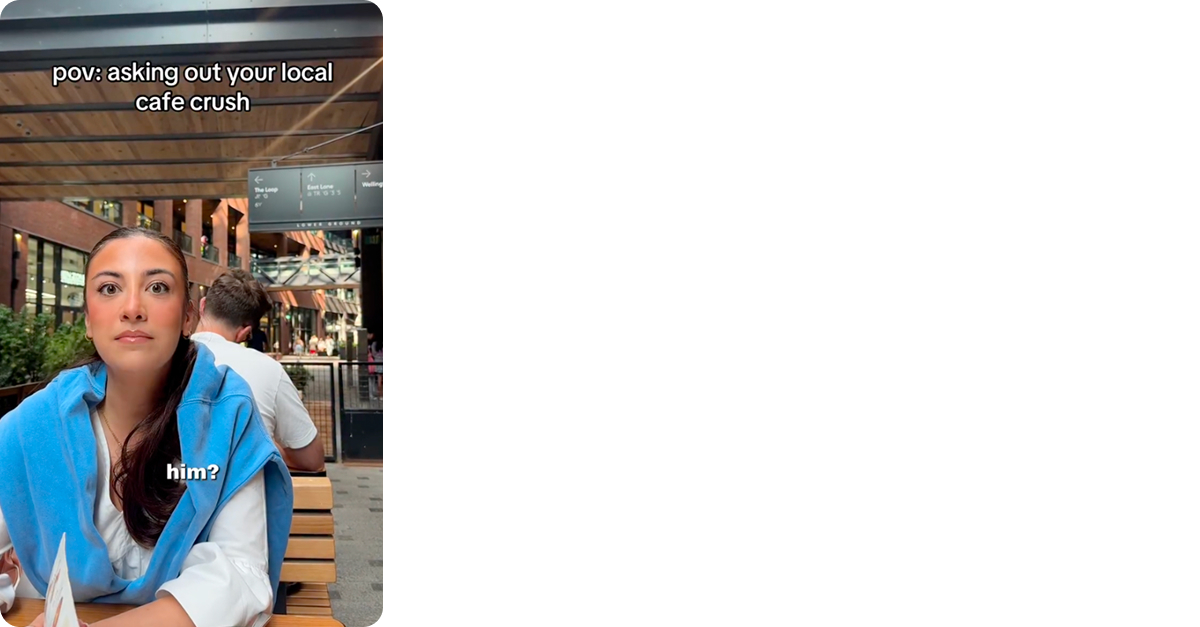
The Happn creative is a UGC skit: two friends spot a guy they like, hesitate, and miss their chance when he leaves. The fix is Happn, the app that shows you people you cross paths with every day.
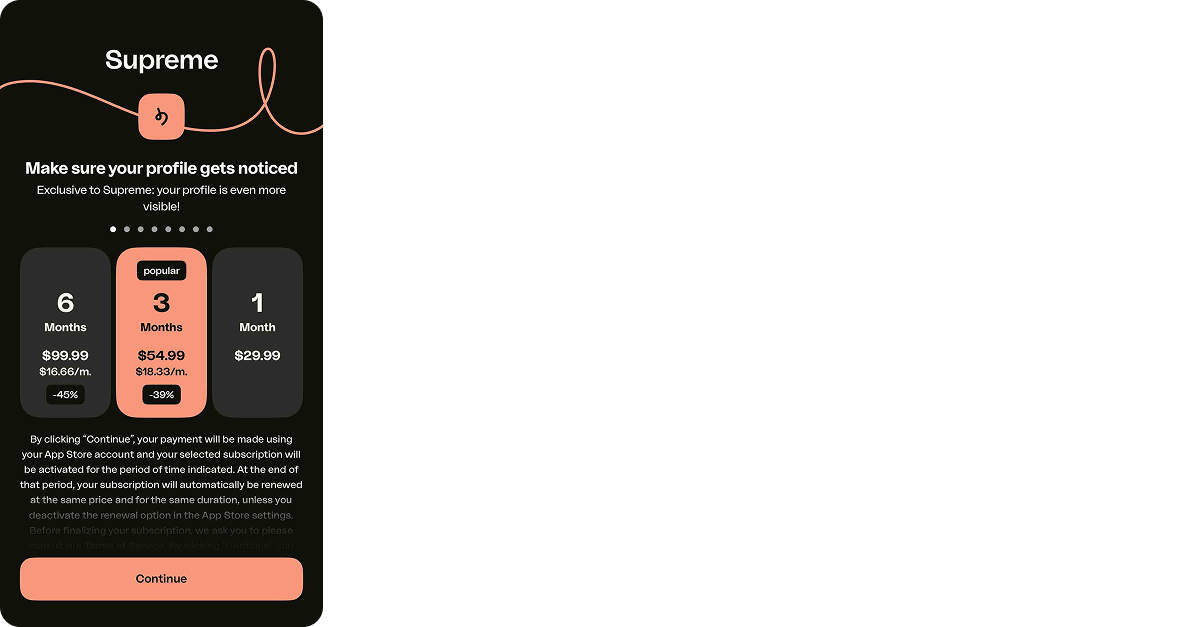
The paywall opens with “make sure your profile gets noticed,” picking up exactly where the ad left off.
“The marketing promise should be aligned with the product promise. Many companies get this wrong. Happn gets it right.”
What works:
- The CTA says Continue instead of Buy. “Buy” feels painful. “Continue” feels like the next step on a path the user already likes.
- The most expensive plan is on the left. When plans run from cheapest to most expensive, everything feels expensive. In the reverse order, everything feels cheaper.
- One plan is highlighted as the default. It makes the decision easier.
- The design is restrained. The screen keeps attention on the central card.
What to fix:
- Replace the “popular” tag with a benefit. Users know the tag is there to push them toward a choice, and other people’s purchases don’t give them value. A line like “3x more likely to match” does. Tinder saw this with Boost: the “popular” label converted okay, while “get up to 3x more views” resonated.
- Drop the carousel. The dots above the card signal a horizontal slider that maybe 5% of users, or fewer, ever swipe. Multi-screen paywalls get very low view rates, and users don’t compare the screens anyway. Lift anything important onto the main screen and remove the rest.
- Cut the legal clutter. A crowded disclaimer, especially in legal language, makes people anxious and gives them a reason to hesitate.
“Users don’t buy features. They care about benefits.”
“Don’t put anything on the screen that doesn’t need to be there. It makes the whole experience feel overwhelming, and what we want to do right now is engineer confidence.”
Small details can matter here. Adding a caret or a right arrow to the CTA gives the button a sense of momentum. At TripAdvisor, a change like that was a win in the double-digit millions, on a billion-dollar base. Other small changes will have no impact at all, so they need testing.
Two quick checks help before testing:
- The blurry eye test. Squint at the paywall. How does the page feel when you can’t see it clearly?
- The driving test. Imagine every user is looking at the screen while driving, glancing down and back at the road. The paywall has to work as a “system one” interface: clear at a glance, with an obvious way forward.
Salams: commonality sells
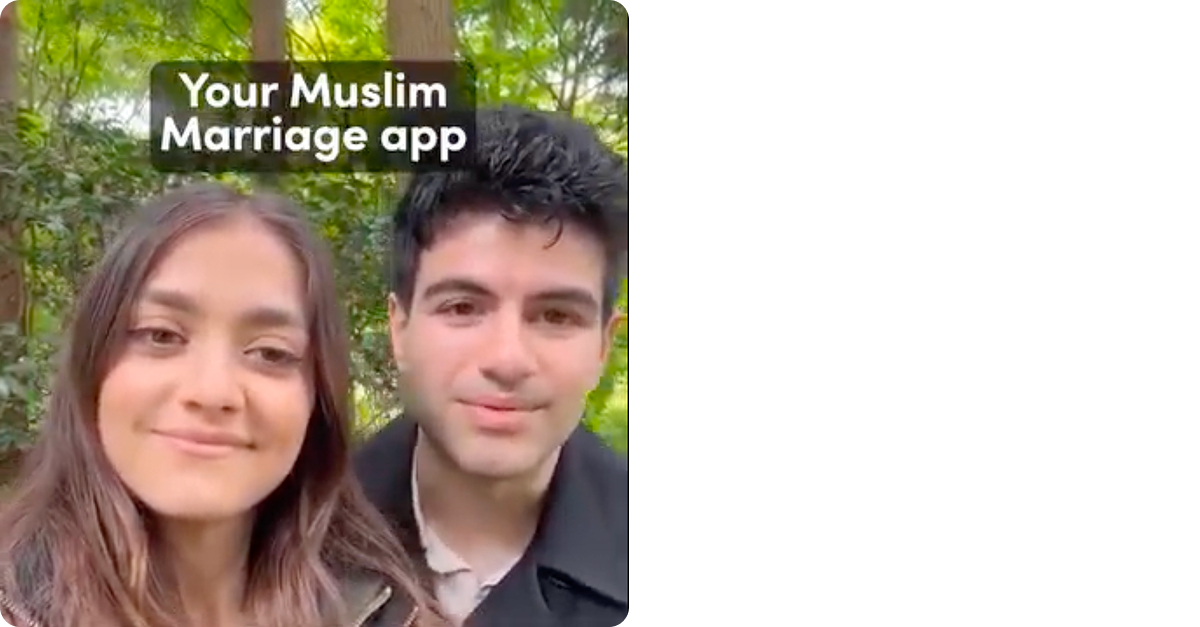
Salams is a Muslim dating app. Its creative is a UGC video of a married couple who met on the app while looking for someone with the same values and lifestyle.
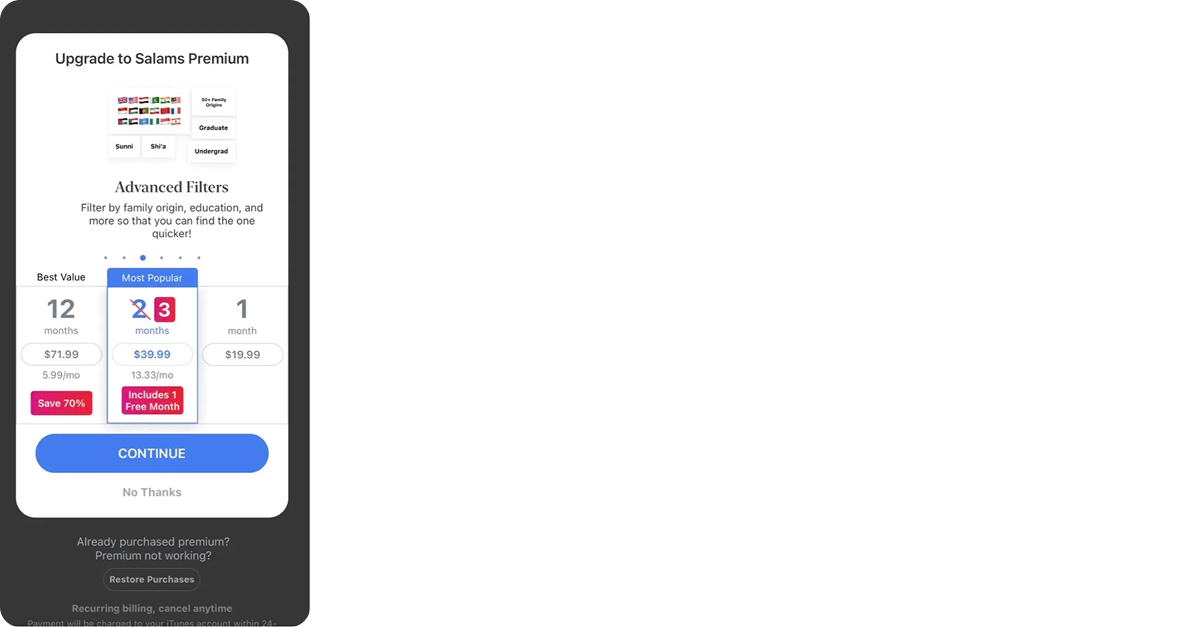
The paywall keeps the promise: it sells filters by family origin and education. The same fixes from the Happn teardown apply here: the multi-screen layout and the “most popular” tag.
The bigger lesson is how much commonality matters in dating.
“It’s shocking how much people are looking for some degree of commonality to turn a stranger into someone they can start to get to know.”
There are two billion Muslims in the world. Sharing a religion doesn’t make two people compatible, but it gives them something to build on. In Tinder focus groups, one couple bonded over both having worked at Walmart, a company with a million employees. The same college, the same hometown, or the same employer goes a long way, both in the creative that brings people in and in the product that gets them talking.
Salams shows this with a module at the top of the paywall: flags, Sunni or Shia, graduate or undergraduate. The idea is right, since these are the dimensions people overlap on. The execution is weak: the module is hard to read without squinting.
The same pull explains why many founders of fitness and language-learning apps end up adding dating. People are looking for connection, and a shared interest makes it easier to start a conversation. The hidden benefit these products sell is the chance to meet someone.
How long should dating app onboarding be?
A shorter funnel seems like it should convert better: remove a step, and step-to-step conversion goes up. The data often says otherwise. At Sesame, replacing a 3-step checkout with a 25-step intake raised conversion by 40%. Long flows are common among top web onboardings too: Calm runs a quiz of around 40 screens, and the astrology app Nebula asks more than 30 questions.
The reason is that a well-designed funnel gives value as well as asking for it.
“At the end of the day, onboarding is about giving a person enough confidence that they want to activate into and get value from your product. I call it confidence engineering.”
How much friction a product needs depends on how consequential the decision is:
- Low consequence, fast value: keep it short. Before Tinder, signing up for eHarmony or Match meant answering many questions. eHarmony even advertised its 120-question signup on TV. The friction was the point: when meeting a stranger online felt risky, a hard signup filtered for people worth meeting. As the culture changed and people became more willing to connect, Tinder cut the path to a match and a conversation down to minutes.
- High consequence: go long. At Sesame, the checkout flow was for GLP-1 weight loss medication. People had questions about injections, side effects, and how much weight they would lose. The onboarding answered them all, and once users reached the checkout page, 80% clicked the checkout button.
“If you go to a doctor and they ask you one question and say, ‘Here’s the drug you need,’ you’d say no way. It’s the same with a personal trainer. But you don’t need to answer 50 questions to get a gym membership.”
When the drop-off isn’t about length
Reev’s onboarding is standard except for the last step: choosing a prompt from a list and recording the answer in your own voice. That step is the biggest drop-off point, at 20%. The whole flow takes less than five minutes. What makes people quit is the awkwardness of picking a prompt and talking to their phone.
“It’s awkward to choose something and then record. If we make it more natural, people are more likely to share their stories and what they really value. People love talking about themselves.”
Other products have found ways to make a first voice recording less awkward:
- Wispr Flow gives first-time users a script to read, so they don’t have to think about what to say.
- Some products tell users the recording won’t be published yet and they can review it first, which takes the pressure off.
Who should a new dating app build for?
Every strong dating brand starts with a very specific ideal customer profile and a value proposition that customer needs:
- Tinder is built for the 21-year-old who wants to meet people and isn’t looking for anything serious. Every other product decision flows from that: keep it simple, light, and fun, with as little friction as possible. Tinder is also the largest dating app for people over 50, who have very different needs, but product decisions aren’t made for them.
- Hinge is built for the 28- or 29-year-old who is looking to settle down.
A narrow focus doesn’t limit reach. People often want to be around a product made for a specific niche.
“I worked with a marketer who said basically everybody wants to be 21. ‘We market Mountain Dew to 21-year-olds, and it turns out 16-year-olds want to be 21, and 30-year-olds want to be 21.'”
Many products fail because they copy another app and never define their own audience.
“Ask yourself: why is your product different from the others? When people talk about you, what do they say about you? If you’re not clear on that, it’s very difficult to capture the market.”
Needs matter more than age brackets
Teams often describe their audience in five-year increments, such as 24 to 29. But a 24-year-old and a 29-year-old lead very different lives and want very different things from dating. A narrow range brings clarity, and needs define the audience better than demographics. A 32-year-old who just got divorced is probably looking to settle down. A 50-year-old may be closer to a 21-year-old: they want to have fun and aren’t thinking about a second marriage.
Early and late adopters also differ. Reev’s value proposition targets people 28 and older, but more mature users are reluctant to try something new and want a proven product. Twenty-one-year-olds are much more open. So Reev is starting with university students, where word of mouth and network effects kick in faster, expecting older users to follow.
What do women want from a dating app?
The first answer is safety. Many men don’t know how to interact respectfully, and that makes women uncomfortable. Prioritizing women also matters for the business.
“Where women go, men go, and the men pay for that.”
Prioritizing women takes testing, though. Bumble gave women every decision: men couldn’t message a woman until she approved. It sounded great, but many women burned out from having to approve every single conversation. It also made monetization harder, since men had fewer reasons to pay. Bumble changed this only recently. Strategies like this need to be tested with part of the audience before they roll out to everyone.
The deeper problem is that many dating apps were designed as if men and women choose partners the same way. A common complaint from women is that there are lots of men on the apps, but they can’t tell who is worth talking to. Photos were never how men presented themselves to women, so most men aren’t good at it, and women can’t assess them well that way. Instead, women look for indirect cues: a photo with friends suggests the person is socially accepted, a photo with a dog suggests he’s kind. Men’s effort level is another signal. A one-word “Hey” as a first message reads as not caring.
“A lot of dating apps are designed around men’s pre-selection process, filtering based on looks. But for women, the first interaction is the filtering process. Is this person confident enough to come and talk to me? Is he choosing me over other women? How funny is he? All of that is flattened into ‘Hey, what’s up’ and a few photos.”
The value proposition for women is giving them better information, in both breadth and depth, so they feel secure enough to start a conversation themselves.
What’s next for dating apps?
Users are frustrated and the industry needs change, but there is no proven direction yet. One path makes selection, matching, and organizing the first date easier, through AI or more advanced algorithms. Another moves dating back into real life. It may take time to see whether one wins or people end up choosing among several.
Dating apps still work: recent data shows they remain the number one way couples meet. But they solve only half the problem.
“The swipe really solved matching, but it didn’t solve meeting.”
From the screen into the same room
Tinder is already moving in this direction, with more places in the app that nudge people to meet in person. Its Double Date feature shows the appetite: women are three times more likely to match with a pair. Younger users in particular prefer low-pressure dating. A one-on-one date feels stressful, so they would rather hang out as friends first and decide later.
Shared interests are the new opening line. Run clubs and group fitness competitions draw people who are there to meet someone as much as to train.
Double Date took years to launch in the US: coordinating four people is much harder than two, the funnel dropped off steeply, and monetization was the priority at the time. The learnings went into features that bring people together around shared contexts:
- Tinder University: swiping on people from your college, with schools competing for the most swipes
- Festival Mode: swiping on people going to the same festivals during the summer season
- Swipe Night: a live event where everyone watches content at the same time and then swipes on each other
The rise of social discovery apps
There is a spectrum: social networks connect you with people you already know, and dating apps connect you with people romantically. In between sit social discovery apps, which help people meet someone new without romance being the main reason.
This space has room to grow. The real-life institutions people relied on to meet others outside their immediate circle, like churches and associations, have faded, and most places people spend time online aren’t built for meeting someone. That’s why Instagram is sometimes called the largest dating site: people slide into DMs because they want to meet someone without the pressure of a dating app.
Will AI companions compete with dating apps?
They will compete for the same underlying need: companionship. But AI companionship and real-life dating are different use cases, and the two often get conflated. An app like Reev is built for meeting someone you’ll want to see in person, where location matters. Apps that offer online companionship with no intention of meeting are the ones AI is most likely to disrupt, because an AI is always available and has no opinions of its own.
“I think a lot of money is going to be made in that market, but there are also some moral icebergs to be aware of.”
One of those icebergs is rejection. In-person rejection is painful, and people already avoid it by moving online. An AI that always agrees makes it even easier to skip the uncomfortable parts of connecting with people, which leads to more isolation.
“We are wired to find our people. The product that will win is the one that gets that from the screen into the same room, around shared interests.”