







This post is based on a talk at Apps in Motion, a conference on mobile app growth hosted by FunnelFox and Adapty at Nasdaq HQ, New York. Watch the full session.
FunnelFox is a web2app platform for subscription apps — AI-generated funnels, cancellation flows with reason-based routing, built-in A/B testing and analytics, and a billing infrastructure that works across 60+ providers and handles smart retries, payment routing, and tokenization.

Most teams I work with, that are struggling with AI app retention, jump straight to lifecycle: more push notifications, more emails, more in-app messaging. But the problem can sometimes sit upstream of all that. It’s in how the product is priced and packaged.
Pricing determines how users explore your product, what they have access to, how fast they discover value, and how often they return. In AI apps specifically, that makes pricing not just a monetization decision but the whole product experience. And a lot of retention problems are actually pricing design problems in disguise.
Why the traditional subscription playbook doesn’t work for AI apps
On the surface, AI apps look strong. They convert faster than traditional apps and make money quickly. But the reality is that they behave much more like usage-driven SaaS or utilities, and the unit economics are completely different.
In a traditional subscription business, you spend to acquire users, and from there, engagement is essentially free. Retention drives LTV. Users build a habit and renew over time. With AI apps, every prompt, every token generated carries a real compute cost. The result is something most subscription teams haven’t had to deal with before: your most active users can be your least profitable ones.
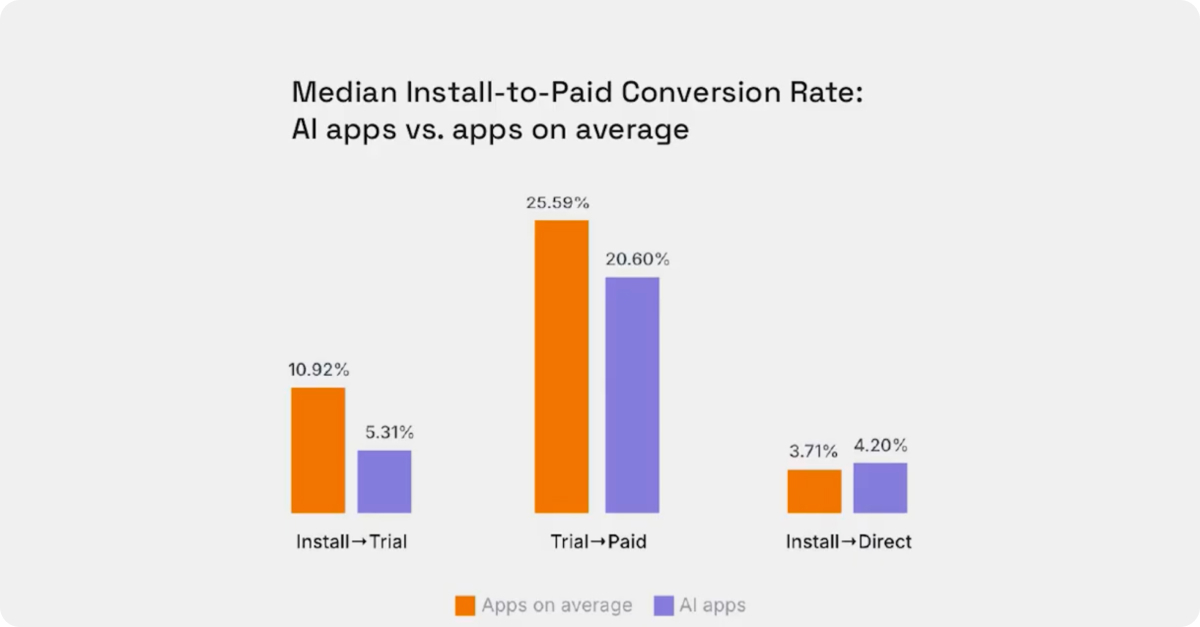
According to Adapty’s 2026 subscription report, AI apps convert into trials at roughly half the rate of the average app — 5.31% install-to-trial versus 10.92%. They’re slightly better at direct conversion, but the classic try → habit → subscribe path doesn’t exist in the same way. Users either see value immediately and pay, or they drop off entirely.
And while AI apps generate a higher median install LTV, the retention curve tells a different story. AI apps fall off faster, particularly between Month 0 and Month 3.
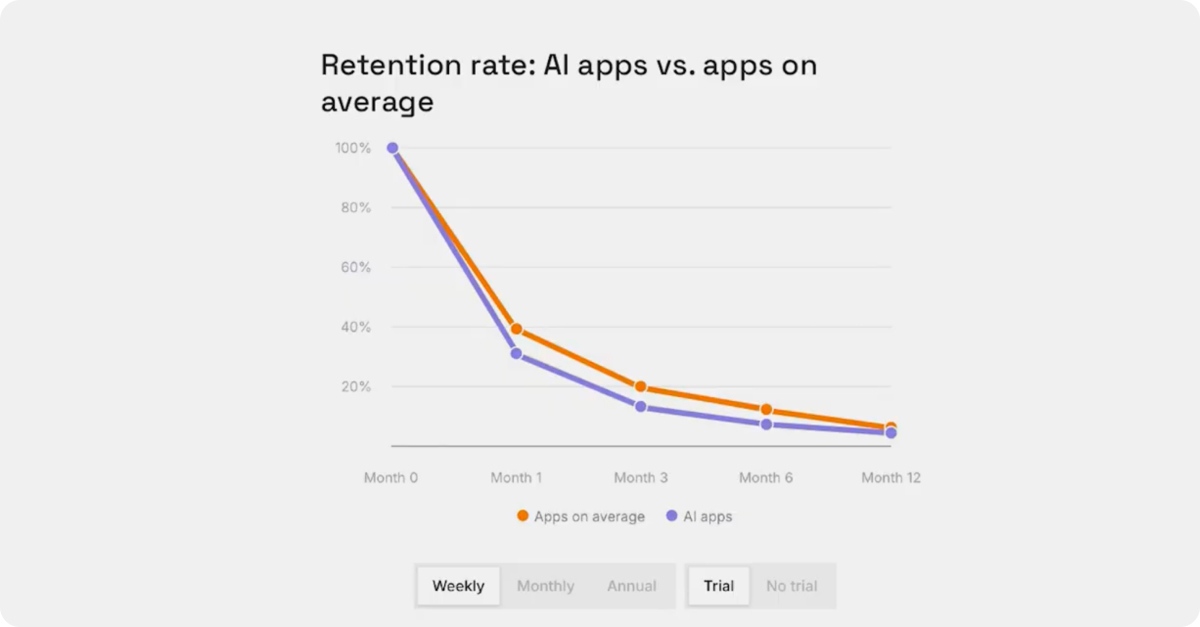
The model looks strong on revenue but is fragile underneath because AI apps behave like tools rather than habitual products. A user opens the app, generates an output, gets what they need, and leaves — value extracted in a single session. There’s no recurring reason to return, and no habit forming. Pricing is how you design your way out of tool behavior.
Two ways to kill AI app retention
1. Hard paywalls
The most common reaction to high compute costs is to gate everything behind a paywall. If users haven’t paid, they can’t do anything. The logic is understandable — publishers want to make sure everyone in the app is a subscriber.
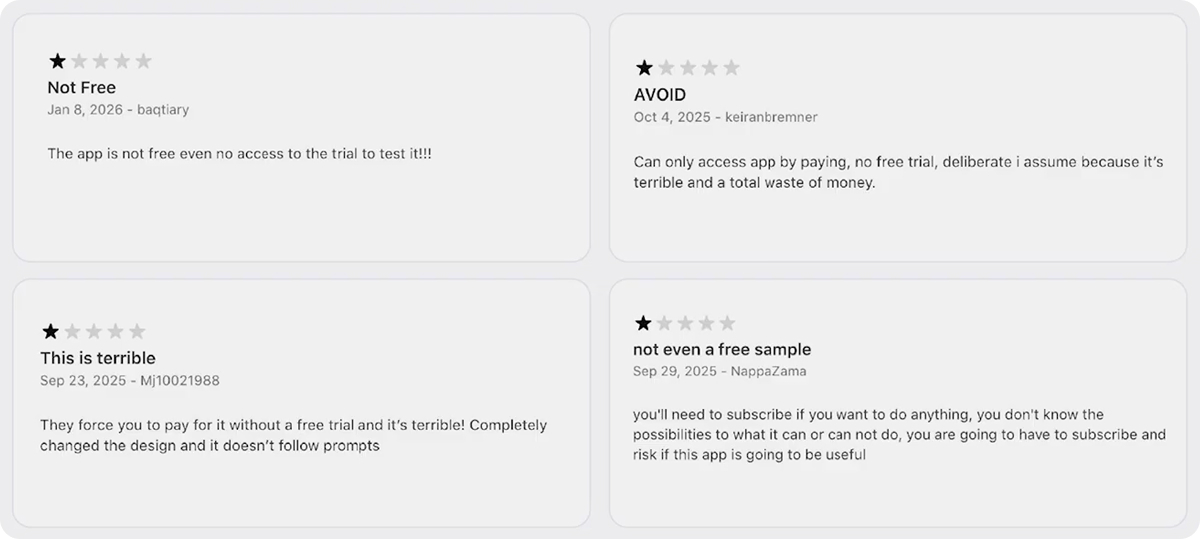
But what this means in practice is that all features are locked before the user has experienced anything meaningful. They never discover what they’re paying for. And over the last few years, the subscription industry has trained users to expect some form of free trial before committing — especially when prices are higher than they used to be. Asking someone to pay without letting them experience the product first doesn’t protect margins. It eliminates conversions.
The app store reviews tell the story clearly. One-star reviews for AI apps with hard paywalls follow a consistent pattern: users aren’t complaining about the price — they’re complaining about the impossibility of understanding what they’re paying for before being asked to pay for it.
2. Misaligned credits
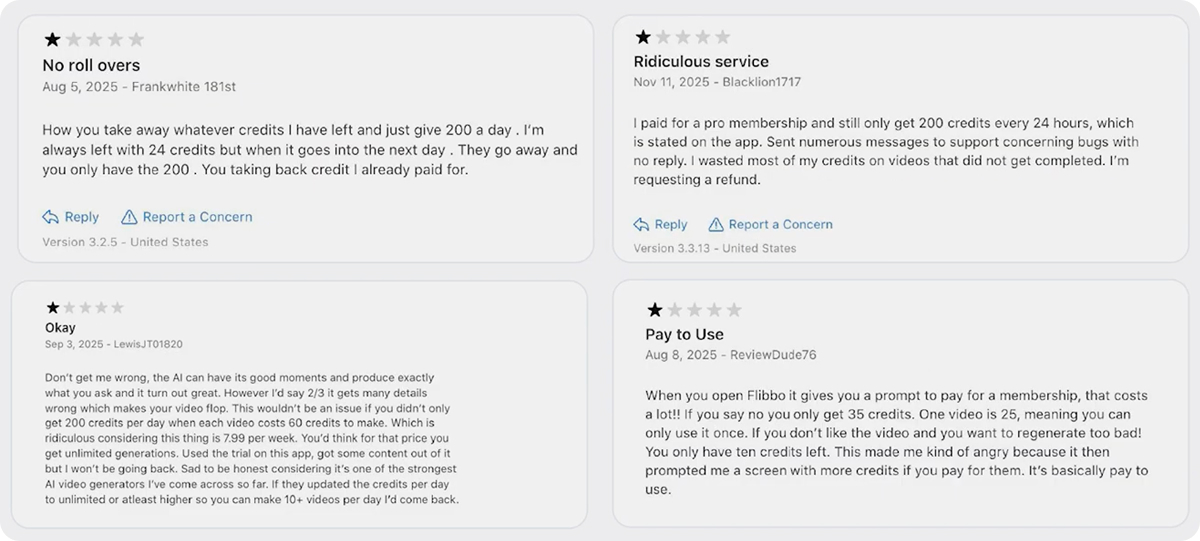
The more nuanced approach is to add usage limits — credit systems that allow some exploration but cap it. Credits and usage limits are the right instinct; the problem is in how they’re set. A lot of publishers aren’t thinking through how users actually use their product when defining those limits.
A video generation app that gives users 200 credits per day, where a single video costs 60 credits, is a good example of this. Video generation requires iteration — most users need multiple attempts to get a usable output. That’s four generations maximum before credits run out, and then a 24-hour wait before they can continue. The value cycle breaks. The user gets frustrated, loses trust, and doesn’t come back.
This isn’t an argument against limits. Limits are necessary and correct. But they have to reflect real usage patterns, not arbitrary thresholds designed purely around cost control.
A photo and video editing app I worked with as a subscription growth consultant discovered this directly. When they added usage limits, conversion improved, particularly to mid-tier plans. But retention dropped because users were hitting those limits before they’d found real value in the product. They questioned whether the AI features were worth it at all, and they lost trust. The answer was to fix the underlying mismatch between what the plans offered and the real usage patterns of the users they were acquiring.
If you have to price by usage, qualify users first
The issue isn’t letting users in — it’s letting everyone in without any filtering. When curiosity traffic hits your app with no expectation setting and no intent understanding, you pay for compute costs before you know anything about the user. High usage, low retention, and infrastructure costs starting immediately.
The solution is qualification — using onboarding, quizzes, and pricing tiers to filter users early, so that the plan they end up on matches their real use case.
Filter in onboarding
If you can identify what kind of user someone is before they reach the paywall, you can show them the right plan and the right amount of credits for how they’ll use the product. The filter doesn’t need to be heavy. A well-designed onboarding quiz is a compact way to surface use case and intent without adding meaningful friction.
Duolingo Max is a good example. It’s a higher-tier subscription aimed at more serious users — people who identify with a professional or business use case rather than casual learning. The tier includes AI conversation features, and the pricing reflects the higher level of commitment and usage those users bring.
Let users self-identify at the paywall
When onboarding filtering isn’t enough, the paywall itself can do the work. Instead of presenting plans by price alone, structure the options around use case — and let users place themselves.
Flibbo, a creative content app, tested this directly. Their paywall presented three user types: casual explorer, occasional creator, and daily professional. Each came with a credit package calibrated to that profile.
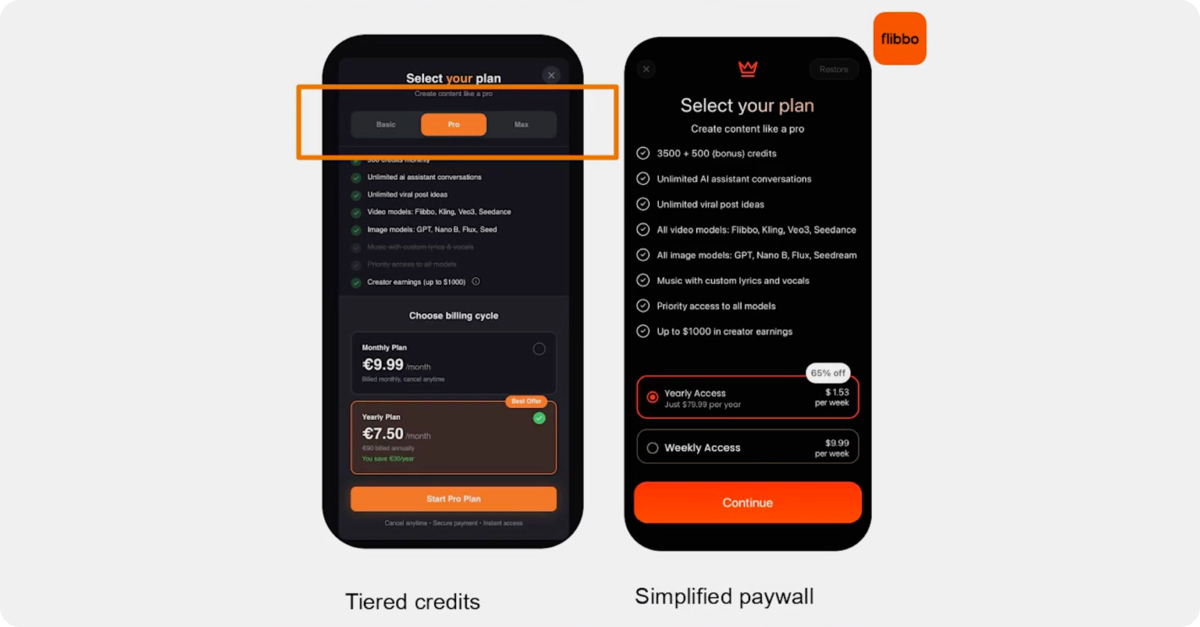
The result was fewer mismatches between what users expected to be able to do and what their plan supported. Over time, the team simplified the paywall after learning they weren’t acquiring enough users at the highest tier, but the principle stayed: match the credits to the use case, not to a cost ceiling.
Remove options that cannibalize commitment
Sometimes the problem isn’t the pricing tiers themselves — it’s an option that attracts the wrong users and crowds out the right ones.
Mojo, a social content creation app, tested removing credit packs from its paywall entirely, leaving only subscriptions. Revenue increased by 14%.
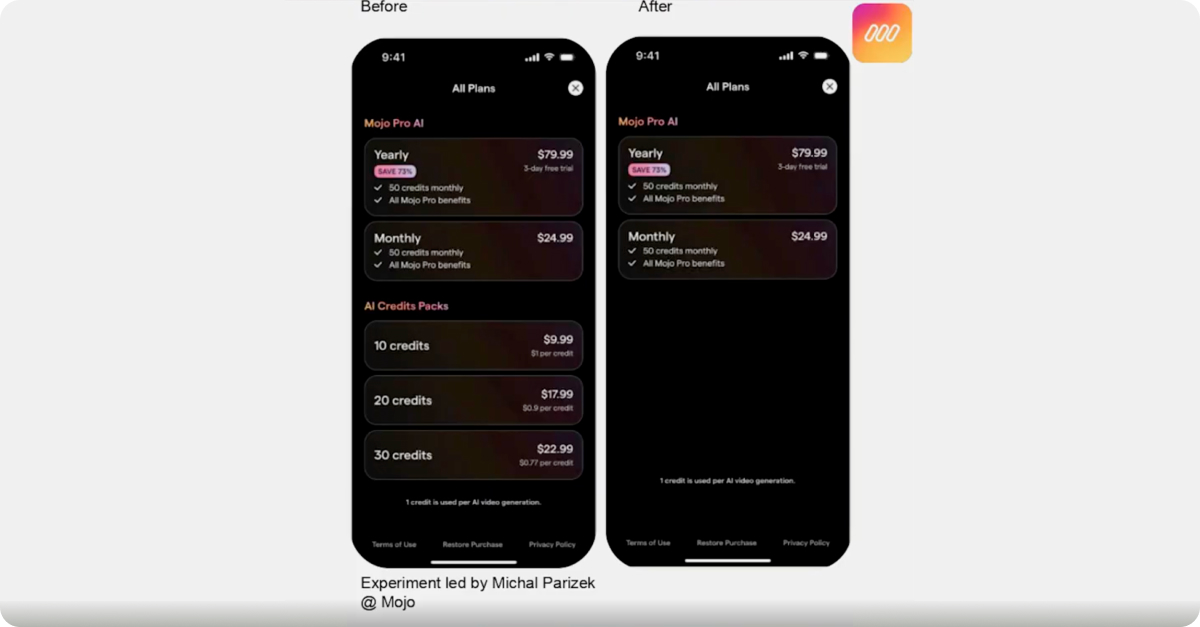
Credit packs had been attracting low-commitment users who wanted cheap access instead of committing to a subscription. Their usage patterns didn’t match what the plans could sustain. Removing credit packs filtered them out, leaving users who were genuinely ready for habitual use, and power users who needed more could still purchase additional credits inside the product.
A practical framework for pricing AI features
Not all AI actions carry the same cost, and not all of them serve the same function in the user journey. A pricing system that doesn’t distinguish between them will either destroy margins or destroy retention.
Encourage exploration
Early usage needs to be low-friction. Before a user understands what your product can do for them, every barrier you put in place reduces the chance they’ll ever find out. The goal at this stage is not to monetize instantly but to get users to the point where the product makes sense to them.
One way to do this without absorbing high compute costs is to use pre-generated content. If you want to show a user what an output looks like — say, a video edit in a particular style — showing a pre-generated example at onboarding is far cheaper than generating it live for every new user. The user gets a genuine sense of the product’s value. You don’t pay for it until they’ve shown intent to stay.
Protect learning actions
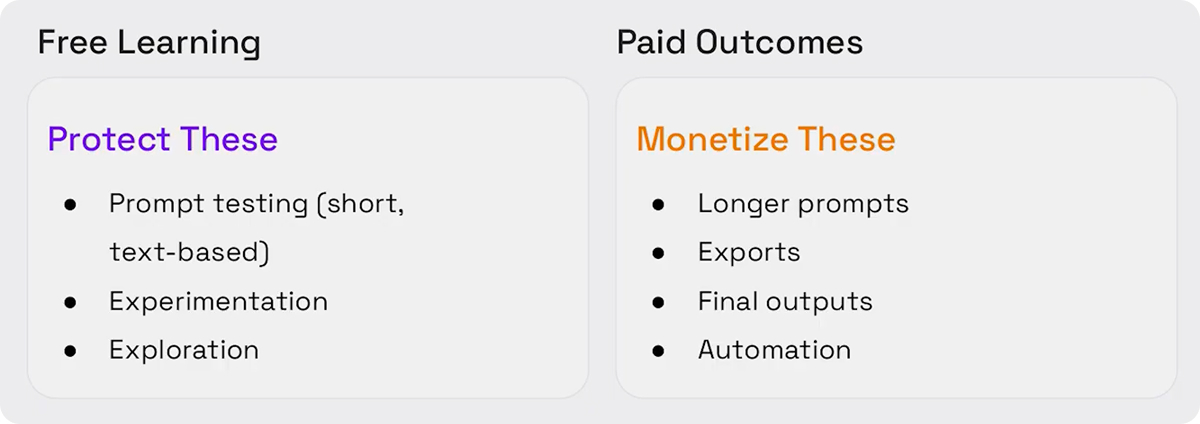
Short text-based prompts, experimentation, basic interactions — these carry low compute cost and serve a critical function: they let users understand what the product does. Treat this as acquisition cost, not as a leak. Charging users for discovering what your product does is one of the fastest ways to kill conversion.
Pace value discovery over time
This is where limits become a tool rather than a barrier. The goal here is to control the speed at which the value is consumed. Rolling credits work well here: a user who runs out today comes back tomorrow, and each return is an opportunity to deepen the habit.
The difference between bad limits and good limits is simple:
- Bad limits: user hits the ceiling before discovering value → frustration → churn.
- Good limits: paced usage → user finds the aha moment → habit forms → retention improves.
ChatGPT and Claude do this well. On any tier, including free, users can interact with the product and get a genuine sense of what it does. At a certain point, the system says, “come back in an hour,” or “you’ve reached your limit for today.” That’s pacing, not blocking. Users understand the value before they’re asked to commit, and the limit creates a reason to return.
Control infrastructure cost
When exploration is structured — learning actions protected, outcomes monetized, usage paced over time — infrastructure cost becomes manageable by design rather than open-ended. The system controls how value is consumed instead of letting users extract everything in one session.
To sum up: Three questions to diagnose your pricing system
If your retention curve isn’t moving despite lifecycle work, the problem is likely upstream. These three questions are a quick diagnostic — if you can’t answer yes to all three, your pricing system is probably working against retention, not alongside it.
1. Are you charging for outcomes, not for learning?
If users are hitting paywalls or credit limits before they’ve understood what the product does, you’re charging for discovery. That kills conversion before retention even becomes a question.
2. Are the right users on the right plans?
If the credit allocation on a given plan doesn’t match the real usage patterns of the users on it, frustration is inevitable. The plan should reflect how that user uses the product — not an average, not an arbitrary threshold.
3. Are you in control of how value is consumed?
If users can extract everything the product offers in a single session, there’s no reason to return. Retention requires a reason to come back. Paced usage creates that reason — open-ended access removes it.
Pricing in AI apps isn’t just a revenue mechanism. It controls cost, shapes behavior over time, and determines whether users build habits or burn out. Lifecycle tactics operate within the constraints that pricing creates, so getting the pricing layer right is the precondition for everything else.