





Turning an ad click into a completed web payment involves more moving parts than most mobile teams expect: checkout design, payment methods, pricing, retention, and a growing stack of compliance rules.
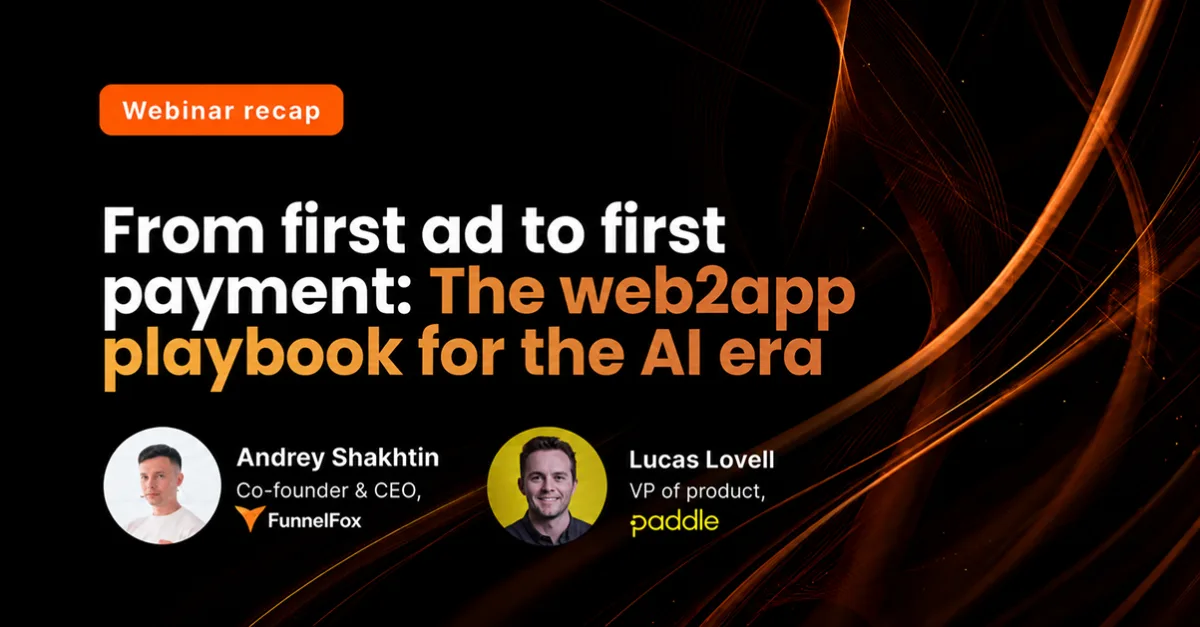
In the FunnelFox webinar “From first ad to first payment: The web2app playbook for the AI era,” FunnelFox CEO Andrey Shakhtin sat down with Lucas Lovell, VP of Product at Paddle, to walk through that journey end to end.
Paddle is an end-to-end billing and payments infrastructure platform that operates as merchant of record. It works with over 10,000 digital product companies, many of them mobile apps selling on the web.
In this blog post, we cover the key takeaways from the conversation.
What a merchant of record actually is
Andrey opened by clearing up a question the FunnelFox team hears often: what a merchant of record (MoR) is, and how it differs from a payment provider like Stripe or an acquirer.
Under a MoR model, Paddle resells your product and takes on the liability for the transaction, along with the compliance and regulatory obligations around it. It’s the same structure app developers already know from the App Store: when you sell through Apple, Apple resells on your behalf.
“As a merchant of record, we are a reseller of your product… we take on liability for the transaction.”

The practical difference is that a payment provider handles the transaction itself, while a MoR sits one level above it. Paddle integrates with the PSPs under the hood, handles global sales tax (calculating, capturing, and remitting it), and removes the need to set up entities or register with local tax authorities. As Lucas put it, that lets teams “freely sell and grow around the world with ease.”
How it increases checkout conversion and payment acceptance
Beyond offloading tax and compliance, using a merchant of record like Paddle also shapes the two metrics Lucas called most important for a mobile app selling on the web: checkout conversion and payment acceptance. He walked through the lever behind each:
- Local payment methods → checkout conversion. Buyers are more likely to pay when they see a method they already use. Paddle handles those integrations, covering Europe and India, with Pix Automático (recurring Pix) coming to Brazil.
- Payment orchestration → payment acceptance. Paddle routes each transaction behind the scenes based on type, price point, location, product, and buyer profile, giving it the best chance of clearing with the acquiring bank.
Andrey added that orchestration is one of the most overlooked areas for teams new to web payments, and that it can double as a go-to-market tool, especially when entering markets where local payment methods are critical, such as Brazil.
The mobile-first checkout
Mobile app teams tend to arrive at web payments with a performance-marketing, experimental mindset. Lucas said the first thing many teams overlook is also the simplest: optimize everything for mobile.
In a web2app context, traffic is almost entirely mobile—often a social ad opened on a phone—so the checkout has to suit that. His practical guidance:
- Avoid lengthy card forms.
- Surface wallet payments like Apple Pay and Google Pay.
- Consider dropping card forms entirely, as some apps now do.
“We’re even seeing apps now not even offer card forms at all.”
Lucas said some Paddle customers saw a checkout conversion increase of over 10% just by adopting an Express Apple Pay experience—one-click, Face ID, transaction processed.
Paywall and checkout as one experience
A recurring theme was that the paywall and checkout, long treated as separate steps, are becoming one connected monetization experience: pricing is communicated and payment is embedded directly into the paywall.
“The paywall and the checkout are just two steps in one experience.”
Andrey pointed to Noom as an early example of moving the checkout into the paywall, and noted that placing an Apple Pay button on the paywall showed a +20–30% conversion lift across some projects.
Pricing: models, localization, and discounts
Lucas highlighted the pricing and billing flexibility that web payments offer compared with the app stores, and walked through what teams are testing:
- Paid trials. They raise commitment: fewer users enter the trial, but those who do tend to have higher intent and LTV, and they provide a card upfront, which validates the payment method for renewal. Paddle launched paid trials recently and is seeing high adoption.
- Introductory offers. A discount applied to the first billing cycle, with later cycles at full price.
- Localized pricing. Converting a single USD base price into other currencies ignores differences in willingness to pay and purchasing power. Lucas recommended experimenting at both the currency and regional level, since even euro countries differ.
- Discount framing. Presenting a price as “$20 with 50% off” reads as a better offer than simply listing it at $10.
Andrey added that paid trials also help optimize the Meta pixel quickly, since low-priced trial purchases send fast signals—though they can bring more chargebacks, so the terms need to be clear and balanced. He flagged pricing localization as one of the top growth drivers among FunnelFox customers.
“When apps start localizing pricing, they are growing very quickly.”

He also shared a localization caution: when a US-dollar price is shown to buyers in markets like Canada, the “$” sign can be read as local currency. After localization, a higher local-currency price can raise the perceived cost and lower conversion, so the change needs careful testing.
The full-funnel view
Both speakers warned against optimizing checkout conversion in isolation. Pushing it with dark or misleading pricing tactics can create problems elsewhere in the funnel, including higher chargebacks and churn.
“The price that someone is paying… also impacts the propensity to stay with you.”
Andrey described a common mistake among growth and UA managers: measuring everything by conversion rate or CPA while missing refunds and chargebacks. The takeaway was to calculate the whole funnel together, including retention.
Retention and cancellation flows: the overlooked lever
Asked what most teams overlook when they start selling on the web, Lucas pointed to retention.
“People have a tendency to overlook retention mechanics in favor of conversion mechanics.”
The app stores give little flexibility around retention; the web gives a lot. A cancellation flow, for example, can do several things the moment a user tries to leave:
- Move them to a lower-priced plan instead of cancelling outright.
- Offer a discount to stay.
- Propose a pause instead of a full cancellation.
- Capture why they’re leaving, which feeds the product roadmap.
Regulations require keeping a cancellation option available throughout the flow, but there’s still meaningful room to reduce churn. Lucas framed it simply: aim to increase retention by 10%, the same way teams aim to increase conversion by 10%.
Compliance is becoming stricter
Lucas described compliance as critical to a sustainable consumer mobile business, and noted the most successful companies keep that bar high.
He grouped the requirements into a few buckets:
- No dark patterns. Avoid misleading design in the paywall or checkout.
- Easy cancellation. Make cancelling as simple as signing up (the “click-to-cancel” principle).
- Renewal notifications. Send pre-billing and renewal reminders where the law requires them.
He noted that the landscape is fragmented, with locations like California and Germany especially active—and that high chargeback rates can flag bad behavior to the card schemes and compromise partner relationships.
Both speakers read recent FTC action against app companies as a sign that regulators are actively enforcing these rules and engaging companies directly, with more jurisdictions likely to follow. Andrey framed this as another reason to use a merchant of record: Paddle takes on much of the compliance burden across regulators that often don’t publish clear guidelines.
On click-to-cancel rules specifically, Lucas said companies already operating transparently saw little change in churn. The rules mainly affect companies that made cancellation very hard, such as requiring a call with a support agent.
Chargebacks, VAMP, and fraud monitoring
Lucas explained that Visa and Mastercard are tightening enforcement around high chargeback rates, which often indicate fraud or a product experience that misled customers.
The stakes are high: a chargeback rate that stays too high for too long can get a business kicked off the payment rails. Lucas walked through what’s changed and how Paddle manages it:
- Tighter card-scheme rules. Visa’s VAMP consolidates several legacy fraud programs and tightened its thresholds; Mastercard runs similar but separate systems.
- Paddle’s monitoring. Paddle manages the scheme and PSP relationships, runs its own chargeback monitoring program, and now surfaces chargeback data in its dashboard.
- Early prevention. The focus is catching a climbing rate early—for example, pre-billing notifications before renewals, which raise cancellations but avoid chargebacks—applied mainly where there’s a problem or a legal requirement.
- MoR protection. As a merchant of record, Paddle absorbs some of the scheme pressure while still monitoring and acting seller by seller.
Audience Q&A
What worked in web2app funnels six months ago but no longer works today? Andrey said more companies are dropping introductory offers, which can lower renewal rates once you measure the full funnel and longer-term LTV. Paid trials, popular a year or two ago, are also giving way to companies selling subscriptions right away without any trial. Lucas agreed.
If you could run only one test this quarter, what would it be? From a payments angle, Lucas chose price points, especially regional ones.
From a paywall angle, Andrey suggested starting by estimating what already works in the market—comparing how competitors’ funnels change over time—then betting on bigger swings. His favorite: adding interactive functionality to the funnel rather than a static squeeze page, for example:
- A photo or video app applying effects inside the funnel.
- A face-yoga or skincare app scanning the user’s face for personalized recommendations.
The aim is to convince users to try the product before they pay.
How AI is reshaping the market
Lucas closed on the bigger shift. More people are building—both digital products and mobile apps—but consumer buying has stayed relatively flat, creating a widening gap between what’s shipped and the willingness to buy it.
With technical moats now easier to replicate, the make-or-break question shifts from “can I build it” to “can I get it into the hands of users who are willing to pay.” That puts a premium on speed and growth flywheels.
Lucas sees the shift as net positive for web2app. To compete, teams will need to:
- Go multi-channel and diversify revenue.
- Find untapped audiences.
- Optimize unit economics as CAC rises.
On the tooling side, AI-native funnel and paywall building lets teams experiment and deploy new experiences far faster than before. Andrey shared that FunnelFox analyzed more than 10,000 campaigns and funnels and trained an AI agent on them, so growth managers can go from 0 to 1 quickly with category best practices built in.
See it on your own funnels
FunnelFox and Paddle work together across the web2app journey—funnels and paywalls on one side, payments on the other.
Want to see how these tactics could work in your own funnels?