






Web2app funnels convert up to 2x better than in-app and unlock higher LTV. But there’s one place where most of that advantage gets quietly lost: the payment stage. A user who clicked your ad, went through your landing page, picked a plan—and then gets declined. That revenue doesn’t just delay, it disappears.
In a recent webinar, Nurs Mukhamediya, Customer Solutions Lead at FunnelFox, and David Vogelpohl, CMO at FastSpring, broke down why payments fail, where the biggest drops come from, and what teams can actually do about it. Here’s a recap.
Start with the metric most teams under-track: acceptance rate
Acceptance Rate (AR) is the percentage of payment attempts that succeed. Simple definition—but most mobile app teams either don’t track it at all, or track it as a single global number. That’s where the blind spots live.
The real signal is in the breakdown: AR by geography and by card type. A healthy global average can mask a 65% acceptance rate in Brazil or Mexico, where you’re losing one in three customers at the final step.
What does a healthy number look like? In tier-1 markets with proper setup: 80–90%. In emerging markets routed through a single US or EU acquirer: closer to 65%. With local acquirers in those markets: back up to 80%+. That 15–20 point gap is largely recoverable.
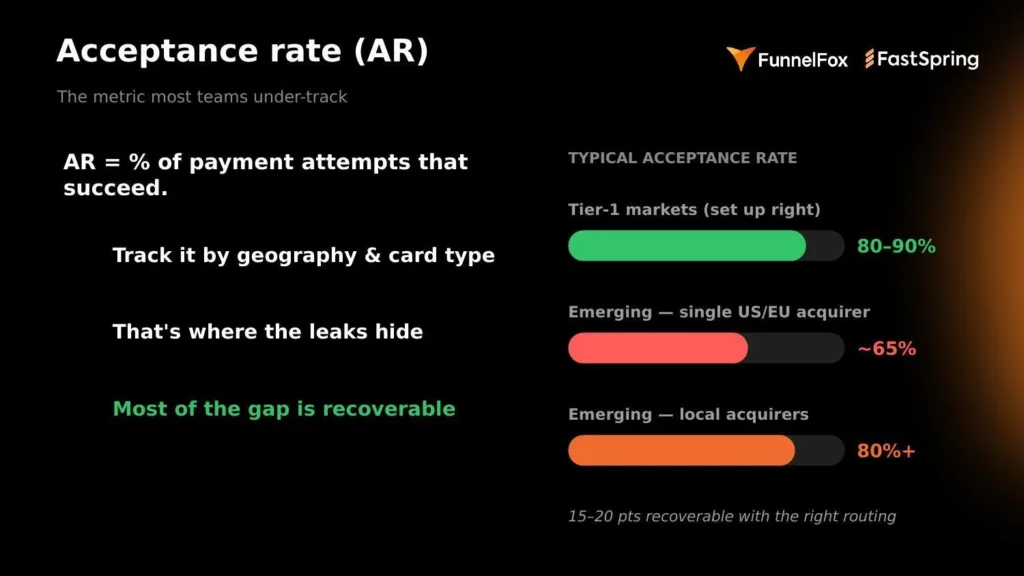
From the webinar: typical AR ranges by market and setup
Why payments fail: the four main reasons
1. Insufficient funds
This is the most expected decline reason, and it’s actually fine if it sits at #1. People genuinely don’t have money on their card at that moment. You handle it at the monetization design level—a common approach is a $1 paid trial that converts to a monthly subscription, lowering the upfront barrier. For renewals, there are separate levers covered below.
2. “Do not honor”—the bank doesn’t trust the charge
This is one of the most frustrating decline codes because it tells you nothing. It’s a catch-all that the issuing bank uses when it decides not to approve a charge—no specific reason given. It can represent 20–30% of all declines for some merchants.
The underlying cause is almost always the same: the bank doesn’t trust the transaction. That distrust comes from a few fixable places.
3. Cross-border processing
When a US user’s card is charged by a European merchant account, the bank treats it as a cross-border transaction and applies extra scrutiny. New merchant accounts get this even more—banks don’t extend much trust by default.
The fix is routing through local acquirers in the markets where you have significant volume: Brazil, Mexico, Europe. The same transaction that gets declined cross-border gets approved as a domestic one.
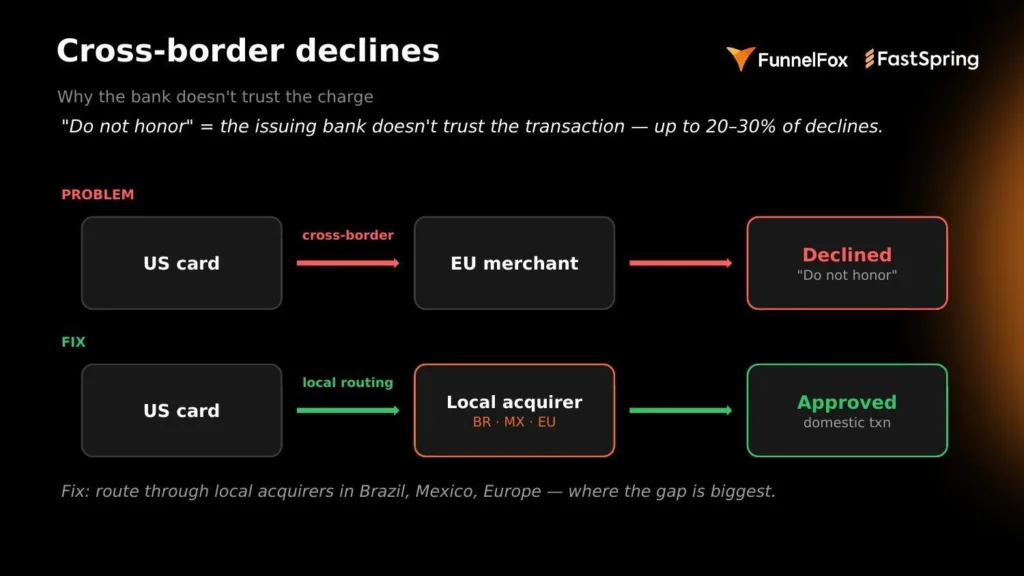
The problem and the fix: local routing turns cross-border declines into domestic approvals
4. Missing billing data
Payment processors use contextual signals—ZIP code, billing address, country, email, device fingerprint, IP—to assess transaction risk. When you don’t pass enough data, the risk engine has less to work with and declines more.
Quick audit: check what your checkout actually sends to your processor. If it’s only card number + amount + currency, you’re leaving AR on the table. Adding billing address and email fields alone can make a meaningful difference.
Wallets vs. cards: the easiest AR win
Apple Pay and Google Pay aren’t just more convenient for users—they authorize at significantly higher rates than cards. The difference is substantial: wallets typically hit 80–90% acceptance, while cards land at 60–70%. That’s roughly 20 percentage points of revenue sitting on the table for teams that only offer cards.
The implementation tip that works: put the Apple Pay button immediately after plan selection, before the user reaches a traditional card form. The fewer steps between intent and payment, the better.
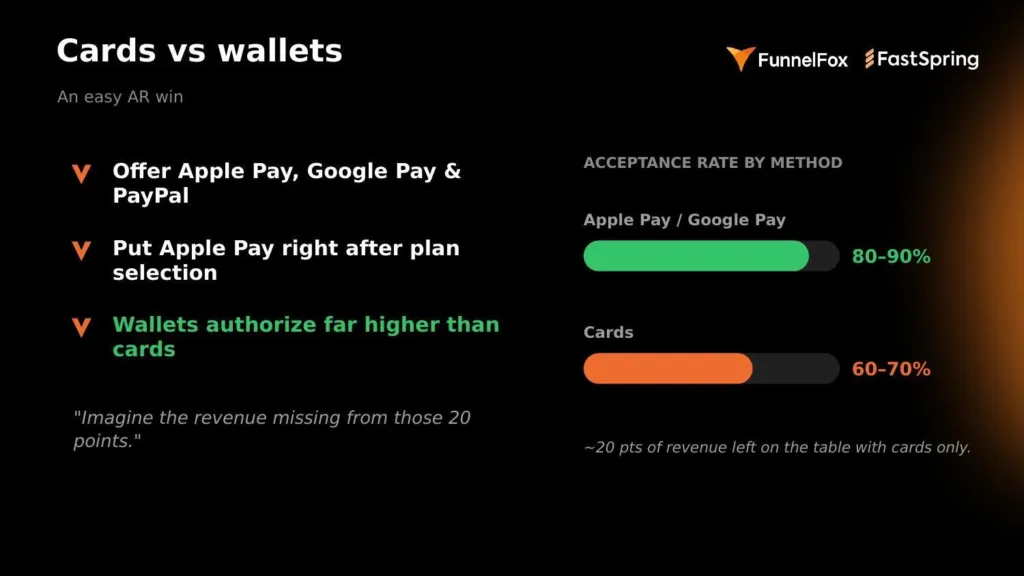
Apple Pay / Google Pay consistently outperforms cards by ~20 percentage points
Local payment methods: go where your users actually pay
Running traffic worldwide with cards-only checkout means you’re invisible to large portions of your potential market. Local payment methods aren’t a nice-to-have for global apps—they’re table stakes.
A quick regional map:
- LATAM: Pix in Brazil (non-negotiable), OXXO in Mexico
- Europe: iDEAL in the Netherlands, SEPA in Germany, Klarna in DACH/Nordics
- Asia: UPI in India, GrabPay in Southeast Asia, Alipay and WeChat Pay in China
- Middle East: Mada in Saudi Arabia, KNET in Kuwait
The implementation shortcut: using a Merchant of Record like FastSpring means you’re adding these through configuration rather than building 10 separate integrations.
Failed renewals: most of it is recoverable
A failed renewal isn’t a lost customer—it’s usually a timing problem. The most common reason is insufficient funds at the moment of the charge attempt. The key insight is that retrying immediately almost never works. Multi-day retry logic does.
Beyond timing, two tactics that work well:
- Partial charges: if you’re getting repeated insufficient funds declines, try charging 70% of the subscription amount, then 50%. A customer paying at a lower amount is better than a churned customer.
- Micro-charges: small test charges to re-establish the billing relationship and get a fresh authorization.
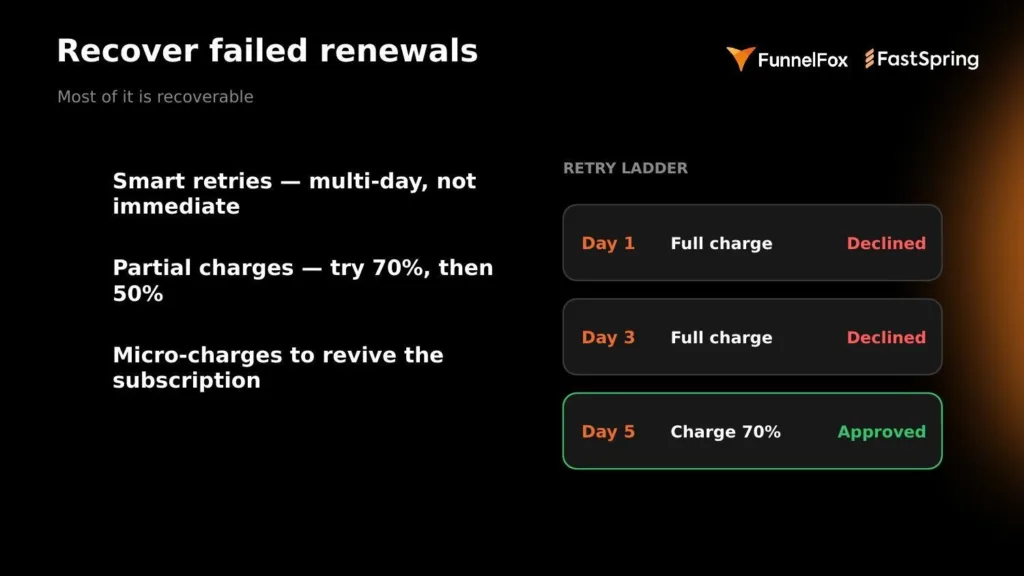
The retry ladder: multi-day cadence with partial charges on Day 5
3 quick wins to implement this week
1—Add local payment methods in your top non-US markets
Start with Pix in Brazil, iDEAL in the Netherlands, and UPI in India. These three alone cover a large share of the addressable revenue gap for most mobile apps.
2—Promote wallets over cards
Move the Apple Pay / Google Pay button to immediately after plan selection. Don’t bury it below the card form.
3—Add retry logic on failed renewals
Multi-day cadence, not immediate retry. Add partial charge attempts (70%, then 50%) after the first failed full-charge retries.
This post is based on the FunnelFox × FastSpring webinar “Why Payments Fail—and How to Recover the Revenue.” Speakers: Nurs, Customer Solutions Lead at FunnelFox; David, CMO at FastSpring.