






This post is based on a talk at Apps in Motion, a conference on mobile app growth hosted by FunnelFox and Adapty at Nasdaq HQ, New York. Watch the full session.
Optimizing locally is a common default — a new paywall variant, a fear-based push, a personalized plan screen. Each one delivers a short-term conversion bump, and that feels like progress.
Over 8+ years in growth, including operating with up to $150M in yearly user acquisition budget, I’ve learned that these tactics plateau fast. In this article, I want to cover why local hacks don’t provide sufficient long-term uplift, and how to build a growth system that actually compounds.
Working funnel isn’t enough for growth
Funnels work because they sell a specific, achievable result tied to a real user problem. You start with a hook, move the user through questions that build curiosity, and surface a specific outcome — here’s how we’re going to solve your problem. When that’s done right, users pay.
The thing is, what happens next? Once you’ve optimized the basics, you hit a familiar wall: you need to build better retention, convert more users to paid, grow revenue — but it’s not clear where to push next.
What most teams do at that point falls into four patterns:
- Introducing FOMO — “without paying, you won’t reach your goal”
- Building an imaginary future self — “pay now for the person you could become”
- Adding fear and dopamine — spikes of anxiety and reward to sustain engagement
- Providing the plan — “here’s your personalized roadmap”
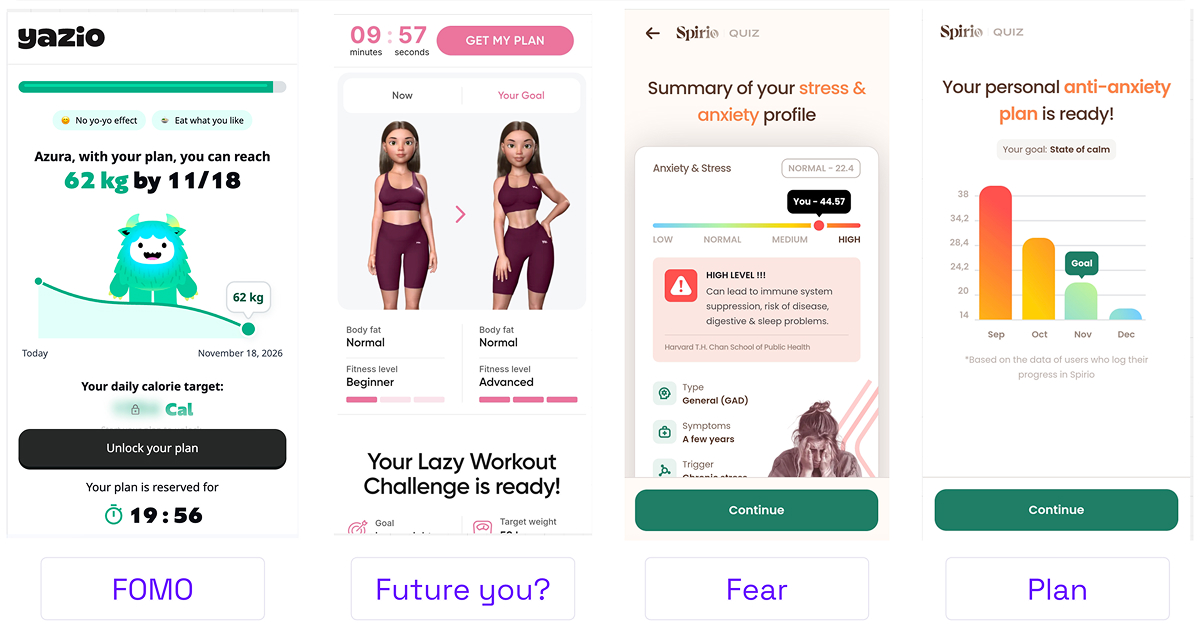
These tactics do work for conversion rates. You target +10%, and you get it.
But local optimization gets you to a local maximum.
In the same cohort, one year out, that initial lift decays to 3% at most — sometimes lower, sometimes negative. These mechanics create a moment of interest at conversion, but they build no momentum for what comes after. The user converts, but there’s nothing pulling them back.
The value momentum exists at the conversion point. After that, it’s essentially absent. That’s the gap a growth system is designed to close.
Start building growth systems, not optimizations
A funnel gets users in. A growth system keeps them. It’s built on what you probably know as growth loops — activation, retention, and viral — broken down into four concrete pillars.
Pillar 1: Build a habit of using your product
The most important thing you can do early is build a habit of using your product. Without that, nothing else works.
Strava is a good example. On first open, there’s exactly one button available: “Start first run.” No onboarding carousel, no feature tour. The activation is the product, and it works because Strava is built for running, so the first thing you do is run.
The principle applies everywhere: the first lesson in Duolingo, the first workout setup in Ladder. Get the user to the first value as fast as possible.
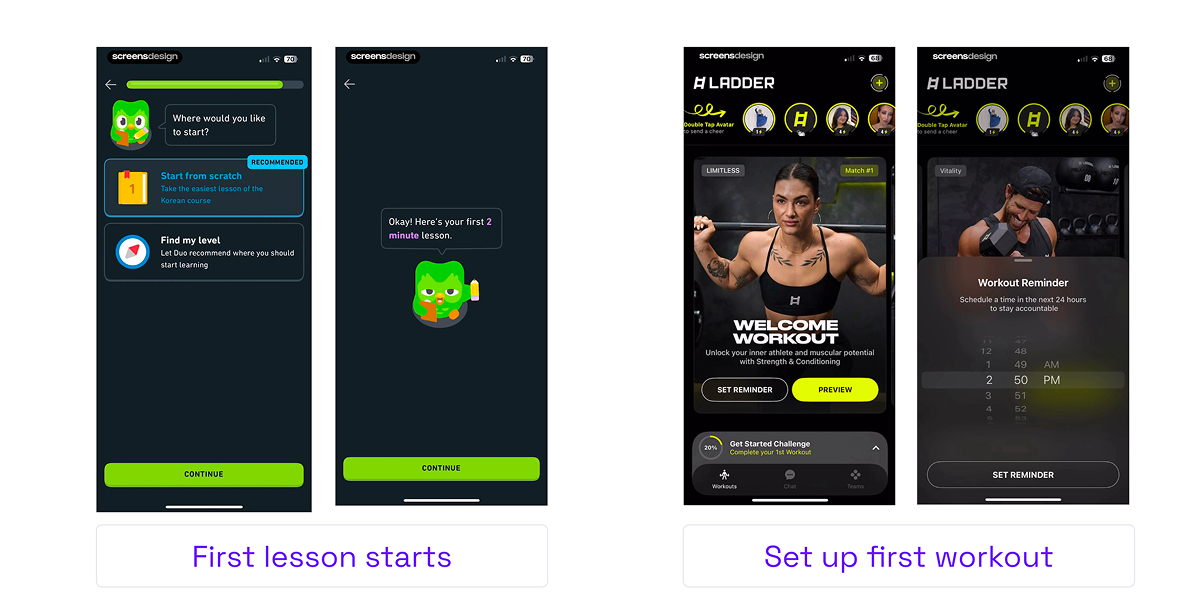
If you build the right activation, you can see at least 3x better retention within the first month comparing activated vs. non-activated users. That’s a meaningful early signal.
But it’s only a first step. Activation builds short-term retention. It doesn’t hold the user past the first month.
Pillar 2: Create retention loops
Retention loops are for already activated users who just need to use your product more often.
Your customer will never retain naturally. You need to create a loop — daily, weekly, or monthly. If your product is built for it organically, great.
You can also build a retention loop completely artificially.
A good example is Finch — a productivity app where you check off daily tasks, then send your mascot on an 8-hour trip. When it comes back, you get a reward. That loop has no real-world equivalent. It doesn’t correspond to anything you can get outside the app. But it brings users back every day to collect their present, and it’s working for them.
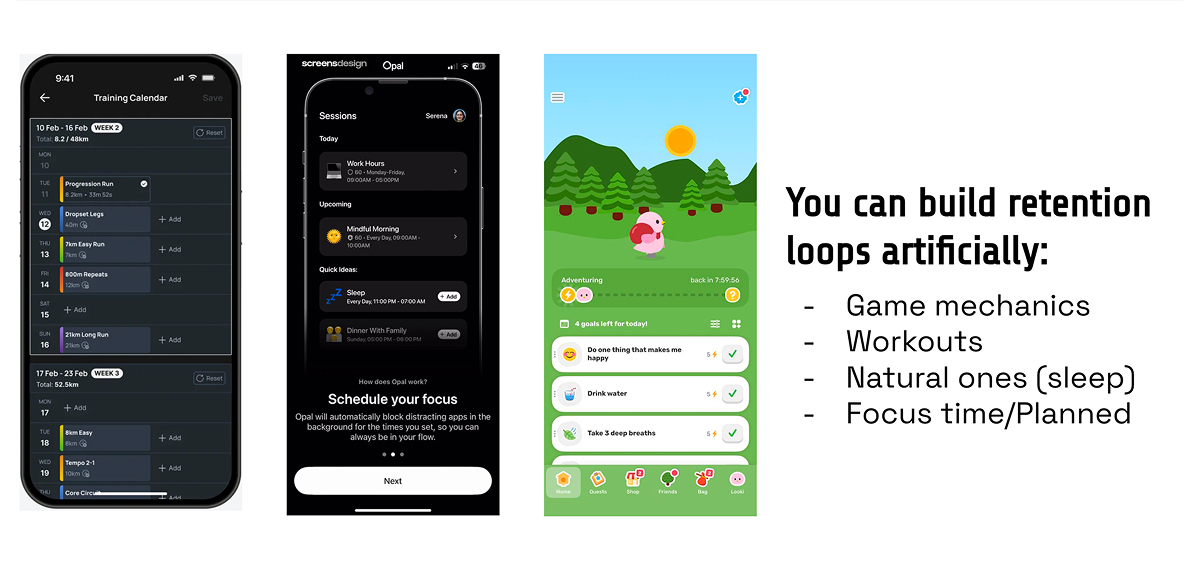
The right retention loops can generate 3x higher retention within one year. But what’s more important is that usually translates into 10x higher LTV, sometimes even higher. Because the loops can be daily, weekly, monthly, even yearly, and within that time you are constantly bringing the user back to get a new reward, a new value.
You’re no longer optimizing once at the funnel — instead, you’re building small wins that work on the average user every day.
Pillar 3: Turn aha moments into conversion triggers
Many of us talk about aha moments, but we create those only within the funnel or only within onboarding. We’re not thinking about it as a constant reward for taking action daily, and that’s one of the most important things you could do.
Duolingo rewards users with experience points after each lesson. That “congrats, amazing lesson” moment really works. And on top of that, they built streaks — hundreds of different types of firing, streaking, and icing streaks — that create dopamine spikes for the users. The industry is saturated with streaks, but Duolingo is one of the best because they build not just the moment of recognition, but the whole system around it.
At Flo, our example is simpler: we unlock your first period prediction during onboarding. And then we do it every time — your predictions update, and you get a reward that’s a necessity for everyday usage, because you’re planning your life around it.
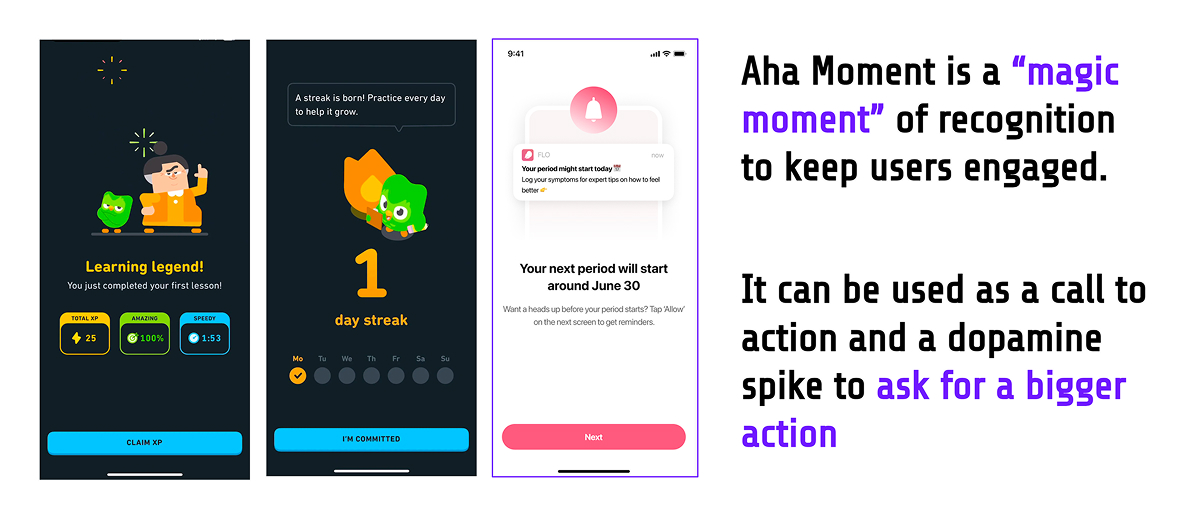
The aha moment is a magic moment of recognition for the user. But in many cases, the market stops there using it only as a reward rather than asking for a bigger action. If you build the right aha moment after the activation and retention loops, you can use it as one of the best moments to push for more.
A correctly placed aha moment can increase notification acceptance by 20%, Apple Health acceptance by 10%, registration rate by 30%, and conversion by 2–3x.
Pillar #4: Add viral loops
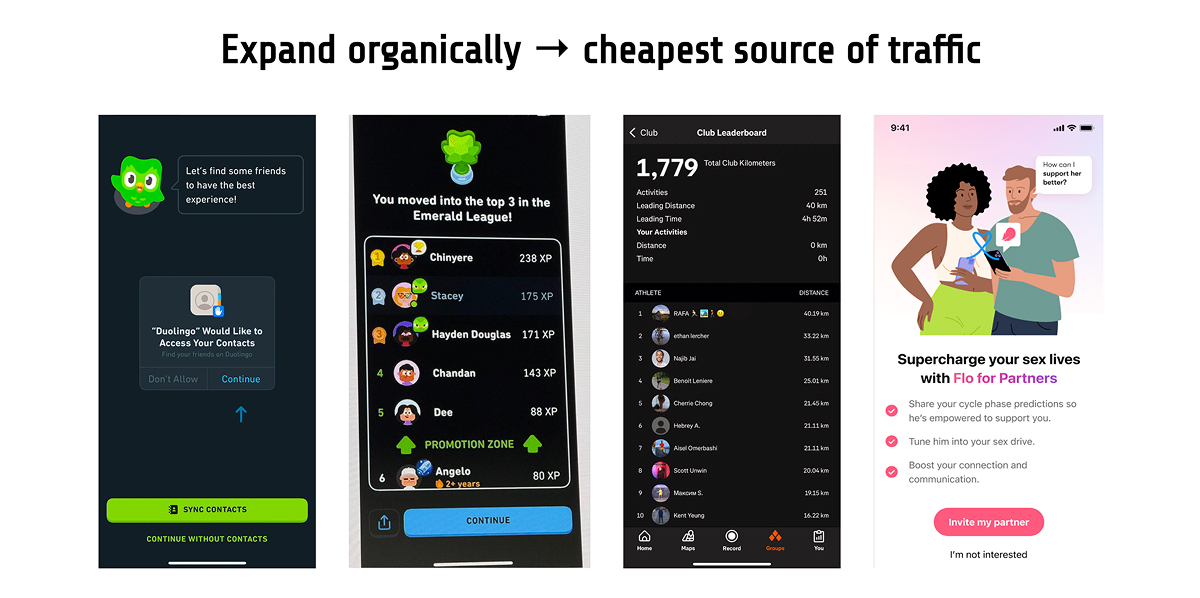
Viral loops are the cherry on top. Competing with friends on Duolingo, comparing runs on Strava, inviting your partner in Flo — these mechanics turn your existing users into an acquisition channel.
It’s the cheapest source of organic traffic: users flexing their achievements, streaks, and results on social networks.
At scale, when the average user is inviting at least 0.5 new users, growth starts compounding on its own. At some point, you’ll even need to adjust your LTV benchmarks, because the cost of acquisition changes.
Putting it all together
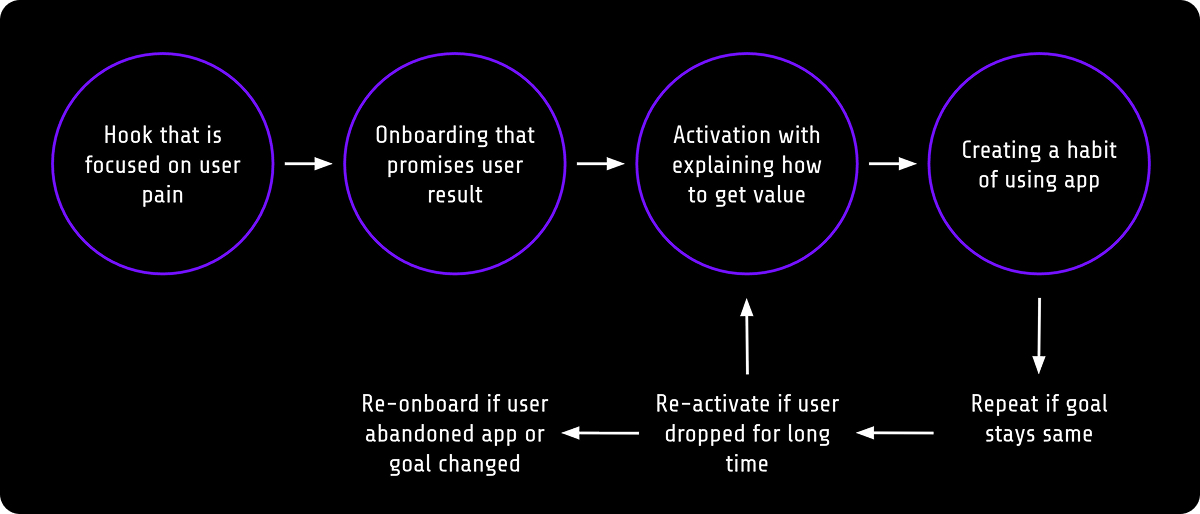
The full sequence looks like this:
- Start with a hook — on the creative and in the funnel
- Onboard the user and promise a specific result
- Activate — get them to first value as fast as possible
- Create a habit of using the app
Altogether, that’s a system of growth.
One thing many teams forget: users will churn. You need to identify the specific points where that happens and have a response for each:
- repeat the habit-forming curve if the goal stays the same
- reactivate if the user dropped off for a long time
- re-onboard if the goal has changed
And the last thing: don’t treat this as a complete framework you can copy. You need to figure it out on your own app, your own business, your own segments. At Flo, we have almost 10 segments, and for each one, we found absolutely new mechanics, new dimensions, new things to work on. If you also have multiple personas or segments, start with the largest ones — that’s where you’ll find the biggest point of impact.