







This post is based on a talk at Apps in Motion, a conference on mobile app growth hosted by FunnelFox and Adapty at Nasdaq HQ, New York. Watch the full session.
Building an app has never been easier: 84% more new apps are launching every quarter than there were a year ago. At the same time, revenue per app is down 22%.
Today, 95% of all subscription revenue goes to just 10% of apps. The gap between top-earning apps and average ones is 15x.
Revenue isn’t spreading — it’s concentrating. At Adapty, my team and I studied $3B in subscription revenue across 16,000+ apps. Here’s what separates the top 10% from everyone else, and how you can get there (or stay there).
Price for the real world and give a weekly subscription plan a chance
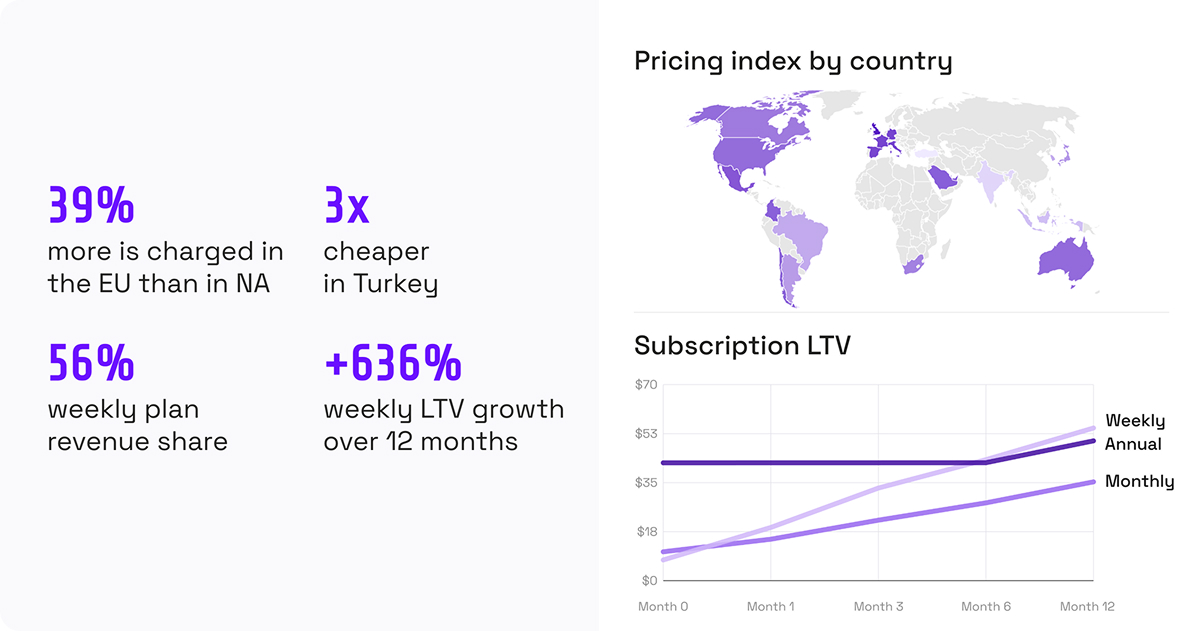
The pricing index varies significantly by country. What costs 1x in one market can cost 1.5x in another or 0.3x somewhere else. That gap has real consequences for how subscription revenue accumulates across regions.
One of the clearest examples we’re seeing: the difference between what subscriptions are priced at in Europe versus North America. Two years ago, that gap was around 6%. Today it’s 39%, and it’s still widening. Turkey sits at the other extreme: subscriptions there are typically 3x cheaper than in other markets.
If you’re selling globally and haven’t yet experimented with region-specific pricing, that’s a gap worth closing.
The second finding was more surprising, at least relative to what the market has been focused on for the past few years. For a while, the dominant combination has been annual plan plus trial.
What we found in the data is a steady shift: weekly plans now account for 56% of subscription revenue, up from 42% two years ago.
The LTV chart tells the full story. Weekly starts low — around $7 at month zero. But by month 12, it overtakes annual. Even with the lump-sum charge that annual carries, weekly cumulative LTV ends up higher.
Weekly plus trial, it turns out, is the superior combination on a 12-month horizon, with +636% LTV growth over that period. If you haven’t tested it yet, the data suggests you should.
Run more experiments, but start with the right ones
More experiments means exponentially more revenue: teams that experiment regularly earn 40x more than those that don’t, at roughly the same stage and revenue level. Among apps that do experiment, the average is 14.7 experiments per year — consider this a reasonable benchmark to work from.
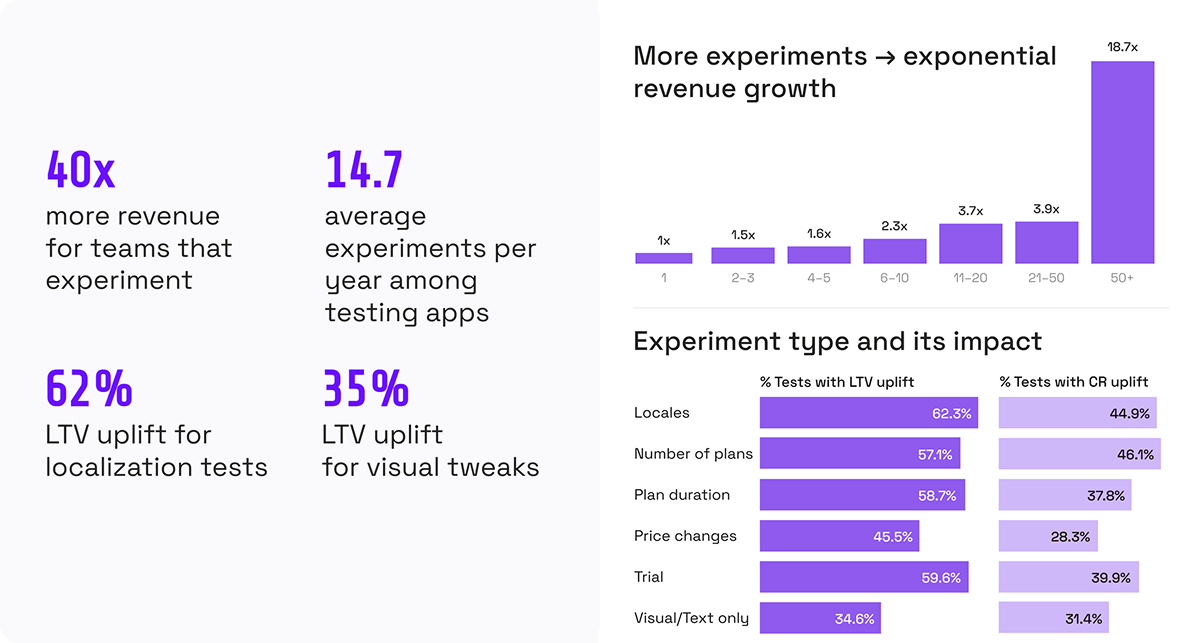
But volume alone isn’t the point — what you experiment on matters just as much as how often.
Locale-based tests produce the highest LTV uplift — 62.3% of them move the metric. This includes both pricing adjustments for specific regions and localization of paywall copy.
Number of plans and plan duration follow close behind at 57.1% and 58.7% respectively.
Visual and text-only tests sit at the bottom at 34.6%. Visuals matter, but they can only get you so far. Running visual tests first, before touching pricing, localization, or plan structure, is working in the wrong order.
Give your onboarding paywall the attention it deserves
90% of trial starts happen on day zero. What this means in practice is that your onboarding paywall gets exactly one shot — and the lead-up to it, the value you communicate before the user reaches that screen, determines whether that shot lands.
What we see top apps experimenting on right now:
Shorter trials. Users who need more time tend to churn more. 7 days or less is the direction most teams are moving.
Hard vs. soft paywall. A hard paywall — full lock — produces on average +20% LTV in our data. A soft paywall converts at roughly 50% higher rates. Which one fits your monetization strategy is a separate question, but it’s a test worth running at least once.
Post-close offers. A discount is shown only to users who didn’t convert on the first paywall screen. This has been producing significant LTV results and is one of the more actively tested mechanics right now.
There have been reports of the App Store cracking down on this practice, so proceed carefully. If you want to test it, start with a subset of your traffic — 10–20% is a reasonable starting point.
Comparison tables. Free vs. Pro on the paywall — removes the “what do I get?” friction before it becomes a reason not to convert.
Plan loaders. A loading screen with social proof appears before the paywall.
Web checkout. A parallel acquisition channel worth testing alongside the in-app flow.
Treat web2app as a growth engine, not a workaround
In 2024, 30% of the top 100 grossing apps used web2app. In 2025, that number jumped to 82%. Web2app is no longer something teams try out — it’s how top apps grow.
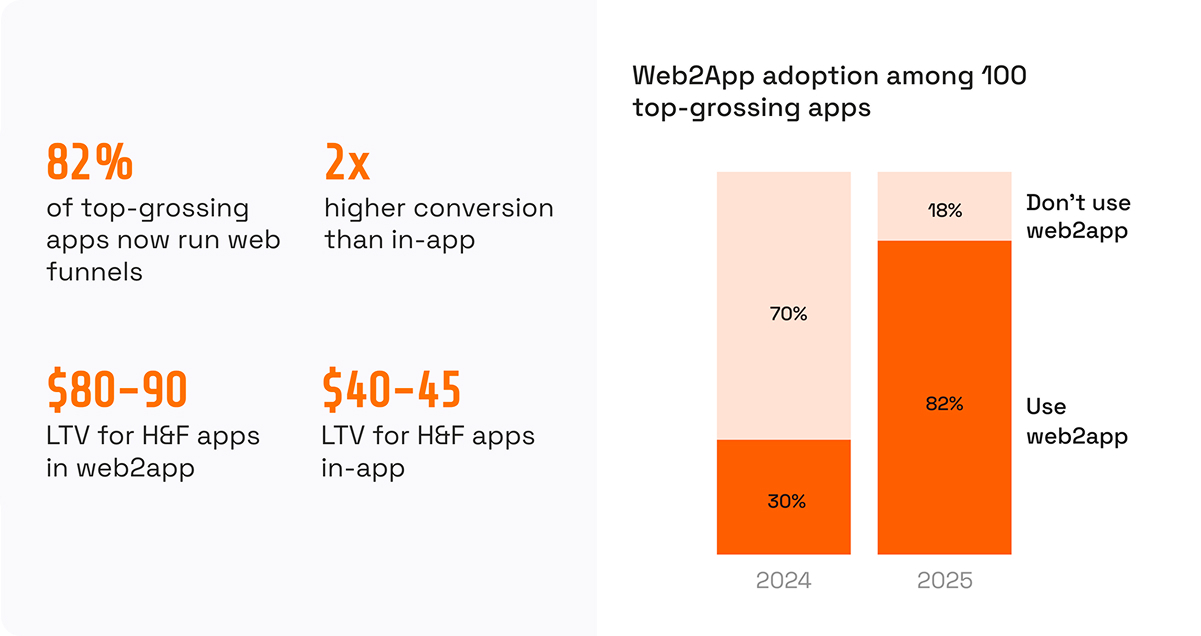
The reasons are visible in the numbers. Web2app conversion runs 2x higher than in-app. For health & fitness apps, LTV in web2app sits at $80–90, compared to $40–45 for the same category going direct-to-app. The difference comes from a combination of factors: no or lower store commission, more freedom to upsell, and a longer, stronger retention curve.
If you haven’t tried it yet — or tried it once and it didn’t work out — it’s worth another look.
Key takeaways
Four things consistently separate the top performers from the rest:
- Localize your pricing by region and give weekly + trial a real shot.
- Run more experiments, but get the order right: localization first, then plan structure, visuals last.
- Make your onboarding paywall count — 90% of trial starts happen on Day 0, so test hard/soft paywall and post-close offers.
- And if you’re not running web2app funnels yet, 82% of top-grossing apps already are.