






This post is based on a talk at Apps in Motion, a conference on mobile app growth hosted by FunnelFox and Adapty at Nasdaq HQ, New York. Watch the full session.
About the author: I’m Jessica Gotti, Head of Performance Marketing at Bend (a stretching & mobility app). I’ve scaled paid UA across more than 20 subscription apps, with experience at Once, Paired, and Bending Spoons, focusing on creative production, media diversification, and funnel diversification.
Every paid UA team eventually hits the same wall: CAC starts creeping up, CTR drops, frequency climbs, and growth plateaus. Cutting budget gives a brief reprieve, then CAC climbs again. And the easy explanation “we’ve saturated the channel” is almost always wrong.
Channels like Meta and TikTok have massive inventory, and they’re genuinely hard to saturate. What teams usually exhaust is their strategy: same funnel, same creatives, same audience, same offer, repeated for months.
In this article, I want to share the framework I’ve been using across the subscription apps I’ve worked on to break through that ceiling. I’ll cover how I spot strategy exhaustion early, the 3-step sequence I follow to unlock new growth, and the mistakes I’ve seen teams make when they try to diversify.
Why “channel saturation” is usually the wrong diagnosis
When CAC starts rising, most teams assume they’ve saturated their core channels (Meta, TikTok, YouTube). That’s rarely the case. These channels have enormous inventory, and saturating them is genuinely difficult.
What teams are usually hitting is strategy exhaustion. After months — or in some cases years — of running the same setup with the same funnel, copy, creative angles, and audience, the audience just gets tired. The channel is fine. The strategy has run its course.
That distinction matters because it changes what to do next. The answer isn’t a new channel — it’s refreshing how the existing ones are being used, and then expanding from there.
How to spot strategy exhaustion
Before assuming the strategy is the problem, rule out external factors first: seasonality (Black Friday spikes competition and pushes CPMs up), or broader economic shifts that move the auction across the board. If the cause is external, the fix is patience.
Once external factors are excluded, three signals confirm strategy exhaustion:
- CAC is rising while CPM stays stable. CTR is dropping, frequency is up, and profitability gets unstable. Cutting budget might help in the short term, but CAC starts climbing again shortly after.
- Creative fatigue arrives faster. Angles, communication, and creatives that were working before stop working, and fatigue kicks in much faster than it used to.
- Marginal ROAS is dropping. Average ROAS may still look decent, but every extra dollar of spend brings in lower-quality users. The incremental return is gone.
When those three signals line up, it’s time to move to the framework.
The 3-step shift: where to look for new growth
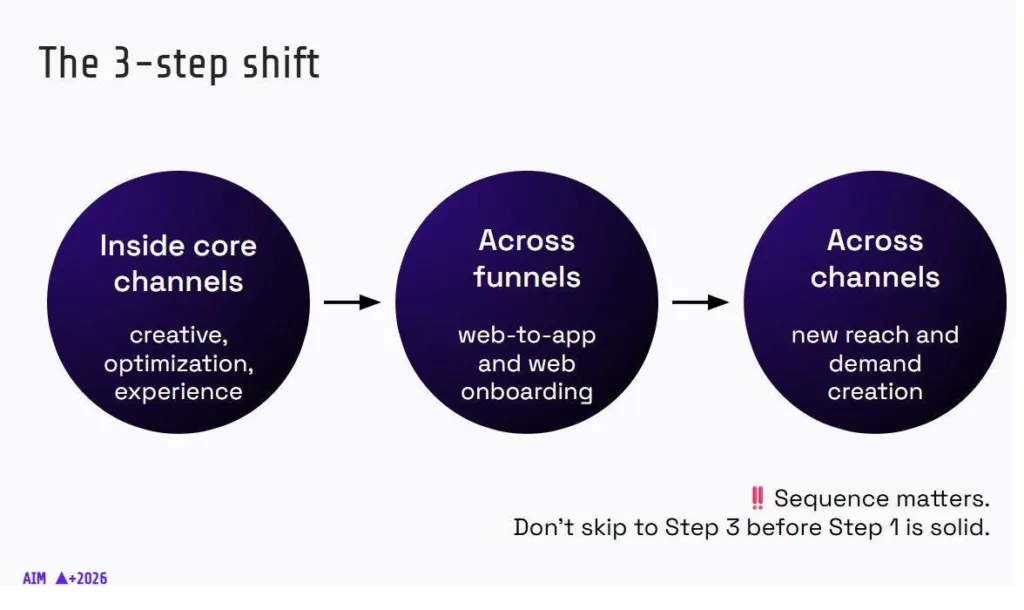
New growth can come from three directions: inside the core channel, across funnels, and across new media channels. The order is critical. Each step adds complexity — in resources, attribution, and creative production — and skipping ahead before the foundation is stable usually creates more problems than it solves. If the core channel is leaking and you jump straight to channel diversification, you’re stacking complexity on top of an unstable base.
Step 1 first. Then Step 2. Then Step 3.
Step 1. Squeeze more value from your core channel
The first step is about getting the most out of the channel you’re already running. There are three parts to this: creative diversification, optimization strategy diversification, and consistency between the ad and the app.
Diversify your creative
Creative is one of the most powerful levers in performance marketing today, especially with the privacy limitations of recent years that have made the creative itself the primary way to target the core audience.
The approach: think about each user persona, identify the needs the app solves for them, and build a dedicated creative production process for each. This shouldn’t be a reactive move triggered by a CAC problem — it should be part of the system from day zero.
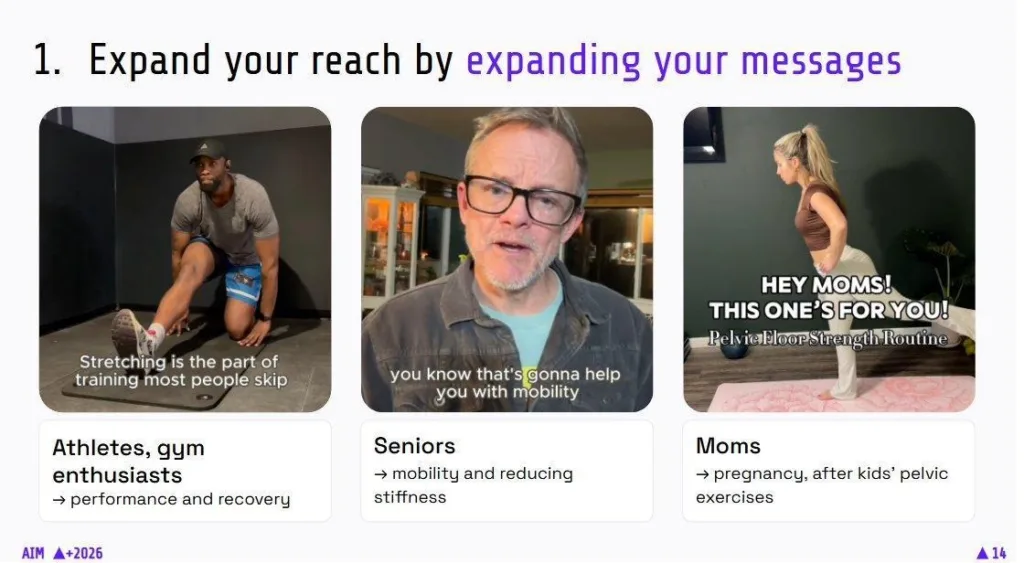
Here’s how we run it at Bend. We’ve set up three parallel creative tracks, one for each of the main personas the app serves:
- Athletes and gym enthusiasts: warm-up, cool-down, and performance stretching routines.
- Seniors: mobility and longevity messaging.
- Pregnant women and moms: pelvic floor strength and hip mobility.
Diversifying creative diversifies reach, which has a direct positive impact on paid user acquisition.
Diversify your optimization strategy
Most teams optimize relentlessly for deep-funnel events like Trial Started or Purchase. That makes sense in principle (this is performance marketing, you want your money back), but at some point you exhaust all the high-intent users the algorithm can reach at that depth.
Three ways to expand:
- Optimize on upper-funnel events. Pick an event that happens within 24 hours of click, has a good correlation with payment, and produces enough volume to feed the algorithm. If no native event fits, you can create one. This is sometimes called “signal engineering,” and Thomas Petit has written extensively on the topic.
- Diversify your bid strategy. Test app event optimization. Test value optimization, which works particularly well if you have a purchase happening at day zero. If you don’t, you can build a predictive LTV model and feed predicted value back at day zero, since algorithms tend to favor signals that happen within 24 hours of click and install.
- Use new platform features. Meta and TikTok regularly release new features that are useful for diversifying strategy. Meta’s Value Rules, released in the past year, are one example.
Match the ad to the app
The final lever inside the core channel is making sure there’s consistency between what the ad is selling and what the user finds in the app. Mismatches drop conversion rates, and the same goes for a hard onboarding. The more frictionless the onboarding and the more consistency between the ad and the app, the better the conversion rate, the LTV, and ultimately the profitability of the campaign.
It’s an underrated step, but it matters.
Step 2. Diversify across funnels: web-to-app and web onboarding
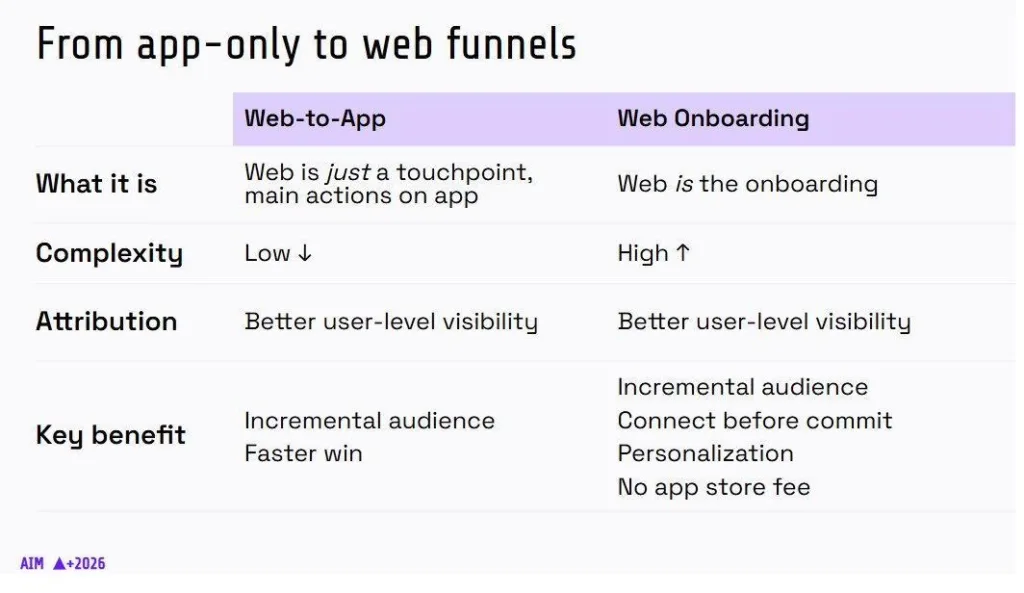
Once the core channel is stable, the next unlock for app businesses is funnel diversification — moving beyond the app funnel and adding web-based flows. There are two distinct options here, and they solve different problems.
A web-to-app funnel is when you leverage the web as a touchpoint, but the main action still happens on the app. The user clicks an ad, lands on a web page, and gets redirected to the App Store. (You’ll also hear it called auto-redirect or enhanced-app funnel — same thing.)
Web onboarding is different: the user goes through the onboarding on the web and takes the conversion action on the web too. The purchase happens before the install.
Both options unlock user-level visibility (which got harder to get from the app funnel) and expand reach incrementally on top of business as usual.
Web-to-app: start from day zero
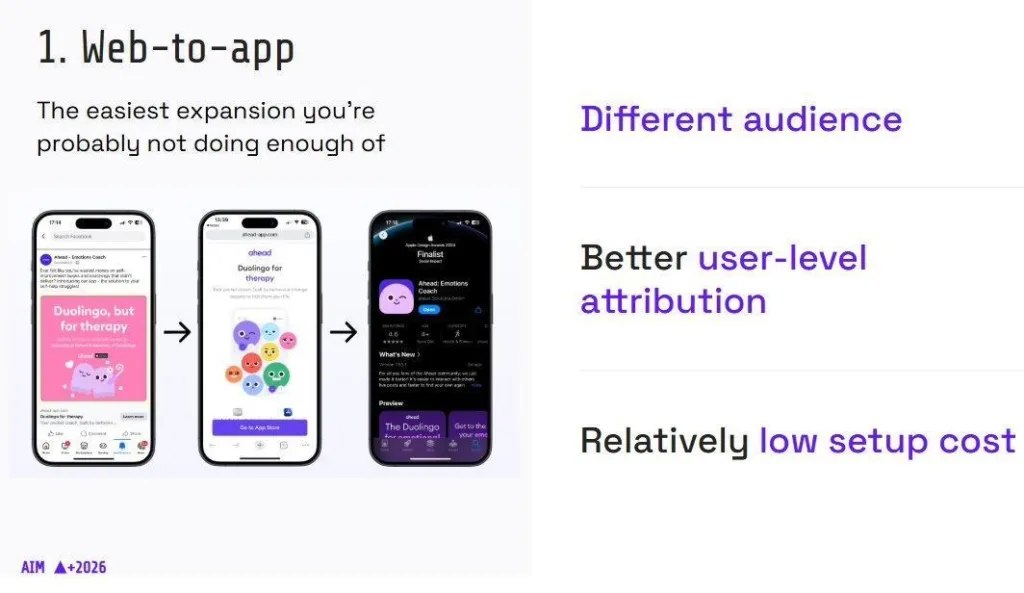
Web-to-app is straightforward to set up, and my recommendation for every app business is to start running it from day zero in parallel with app campaigns. It diversifies the funnel, diversifies the audience, and restores user-level visibility.
Web onboarding: a different beast
Web onboarding is its own product. It requires resources, time, and budget to invest, but it also unlocks significant value. Beyond user-level visibility, web onboarding gives you additional benefits: skipping the App Store fee, the ability to run A/B tests heavily and faster (no apple reviews), the option to deliver a personalized onboarding by user persona, and the chance to create an emotional connection with the audience.
It works particularly well for businesses with a high-LTV model and a complex value proposition. Paired is a good example here. Selling a relationship care app with a 10 to 15 second ad is hard, and a web onboarding gave us the space to ask questions, create that emotional connection, and educate the user about the product, all of which improves the conversion rate at the end.
Where it works less well: casual game apps or utility apps, where the user wants to open the app and solve their need right away.
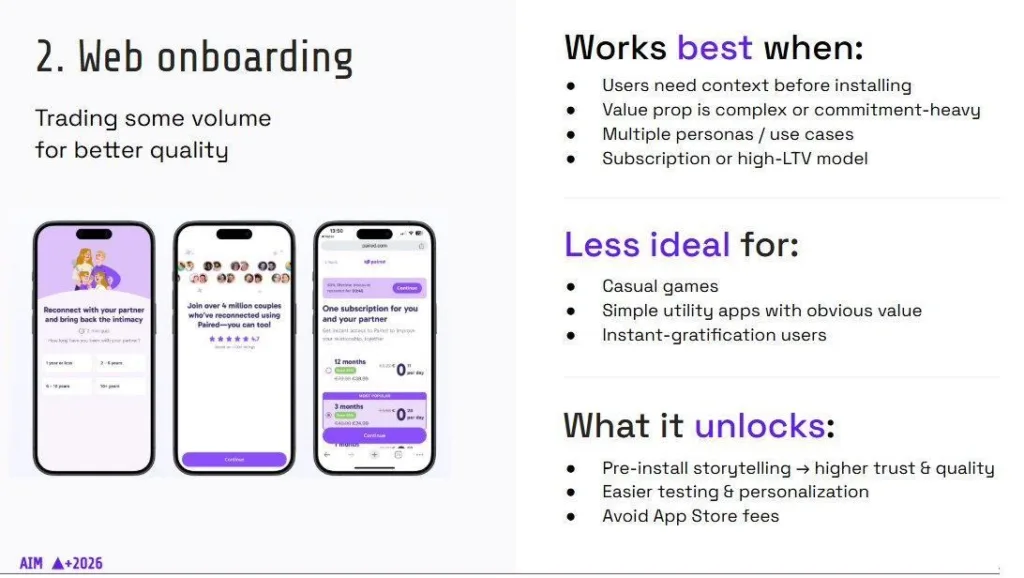
My recommendation: still work on web onboarding, but be honest about the resources, time, and budget it requires. Services like FunnelFox can support the resources and time side by helping develop the onboarding and providing examples to leverage. The investment is real — you have to test a lot before finding the right setup — but the upside is significant once you do.
Which funnel for which situation
The decision usually comes down to where you are as a business.
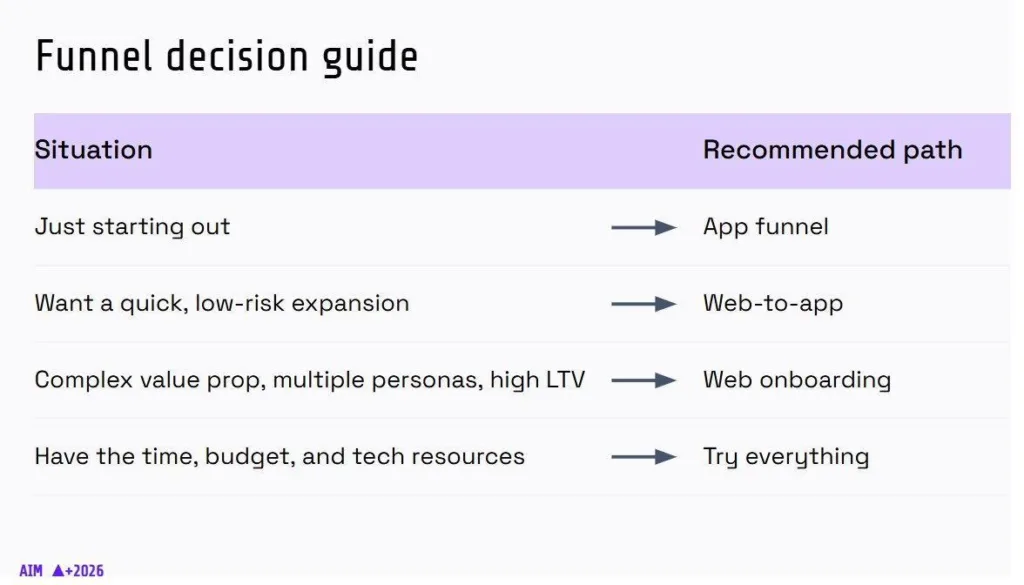
Web-to-app is for everyone — start from day zero. Web onboarding depends on the status of the business and the model.
Step 3. Diversify across channels
Channel diversification is an important step too, but it should be left for last. Once the core channel is fixed and the funnel mix is diversified, then it’s time to expand the media mix.
The reason it sits at the end is the same complexity argument as before: new channels add complexity in resources, time, investment, trackability, and creative production. Done at the right time, the benefits are real:
- You diversify the media mix and stop relying on just a few core channels, which limits dependency on any single platform.
- You expand reach and penetrate the market, since the same target user starts seeing your ads from different placements, which builds brand memorability.
- You create demand by going beyond high-intent users and reaching cold audiences who weren’t searching for your category yet.
The most common question at this stage: which channel to add next? The honest answer is that there’s no universal right answer. It depends on the status of the company, how stable the business is, and whether the team has the resources, the creative setup, and the measurement setup in place. Based on those factors, you can pick the channel that fits.
Group channels by the role they play
To make the choice easier, the main channels can be grouped by the role they play in the funnel and the benefit they bring. Each role does a different job, and each comes with its own tradeoffs.
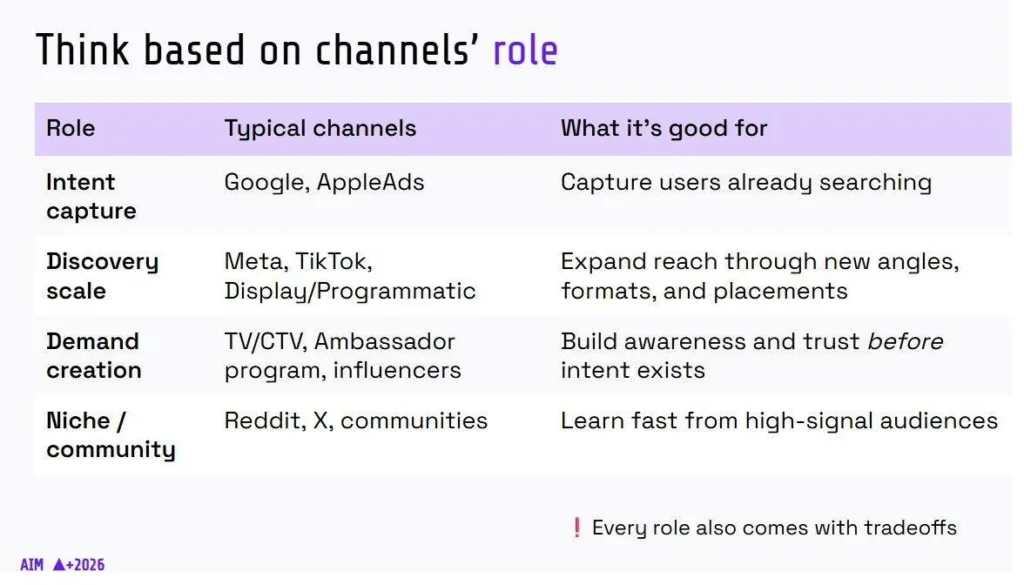
- Intent capture — channels like Google and Apple Search Ads. The job here is to capture users who are already searching for your category. High-intent traffic, but limited to the demand that already exists.
- Discovery scale — Meta, TikTok, Display, and Programmatic. These are the workhorses for expanding reach through new creative angles, formats, and placements. Most subscription apps already run these as their core channels in Step 1.
- Demand creation — TV/CTV, ambassador programs, and influencers. These channels build awareness and trust before intent exists. They’re how you reach cold users who weren’t searching for your category yet.
- Niche/community — Reddit, X, and other communities. The value here is speed of learning from high-signal audiences, often before broader markets pick up on the same trends.
It’s worth going a little deeper on the demand-creation row using influencer and ambassador programs as the worked example. The channel is great at expanding reach, but there’s no targeting layer, so you don’t really control where the content ends up. The play is to build awareness and educate cold users, and the channel does allow you to do that. Influencers create trust before intent exists, which is why they create demand when it isn’t there yet.
The flip side: trackability is a real challenge. Traffic from ambassador and influencer programs is hard to track, and you have to be ready to handle that. It’s also not easy to succeed — you have to test a lot and invest money before finding the right approach.
Three common mistakes
Three mistakes show up repeatedly across subscription app teams trying to break through saturation:
- Skipping Step 1. Jumping into media or funnel diversification before stabilizing the core channel. The added complexity has a real impact on the business, so stability has to come first.
- Running too many things at the same time. When you change too many variables at once, you can’t tell what is bringing value and what isn’t.
- Underestimating resources, time, and budget. Especially on the measurement and creative production side, the cost of diversification is consistently underestimated.
Final checklist
When CAC starts rising and profitability gets unstable, here’s what to take away:
- Rule out external impact first (seasonality, economic shifts).
- Step 1 — Inside the core channel: squeeze more value through creative diversification, optimization strategy diversification, and a smooth ad-to-app experience.
- Step 2 — Across funnels: expand into web2app and web onboarding.
- Step 3 — Across channels: diversify the media mix once the first two steps are stable.
And throughout: respect the complexity that comes with diversification, and be ready on the attribution side, the creative side, and the resources and tech side.