






Most subscription apps start in the US and stay there. IntellectoKids went the other way. Today English accounts for roughly 8% of their ad set, and the rest of the world carries the volume.
In this FunnelFox webinar, Marcus Burke, Meta Ads & App Growth Advisor, sat down with Dmytro Pysmennyi, CEO of IntellectoKids. They covered how a preschool education app runs web funnels across dozens of markets: what it took to get there, what broke along the way, and what you need in place before you try it.
IntellectoKids is a gamified education app for preschoolers aged 2 to 7. It’s a ten-year-old project that once merged five apps into one. It ran mainly on app funnels, then shifted to web after IDFA. Both still run today, with web the bigger side.
Prefer to watch it in full? Here’s the recording:
It started with tests, not a plan
There was no roadmap for entering dozens of markets.
“No one planned a huge geo diversification initially. It was just a result of successful tests, and we managed to find additional users outside our core US tier-one market.”

Not every market worked. But the tests could only run because the homework was done first. IntellectoKids already had 30+ translations live, in the product as well as in marketing. That kept the biggest markets open to them.
From there, the web funnel does the heavy lifting. You get room to test subscription types, pricing models, and local currencies.
The results diverge sharply by region. Some geos reward higher pricing, others lower. The size of the increase after the intro price matters, and so does term structure. According to Dmytro, IntellectoKids sees different winners for different subscription types in different countries.
Keep one geo structure per channel
Dmytro’s advice is to settle on a geo structure, base it on your own test results, and maintain it. Different channels can have different structures.
The reason is signal.
“Keep your own geo structure based on your tests, and maintain it. Big swings into a mature channel would bring you more troubles rather than wins.”
Three things break when you swing hard. You influence your pixel. You risk a mess in customer feedback. And cohort quality moves: scale a non-US country 2 to 5 times, and the cohort behaves nothing like the one your model was built on.
Marcus drew the same line from the paid side. Test a hard paywall on 50% of traffic and you change who converts, which games the algorithm.
So watch how your prediction model performs against factual payments. That matters most when you enter a new market, or scale an existing one 2x to 3x beyond its usual size.
Localize the product, not just the marketing
Asked whether this is translation or localization, Dmytro was unambiguous.
“You can try it for a cheap ticket on marketing, but if you really want to scale it up sustainably, then you have to adapt your product as well. It’s a full localization: text, navigation, voiceovers, everything.”
IntellectoKids has full localization for 30 languages across most of its content.
The timeline is the interesting part. Only 3 of those 30 were added in the last year and a half. The other 27 sat there for a while, waiting for the user acquisition and creative approach that would grow those regions.
Which points to the real constraint:
- Marketing localization is a cheap ticket. You can test a geo on the marketing layer without committing much.
- Product localization is the expensive part. Scaling sustainably means adapting the product itself.
- Quality control doesn’t scale by headcount. With 30+ languages, IntellectoKids doesn’t have native speakers for each one. They run a mix of AI and human proofreading, in the product especially, and sometimes in the funnels too.
What changed in creative production
IntellectoKids has seen dramatic growth in video over the last year and a half, roughly since Andromeda. On statics, the shift is about volume.
“Everyone is producing 10, 100 times more than they used to. That drops the success rates and increases fatigue of the creatives, so we produce more and test more to get the same amount of winners you had before.”
For IntellectoKids there’s an extra multiplier. DLO testing means testing in more than just English.
Statics still earn their place, because they unlock video. Animated statics are a way to test angles, problems, and hooks. Building a static costs far less than testing the same idea as a video. As Dmytro put it, you can’t live only on video.
On UGC, the picture is more mixed:
- Animated statics were the highway for a long time. Video and UGC are recent additions.
- UGC hasn’t been their best-performing format, though it’s improving.
- They run AI iterations of real UGC. AI UGC from scratch didn’t produce good results for them.
- Kids’ voiceovers remain a quality problem for AI compared with adult voices.
- Filming kids is a task in itself, which complicates UGC, user tests, and custdev alike.
Marcus tied the format question back to defensibility, referencing a LinkedIn post from Nick Candler: these days the moat is how copyable you are, because anything can be copied. High-quality UGC is still expensive to replicate.
That creative mix has one upside. The EU, California, and New York are all moving on AI labeling, and IntellectoKids isn’t exposed. As Dmytro put it, that’s where they are safe.
Inside the ad library
Marcus walked through the IntellectoKids ad library and pulled out the recurring angles.
The first is worksheets and exercises. Because the subscription also covers off-screen activities, the ads can sell something closer to a physical product, which brings in a different audience.
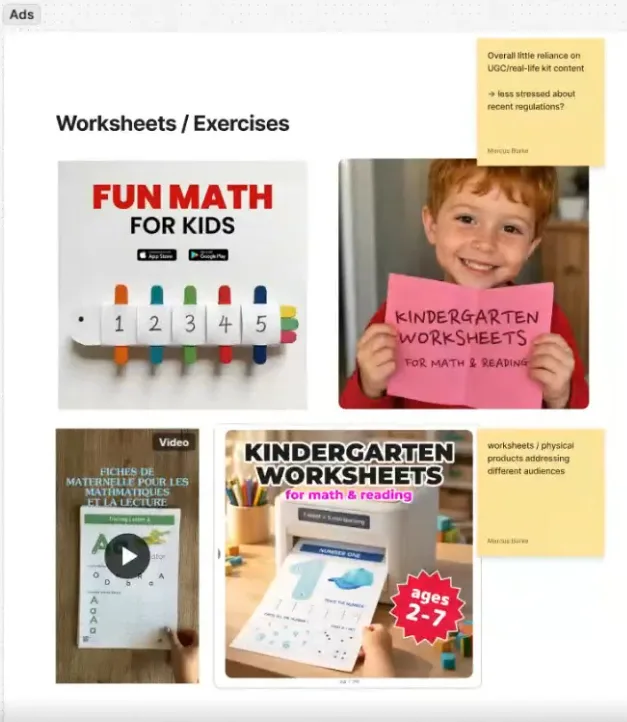
IntellectoKids ads for worksheets and exercises, from Marcus Burke’s ad library breakdown
Marcus’s note on this set: overall little reliance on UGC and real-life kit content, which may mean less stress about recent regulations. Dmytro confirmed the angle is deliberate. Worksheets let IntellectoKids meet parents who want to cut screen time, and the company can offer something for that.
The second angle is parent nostalgia. Some ads are clearly kid-facing, with toys and bright colors. Others are aimed at the millennial parent: The Land Before Time, a dinosaur strategy game, or lettering that recalls a Nintendo 64 box.
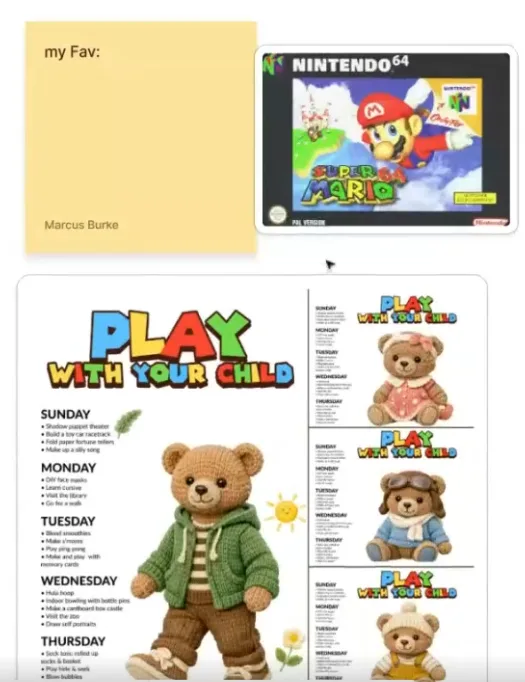
IntellectoKids “Play with your child” ads next to a Super Mario 64 box, marked as Marcus Burke’s favorite
The app itself also stays front and center in the ads, which is less common. Dmytro said that’s on purpose: it manages expectations about what the user actually gets.
Personalize on geography, age, and skills
IntellectoKids personalizes in three dimensions.
- Geography currently means language. Cultural adaptation inside the product sits in the backlog as a next step.
- Age splits into four routes: 2 to 3, 3 to 4, 4 to 5, and 6 to 7.
- Skills covers what the parent wants the child to learn: numbers, math, reading. Special needs is part of it too, with methodologists working on the content and how it’s presented.
Marcus flagged that the split shows up in the ads too. The YouTube-replacement set runs age-based variants for 2 to 3, 3 to 4, and 5 to 6, so age-based ads feed an age-based funnel.
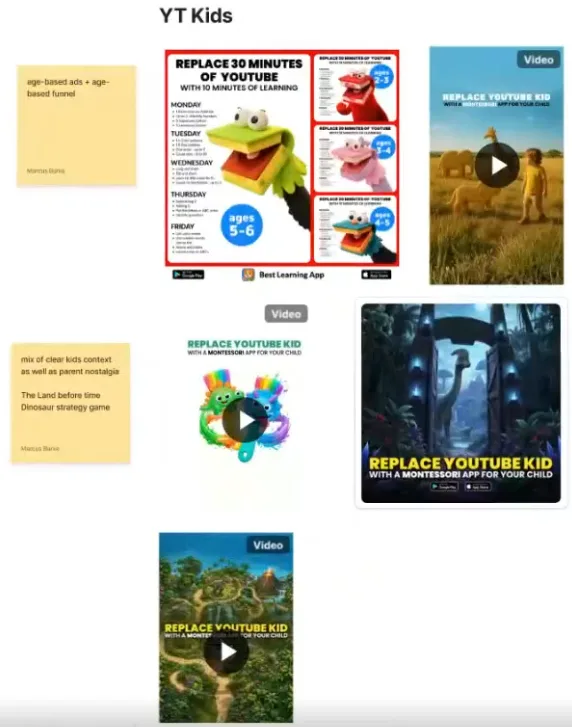
IntellectoKids ads offering to replace 30 minutes of YouTube with 10 minutes of learning, in age-based variants
The critical detail: these adjustments run in the product, not only on the web funnel. The parent answers questions, and the product they open reflects those answers.
That’s also where the responsibility sits. IntellectoKids advertises to parents only.
“All of our marketing assets are always directed towards parents. We never sell anything to kids, neither on our creatives nor in the app itself.”
A mismatch costs more here than in adjacent verticals. In gaming, you can capture someone with one thing and transition them into something else, and an adult can decide for themselves. Put something unexpected on a child’s screen and you get rage.
How many funnels you actually need
IntellectoKids runs 3 active web funnels and has tested 3 or 4 more.
A new creative topic doesn’t automatically get a new funnel. Sometimes the general funnel handles it. Challengers are tested against the default funnel, the one with the most testing behind it. If a challenger wins, it stays. If not, the default keeps running.
Language has never triggered anything beyond translation. Geography has. IntellectoKids runs roughly 7 tiers and runs similar tests in each. The results diverge, so the default funnel ends up looking different tier by tier. Some tests win in one place and lose in another.
The guardrails are minimal. No misleading practices. The tests decide the rest.
On teams running hundreds of funnels, Dmytro was blunt about the resourcing. At 100 times their size, you’d need 100 funnels and 100 growth managers to work them.
How the Meta account is set up
With ads translated into 25 languages, you’d expect the account to be chaos. It isn’t.
Campaigns are structured toward tiers. Some run worldwide, some are tier-specific. The per-country strategy comes from the creatives themselves. To grow a country, the team moves creative strategy in that direction and runs it on worldwide or broad campaigns, with Meta’s dynamic language optimization handling the rest.
So there’s no geo strategy in the account. The creative mix triggers a geo pattern, and that pattern holds over time. For a seasoned product with stable demographics and cohorts, big geo shifts only come from specific triggers: US elections, or adding a language and marketing in that region.
Review it retrospectively. As Dmytro put it, thinking about how it should look next month makes no sense.
Marcus described the creative manager’s job as placing bets: spotting a market that looks interesting and moving creative in that direction. Dmytro agreed.
“Creative strategy is always placing your bets and then just checking who wins.”
From manual bids to ROAS campaigns
Over the last year, IntellectoKids swapped bid-oriented campaigns for ROAS and value optimization. The split went from 90/10 to 10/90.
The math explains why.
“We have like 150 countries, 30, 40 currencies, 30, 40 subscriptions. It’s no longer human work: you have to calculate LTVs and send them to the system.”
— Dmytro Pysmennyi, CEO, IntellectoKids
“We have around 150 countries, 30-40 currencies, 30-40 subscriptions. It’s no longer human work: you have to calculate LTVs and send them to the system.”
That makes predicted LTV a prerequisite for geo diversification. Dmytro named it as a checklist item: build a bulletproof pLTV framework, feed the real numbers into your ROAS campaigns, and that’s what unlocks going wide.
He also flagged an honest caveat. IntellectoKids changed several things at once: US to diversified, statics to video, bidding model. Isolating the effect of any single change isn’t possible. Which makes one check non-negotiable.
“Check your factual cash income, how it comes from different regions: is it along with your predictive model, or not close at all? I would take the money in the bank, not what you calculated on some sheet.”
Paywalls and subscriptions by market
Dmytro’s read on the regulatory shift is optimistic. The market is adapting toward a new equilibrium. The result is cleaner funnels and more sustainable products that care about user experience, and optimizing toward high-quality usage gets easier in that environment.
On paywall mechanics, nothing is fixed, and the market variation is real:
- Some markets favor shorter billing periods, like weekly.
- Others show growth in direct yearly subscriptions without a trial. Dmytro called it non-traditional but growing.
- Most products have no free trial on web.
- The steeper the step-up from trial price to first rebill, the more questions it triggers. IntellectoKids keeps the increase shallower on purpose, which also points Meta’s algorithm toward their type of user.
Marcus added the market-level view. Payment providers are clamping down on refund rates alongside the FTC, and that pressure is pointing teams somewhere useful.
“It pushes people to focus on the right things: how can we use this funnel to provide value, rather than using gray-zone tactics to trick them into a subscription they don’t want to pay.”

How long should a funnel be?
The IntellectoKids default funnel sits at 35 screens. It got there through 500–700 tests, roughly half of them dedicated to adding or removing screens.
Dmytro’s answer to the length question was pragmatic. The best funnel for you is the one that gets you the best results. Look at big competitors as a starting point, since they’ve likely done the testing, then run your own.
He offered two dimensions that shape the answer:
- The pricing model. With a free or cheap trial, you can run a shorter funnel and move decision-making into the product. If you want a larger first payment, you have to tell the longer story: what the product is, who it’s for, which problems it solves.
- The type of audience. Different audiences respond to different marketing assets, funnel length included.
Marcus pushed back on moving too much decision-making downstream. That’s how app funnels ran for years: a registration screen and a trial paywall. The trend since has gone toward longer onboarding. Traffic from a discovery channel like Meta isn’t problem-aware or ready to purchase, and education lifts both trial start rate and trial conversion.
“Don’t outsource everything to the product team. The better you educate and nurture beforehand, the better conversion usually looks. In the end, the funnel is the extension of the ad.”
A 30-second video ad that explains a lot delivers users who need less nurturing. A simple hook delivers users who are far from problem-aware, and the funnel has to get them there.
For kids’ apps, the length has a purpose. You need information about the kid and about the parent. The parent also needs convincing before handing over the device. That’s onboarding you can do on the web that a store transition can’t.
Testing rules from the Q&A
The closing questions produced a compact set of principles:
- Use Bayesian models and aim for statistical significance, at least 90%. It isn’t always achievable in small geographies, but aim for it anyway.
- Don’t pair tests. Overlapping tests give you cohorts that aren’t cleanly separated by one variable.
- Independent tests can run at the same time. Post-purchase communication versus creative tests, for example. Think carefully about whether they’re truly independent.
- Go from top to bottom. If 70% of users drop off on the first screen, your goal is that drop-off, not purchase rate. Know the goal of each test so you can decide quickly at lower spend.
Key takeaways
- Geo diversification is a testing outcome, not a launch plan. It only works if product localization is already in place.
- Set a geo structure per channel and maintain it. Big swings damage signal, feedback, and cohort quality.
- Statics are the cheap way to test angles before committing to video.
- Personalization should reach the product, not stop at the funnel.
- Predicted LTV is a prerequisite for going wide. Without it, ROAS and value optimization can’t do the per-market work for you.
- Always check factual cash by region against your model.
- Funnel length follows the pricing model and the audience. The funnel is the extension of the ad.
Watch the full webinar for the ad breakdowns, the full Q&A, and Marcus’s walkthrough of the IntellectoKids ad library.
See it on your own funnels
Want to see how these tactics could work in your own funnels? Book a demo with FunnelFox.