





Creative has always been one of the most important levers in user acquisition. But how each platform actually treats your creative, and what makes it perform, is different on every channel. Understanding those differences is what separates campaigns that scale from ones that stall.
This article is based on a recent FunnelFox webinar with Mariusz Gąsiewski (Google), Anna Zdorenko (Founder & CEO at INCYMO.AI), and Andrey Shakhtin (CEO at FunnelFox). The session covered three distinct topics: how creatives work inside Google App Campaigns, what’s changed in Meta’s auction, and how web funnels should connect back to the ad creative.
How Google App Campaigns actually compose your ad
Google App Campaigns work differently from most ad platforms. You don’t upload finished creatives. You add creative components, and Google AI mixes them, showing them across different types of inventory.
A single App Campaign can serve across Google Search, Google Play search, Google Play app pages, YouTube, the Display Network on mobile websites, and the Display Network in apps. Each surface composes a different-looking creative from the assets you’ve added: up to 20 videos, 20 HTML5 assets, 20 images, and text per ad group.
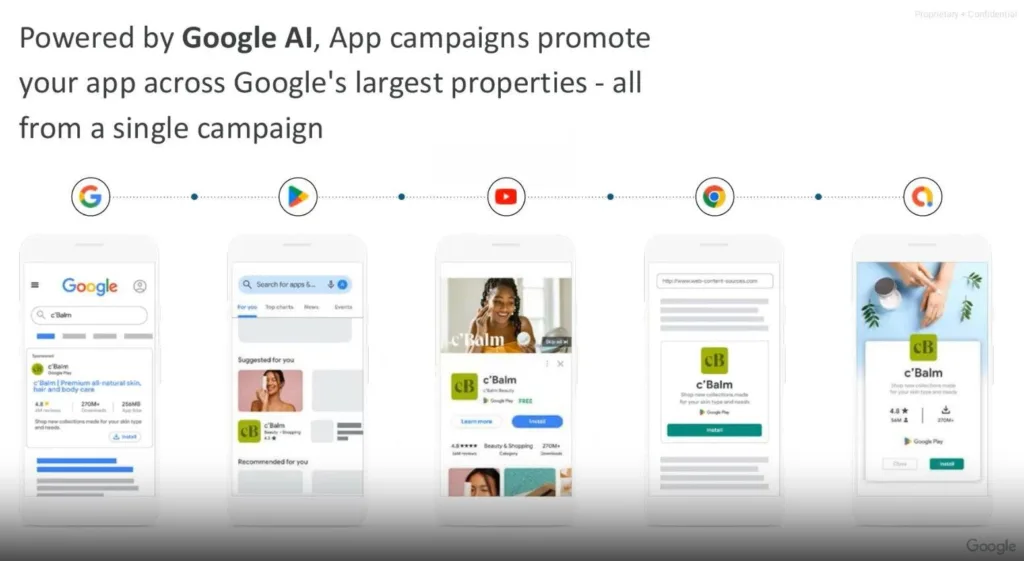
Quite a big part of the creative, especially on Android, comes from additional elements pulled directly from the Play page: the app icon, rating, review counts, and download numbers. That’s why the performance of a creative can change without anyone touching the assets in the account.
“Sometimes it happens that people are surprised at what really happened—the performance of the creative changed, but not necessarily the elements that we added to the account.”

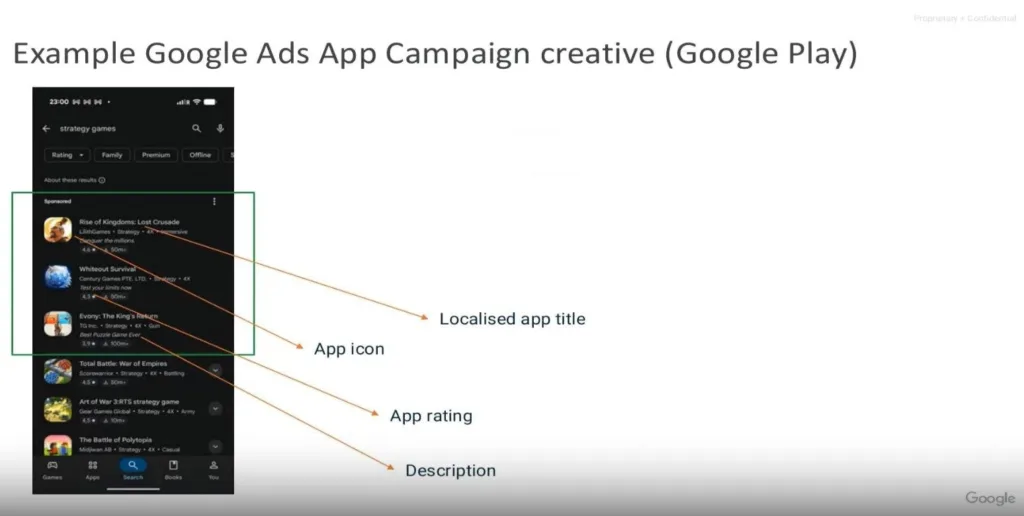
Example of a Google Play creative — app icon, localized title, rating, and description are pulled from the Play page.
Social proof, brand relationship, and reviews drive downloads
Google research across many gaming and non-gaming categories looked at the different triggers for download. The top three: social proof, existing brand relationship, and app store reviews. That’s why app store reviews are so often such a visible part of the creative, especially on Android.
iOS and Android need different creative thinking
The inventory mix is fundamentally different between the two. On Android, a much bigger share of inventory comes from Google Play, including a significant amount of search-driven text inventory. On iOS, the dominant inventory is YouTube, so video carries much more weight.
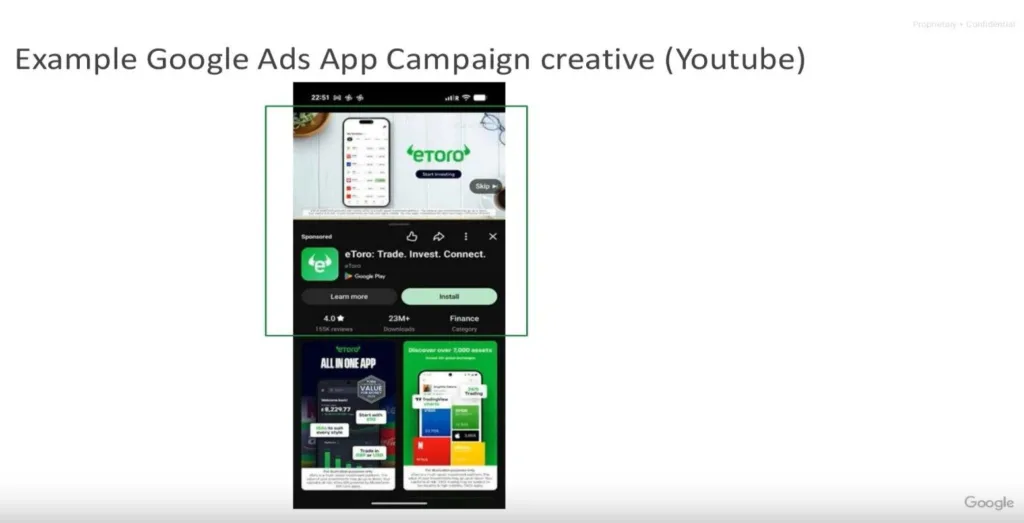
Example of an App Campaign creative on YouTube. The first five seconds matter most, since users can’t skip them.
Two reasons drive that difference. First, iOS doesn’t have Google Play as inventory, so YouTube fills more of the share. Second, in some categories like fitness or wellness, a lot of demand comes from Google Play search, which makes text creatives stronger on Android. In other categories like strategy or role-playing games, video creatives sell better because they convey graphics quality, narrative depth, and gameplay.
A practical consequence: if you want to use Google App Campaigns for creative testing, it’s easier to do on iOS than Android, because more of the iOS inventory is shaped by what you upload rather than by elements pulled from the Play page.
Ad group testing beats creative testing
Because the same creative can render very differently across surfaces, traditional ad-level testing is harder on Google. The cleaner unit of testing is the ad group, where each group holds one coherent creative line.
For example, if you want to compare user-generated content against cinematic, put each idea in its own ad group. Then you can read performance at the creative-concept level rather than the specific-format level.
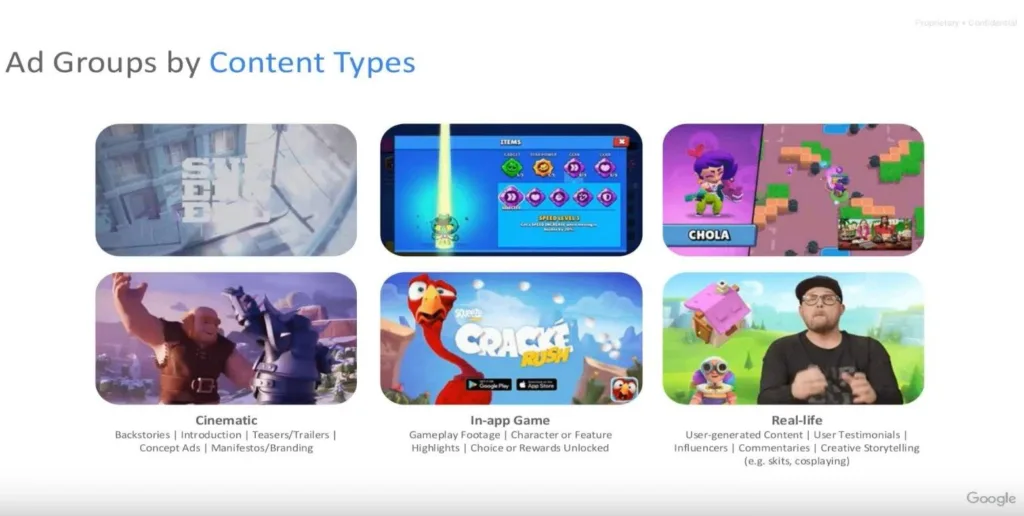
Examples of ad group organization by content type: cinematic, in-app game, real-life.
Two pitfalls to avoid:
- Too many ad groups for the budget. Running five ad groups on a $600 daily budget doesn’t work. Aim for at least a few hundred dollars of daily spend per ad group.
- Skipping video. Across different creative lines, video sometimes carries one line while text carries another. It really makes sense to always add videos, because you never know which part of the inventory will win.
Mind the technical elements
Once you add graphics or videos, they can sometimes be cropped or adjusted to different types of inventory. So avoid putting too much text or too many elements in places that may be changed or cropped. In particular, avoid core messaging in the top 10% and bottom 25% of the video, and don’t put the most important part in the area hidden behind the skip button.
The same logic carries over to Google web campaigns. Auto-generated elements pulled from the landing page are important there too, so when preparing search or shopping ads, look first at how the creative actually renders and which elements come from where.
Meta: Creative diversity is the new targeting
Anna Zdorenko of INCYMO.AI walked through what’s changed in Meta’s auction. The short version: changing only the CTA, headline, or end card doesn’t make Meta treat the ad as a new creative.
The semantic fingerprint
Meta assigns every ad a semantic fingerprint. If you put similar ads in, only one of them gets to the bid. More ads doesn’t mean more reach because of this. The system needs new information to find the right audience.
According to Meta’s report referenced during the webinar, if you change the motivation of the creative, you unlock your audience by 89% (Source: Meta, via INCYMO.AI presentation).
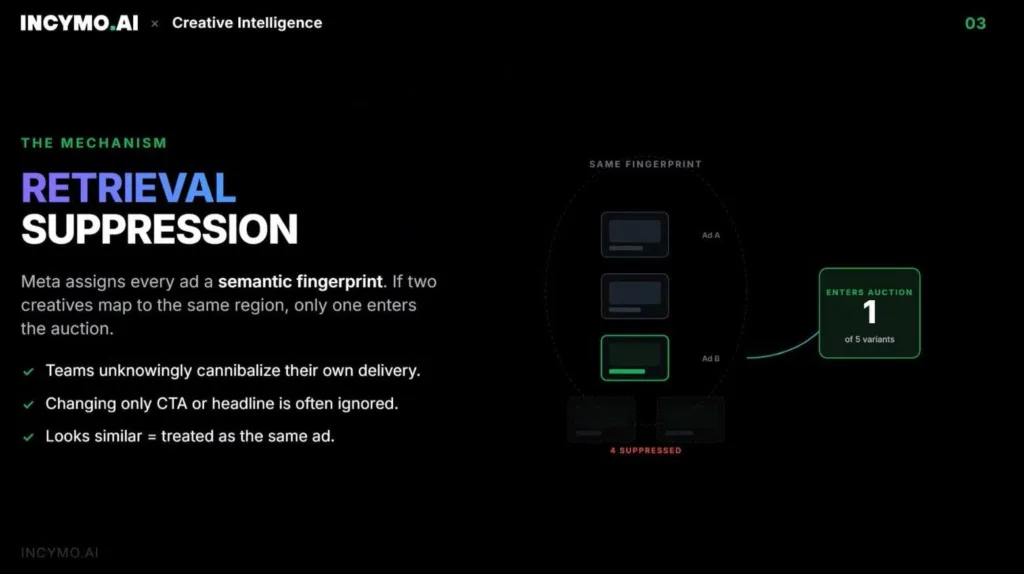
What you can actually change
To give Meta the new signals it needs, you have to vary the things below the surface, not just the surface itself:
- Hooks (first 0-2 seconds)
- Pacing and rhythm
- Emotional framing, tone, intensity arc
- Story structure
- Scene composition
- Visual edits (CTA, headline, end card — the only layer most teams touch)
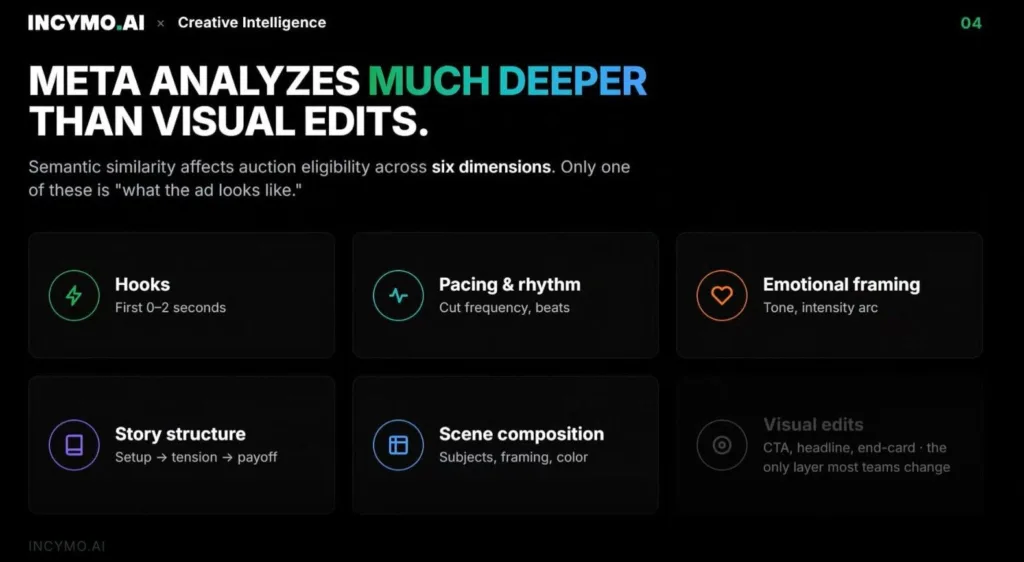
To push the algorithm to read a creative as new, change the storyline, voiceovers, overlay texts. Create more difference between them, so the system can treat them as something new and potentially good for a new audience.
Hooks scale, but not in the way most analyses measure
Hooks come up first because they’re where Anna saw the most discussion in the industry. A LinkedIn post from one analyst found no correlation between different hooks and ROAS, with the conclusion that hooks didn’t matter. A counterpoint from a head of analytics at an app company added: there isn’t a strong correlation in ROAS terms, but there is a correlation in scalability.
The same conclusion shows up in the report Anna referenced: if you repeat hooks, fatigue comes faster. New hooks create new auction opportunities. The algorithm wants to show a new ad and find an audience for it. If the ad is different, the chance someone new will respond to it goes up.
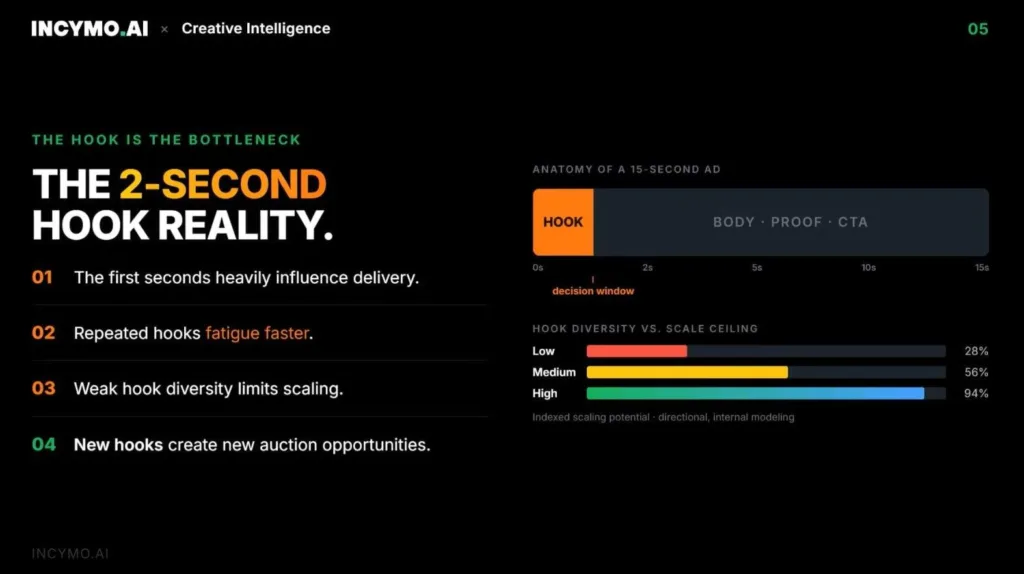
The practical rule: even when iterating from a top-performing ad, always change the hook. You can also vary additional elements like pacing and emotion triggers. Structure is harder to change, but try to vary hooks as much as you can to create scaling opportunities.
“If you put the same ad, you will lose the auction. It will not be in the auction at all.”

Volumes are growing fast
According to the same Meta report, the volume of ad creatives increased 25-30% compared to the previous year, with around 2,400 creatives per quarter created by top gaming advertisers (Source: Meta, via INCYMO.AI presentation). The report covers gaming specifically, but the trend likely applies to apps as well, possibly even more so given that app creatives (UX, UI) are easier to produce than game mechanics.
For context on web campaign volumes: if you run $1 million+ in monthly ad spend, especially on web campaigns, you most likely run more than 1,000 ad creatives per month. Not unique concepts, but different variations. Meta itself can test 35,000 to 50,000 different ad creative variations across campaigns each month.
What teams should test
For Meta, the recommendation from INCYMO.AI’s platform work is to provide the right inputs: the assets you want in the video (characters for games, UI for apps), and your previous creatives — high-performing, low-performing, and top-performing. That last piece is gold and most teams don’t capture it, even though it tells you which patterns shouldn’t be repeated.
With those inputs plus competitor videos, the platform decomposes each video second by second (elements, characters, emotions, storyline, hooks, audio, pacing, timing) and uses that to generate new ideas. The output is storyboards based on the provided assets, which become videos that can be regenerated, upscaled, or translated into different languages.
The new playbook
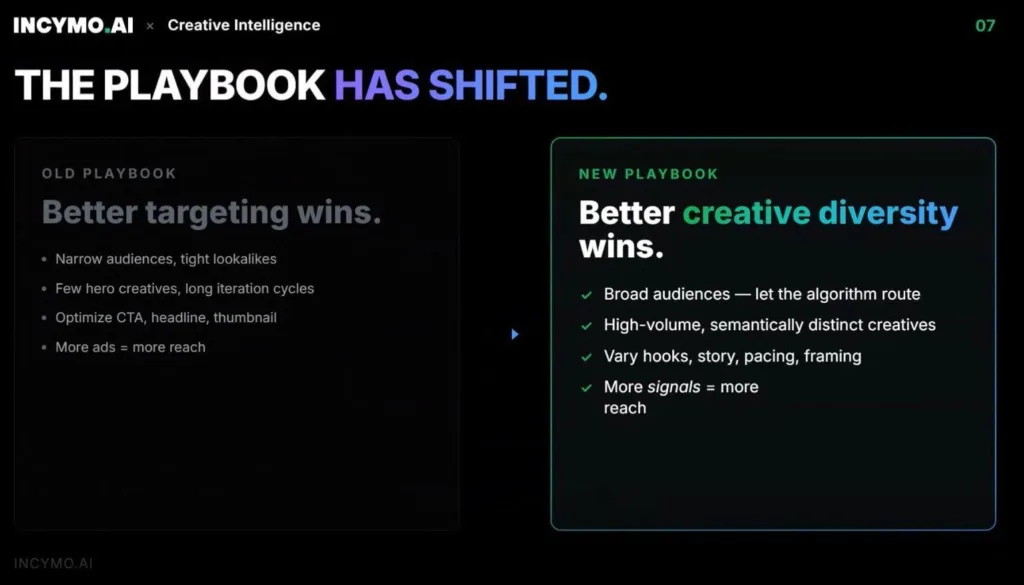
The shift, in short: better targeting used to win. Better creative diversity wins now.
The post-click layer: Web funnels as an extension of the ad
The third part of the webinar, presented by Andrey Shakhtin, covered how web funnels should connect with ad creatives. The main point: it should be the whole funnel and the whole holistic storytelling. What’s said in the ad creative should be translated into the whole funnel, across all the screens.
Examples of creative-to-funnel continuity
- SmartyMe: The video creative carries the message “Stop speaking like a nice girl. Speak like a high-value woman.” The web onboarding opens with “Speak like a leader. Get your personal communication plan.” It’s really connected to each other, which helps users feel like it’s a seamless flow.
- PawChamp: The video creative shows a training path. The web onboarding starts with questions about the dog and mentions the personalized training challenge tied to the ad.
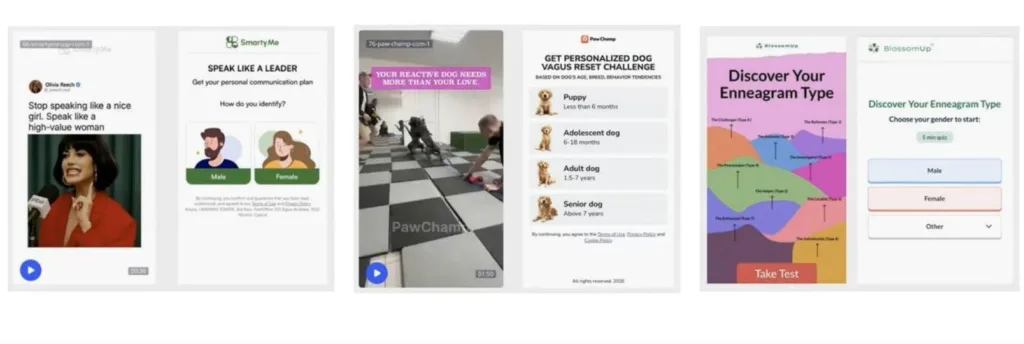
Examples of creative-to-funnel narrative continuity
Continuity doesn’t have to stop at the first screen. It can run through the whole funnel. Noom is probably the best example: the ad creative shows a weight prediction graph; the web onboarding opens with a relevant weight-loss goal question; the same graph appears in the quiz so it’s already familiar; and the paywall shows the personalized plan with the same graph again. Across Noom’s roughly 120-140 screens, the same message runs from creative to checkout.
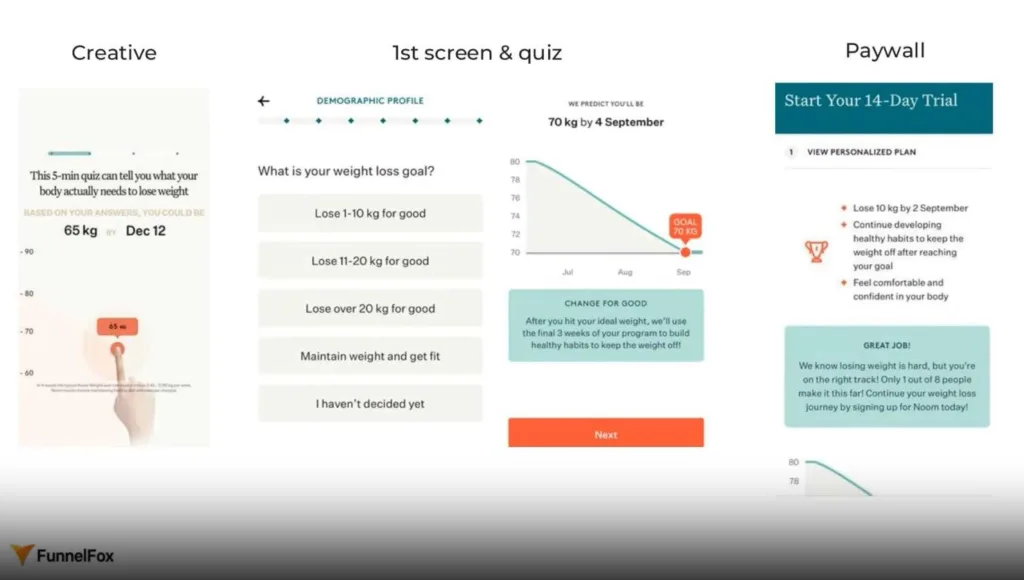
Noom: One narrative arc from ad creative to paywall
Why this converts better
When the web funnel was compared to the app funnel in FunnelFox’s recent research, the web funnel converted users about twice as well as the app funnel — measured from first impression and ad click through to purchase, not just from the start of onboarding (Source: FunnelFox State of Web2App report).
A big driver: in the app funnel, the third step is the app install, and that’s where users hit the first friction. They click the ad, land on the app store page, but aren’t yet warmed up enough to install. In the web funnel, the flow is more natural and seamless. Users click the ad and start engaging with the quiz right away. If you connect the web onboarding with the ad creative seamlessly, with the same messages, conversion rates rise across the whole funnel.
Funnel diversity follows creative diversity
That’s why a lot of big players, and many medium ones too, run a lot of different web funnels for different segments. Each funnel is built for a different vertical, topic, or audience segment, because each needs to be personalized for the creative it pairs with.
The correlation also shows in the data. FunnelFox analyzed how many funnels companies run against revenue, splitting customers into four buckets by revenue volume. The top performers (bucket four) run the most funnels and iterations. The variations don’t all have to be completely distinct funnels. They can be different segment variations, like Pilates for women, Pilates for women 40+, yoga for men, calisthenics (Source: FunnelFox State of Web2App report).
Where to start with personalization
For teams testing different segments, the minimum personalization is the first screen of the funnel and the paywall. That’s enough to align each creative with a specific message and offer. If a segment starts performing, the personalization can extend across the whole funnel — quiz, copy, UI — for that exact segment.
Categories that are working in web funnels
Health and fitness is still the biggest category overall, but it’s no longer the only one performing strongly. Other categories Andrey mentioned during the Q&A:
- Utilities. One of the first customers to scale web funnels in FunnelFox was a weather app — not the category most people would have predicted.
- Language learning and micro-learning. Growing very well through partners.
- Short drama. Emerging now in web.
- Lifestyle with deep search. For example, apps that let users check whether someone (a partner, a friend) has a Tinder profile or similar.
This was based on FunnelFox data alongside different industry reports, including Adapty and AppTweak.
Want to see how FunnelFox helps teams build narrative-aligned web2app funnels at the same speed they iterate creatives? Book a demo.